This comprehensive guide compares AURORA and CRO, two distinct blockchain assets serving different market segments. AURORA operates as an EVM on NEAR Protocol, enabling Ethereum-compatible DApp migration with low transaction costs, while CRO represents an established ecosystem launched in 2018, partnered with Crypto.com and serving over 100 million users globally through DeFi and gaming applications. The analysis examines historical price performance showing AURORA's 99.87% decline from its $35.4 peak versus CRO's 90.53% decline, current market fundamentals including trading volume and capitalization disparities, and investment strategies tailored to different risk profiles. CRO demonstrates superior liquidity and market stability with $1.56M daily volume, while AURORA presents higher growth potential for risk-tolerant investors. The article provides actionable recommendations: conservative investors should favor CRO with 70-80% allocation, while experienced investors may diversify with 60-70% CRO and 30-40%
Introduction: Investment Comparison Between AURORA and CRO
In the cryptocurrency market, the comparison between AURORA vs CRO has consistently been a topic that investors cannot overlook. These two assets exhibit notable differences in market capitalization ranking, application scenarios, and price performance, while representing distinct positioning within the crypto asset landscape.
Aurora (AURORA): An EVM built on the NEAR Protocol, providing a turnkey solution for developers to operate applications on an Ethereum-compatible, high-throughput, scalable platform with low transaction costs. It facilitates the migration of Ethereum users and dApps to the NEAR blockchain, enabling Solidity smart contract deployment and cross-chain asset transfers including ERC-20 tokens.
Cronos (CRO): Since its launch in December 2018, Cronos has established itself as a leading blockchain ecosystem partnered with Crypto.com and over 500 application developers. Representing an addressable user base exceeding one hundred million people globally, its mission focuses on unlocking the future of finance through decentralized finance and gaming applications.
This article will comprehensively analyze the investment value comparison of AURORA vs CRO through historical price trends, supply mechanisms, institutional adoption, technical ecosystems, and future forecasts, attempting to address investors' most pressing question:
"Which is the better buy right now?"
I. Historical Price Comparison and Current Market Status
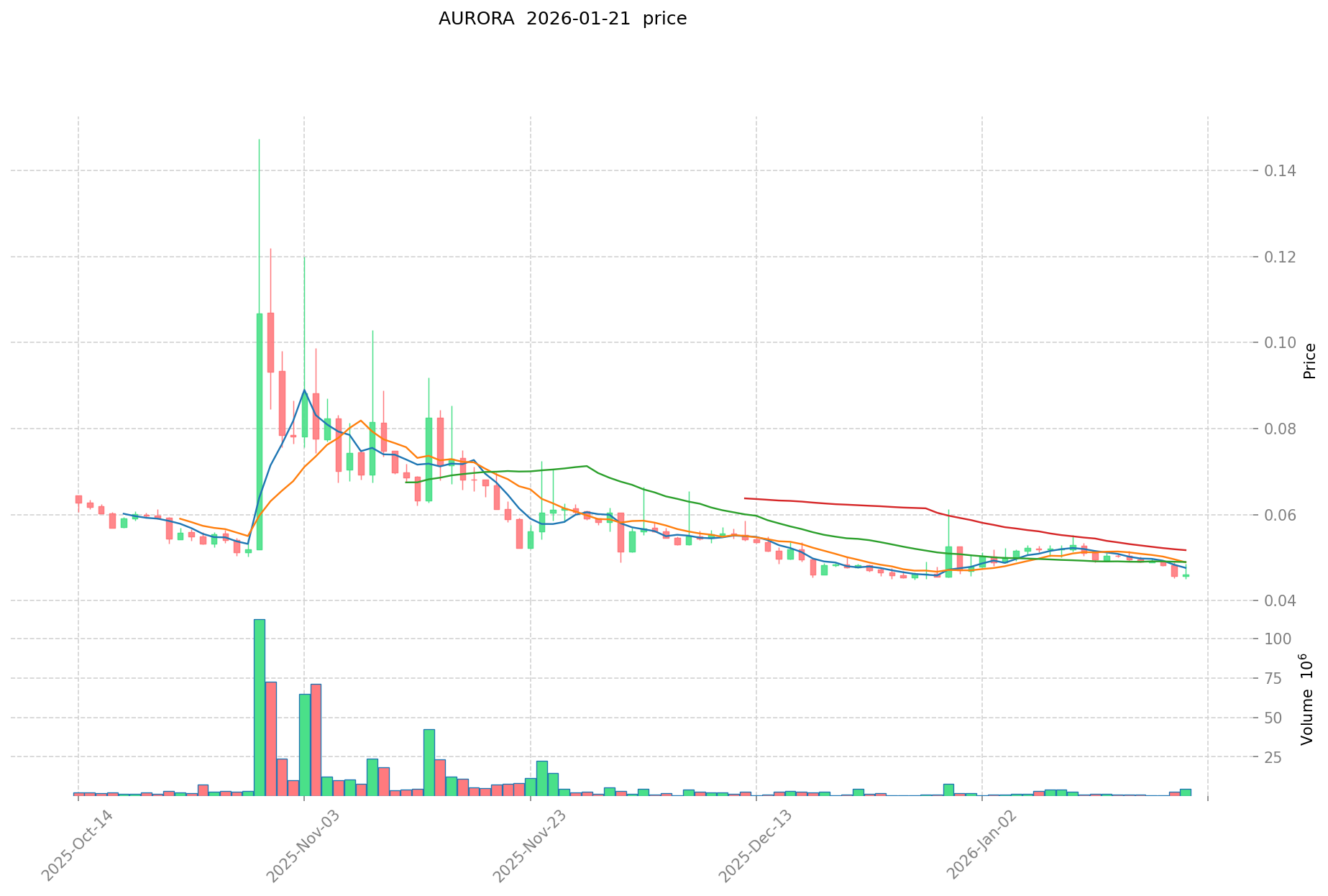
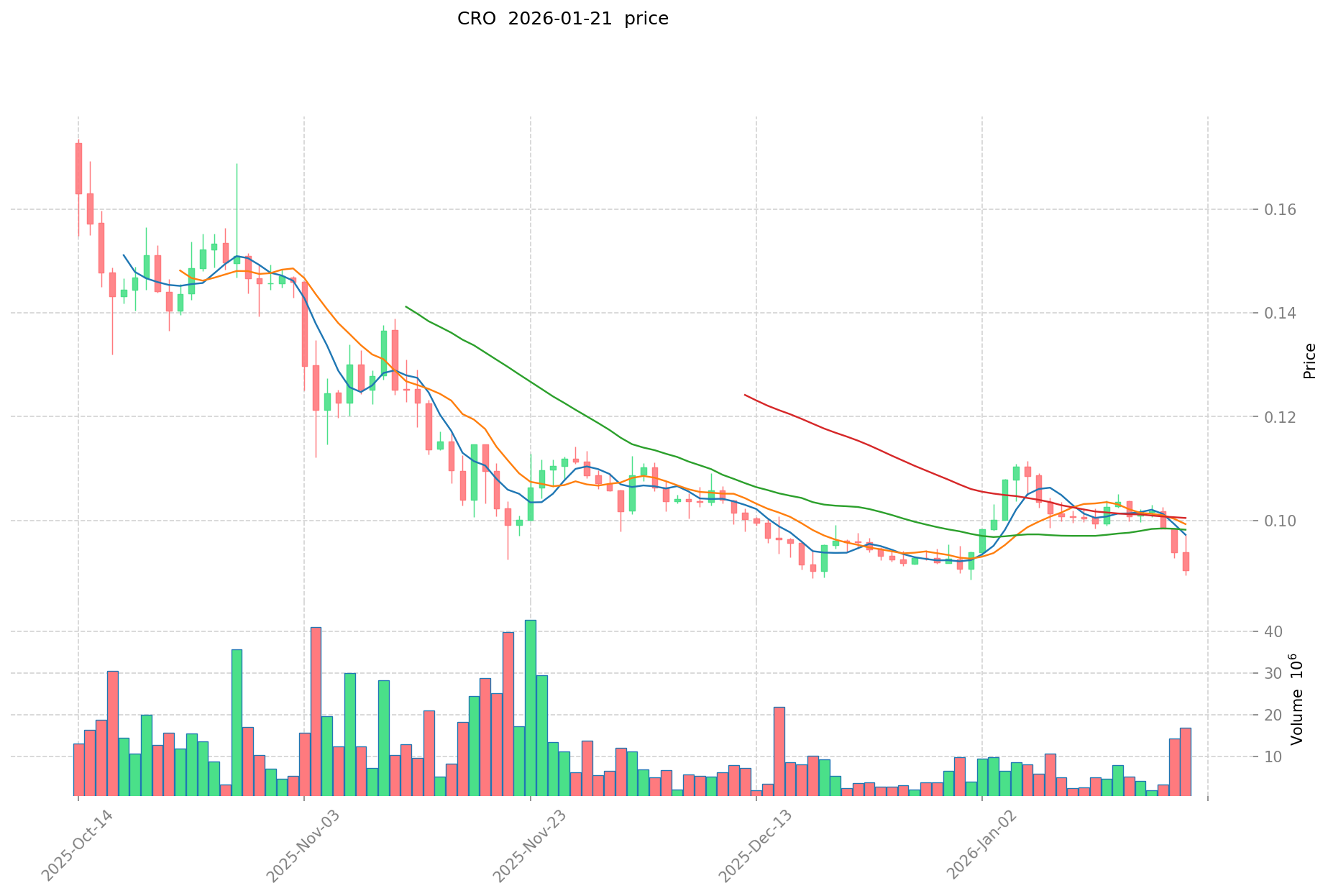
Historical Price Trends of AURORA (Coin A) and CRO (Coin B)
- 2022: AURORA reached a peak price of $35.4 on January 17, 2022, marking a notable high point in its trading history.
- 2021: CRO experienced significant growth, reaching its historical high of $0.965407 on November 24, 2021, reflecting strong market interest during that period.
- 2026: AURORA recorded its historical low of $0.04500567 on January 21, 2026, while CRO's historical low of $0.0121196 occurred earlier on February 8, 2019.
- Comparative Analysis: AURORA has experienced a substantial decline from its 2022 peak of $35.4 to its current level around $0.046, representing a significant value reduction. In contrast, CRO has shown relatively more stable price maintenance, declining from its 2021 peak of $0.965407 to approximately $0.091.
Current Market Status (January 21, 2026)
- AURORA current price: $0.04604
- CRO current price: $0.09139
- 24-hour trading volume: AURORA $214,125.20 vs CRO $1,562,522.36
- Market capitalization: AURORA $30,994,276.02 vs CRO $3,637,171,207.77
- Circulating supply: AURORA 673,203,215 (67.32% of total supply) vs CRO 39,798,350,013.87 (39.80% of total supply)
- Market sentiment index (Fear & Greed Index): 24 (Extreme Fear)
View real-time prices:
II. Core Factors Affecting AURORA vs CRO Investment Value
Supply Mechanism Comparison (Tokenomics)
Due to the absence of detailed supply mechanism information in the provided materials, a comprehensive comparison of the tokenomics between AURORA and CRO cannot be established at this time.
Institutional Adoption and Market Application
Without specific data regarding institutional holdings, enterprise adoption in cross-border payments, settlements, or investment portfolios, and regulatory attitudes from different jurisdictions toward AURORA and CRO, a detailed comparative analysis cannot be conducted based on the available materials.
Technical Development and Ecosystem Building
The provided materials do not contain information about technical upgrades for either AURORA or CRO, nor comparative data regarding their respective ecosystems in DeFi, NFT, payment systems, or smart contract implementations.
Macroeconomic Environment and Market Cycles
In the absence of historical performance data during inflationary periods, analysis of how macroeconomic monetary policies (including interest rates and dollar index movements) affect these assets, or evaluation of geopolitical factors influencing cross-border transaction demand, a substantive comparison cannot be presented based on the current materials.
III. 2026-2031 Price Forecast: AURORA vs CRO
Short-term Forecast (2026)
- AURORA: Conservative $0.043738 - $0.04604 | Optimistic $0.04604 - $0.0501836
- CRO: Conservative $0.0603636 - $0.09146 | Optimistic $0.09146 - $0.1024352
Mid-term Forecast (2028-2029)
- AURORA may enter a consolidation phase with projected price range of $0.0346539 - $0.074258
- CRO may enter a growth phase with projected price range of $0.06382545 - $0.16684197
- Key drivers: institutional capital inflows, ETF developments, ecosystem expansion
Long-term Forecast (2030-2031)
- AURORA: Baseline scenario $0.045888 - $0.0646323 | Optimistic scenario $0.0646323 - $0.110052
- CRO: Baseline scenario $0.127349 - $0.14149934 | Optimistic scenario $0.14149934 - $0.185364
View detailed price predictions for AURORA and CRO
Disclaimer
AURORA:
| Year |
Predicted High Price |
Predicted Average Price |
Predicted Low Price |
Price Change |
| 2026 |
0.0501836 |
0.04604 |
0.043738 |
0 |
| 2027 |
0.058696396 |
0.0481118 |
0.044262856 |
4 |
| 2028 |
0.05660834388 |
0.053404098 |
0.05180197506 |
15 |
| 2029 |
0.074258398269 |
0.05500622094 |
0.0346539191922 |
19 |
| 2030 |
0.093716848926525 |
0.0646323096045 |
0.045888939819195 |
40 |
| 2031 |
0.110052665179062 |
0.079174579265512 |
0.047504747559307 |
71 |
CRO:
| Year |
Predicted High Price |
Predicted Average Price |
Predicted Low Price |
Price Change |
| 2026 |
0.1024352 |
0.09146 |
0.0603636 |
0 |
| 2027 |
0.127001356 |
0.0969476 |
0.055260132 |
6 |
| 2028 |
0.16684197222 |
0.111974478 |
0.06382545246 |
22 |
| 2029 |
0.1435904718633 |
0.13940822511 |
0.111526580088 |
52 |
| 2030 |
0.185364146517511 |
0.14149934848665 |
0.127349413637985 |
54 |
| 2031 |
0.171603334877184 |
0.16343174750208 |
0.138916985376768 |
78 |
IV. Investment Strategy Comparison: AURORA vs CRO
Long-term vs Short-term Investment Strategies
- AURORA: May appeal to investors focused on Ethereum-compatible infrastructure and NEAR Protocol ecosystem development, particularly those interested in the potential for DApp migration and cross-chain functionality
- CRO: May suit investors seeking exposure to established blockchain ecosystems with broader user adoption and partnerships with payment platforms, particularly those interested in DeFi and gaming applications
Risk Management and Asset Allocation
- Conservative investors: AURORA 20-30% vs CRO 70-80%
- Aggressive investors: AURORA 40-50% vs CRO 50-60%
- Hedging tools: stablecoin allocation, options strategies, cross-asset portfolio diversification
V. Potential Risk Comparison
Market Risk
- AURORA: Substantial price volatility evidenced by the decline from $35.4 to approximately $0.046, representing significant downward pressure; lower trading volume of $214,125.20 may indicate reduced liquidity and increased slippage risk
- CRO: While experiencing price decline from $0.965407 to approximately $0.091, demonstrates relatively higher trading volume of $1,562,522.36 and larger market capitalization of $3.64 billion, suggesting improved liquidity conditions
Technical Risk
- AURORA: Network scalability considerations related to EVM compatibility on NEAR Protocol; dependence on cross-chain bridging infrastructure
- CRO: Ecosystem concentration risks; potential vulnerabilities in smart contract implementations
Regulatory Risk
- Both assets may face varying regulatory treatment across jurisdictions, particularly regarding blockchain platform operations and token classifications
- CRO's association with centralized exchange partnerships may attract different regulatory scrutiny compared to AURORA's infrastructure-focused positioning
VI. Conclusion: Which Is the Better Buy?
📌 Investment Value Summary:
- AURORA advantages: Ethereum-compatible infrastructure on NEAR Protocol; facilitates DApp migration; supports Solidity smart contracts and ERC-20 token transfers; positioned within emerging cross-chain ecosystem
- CRO advantages: Established ecosystem with over 500 application developers; addresses user base exceeding one hundred million globally; higher market capitalization of $3.64 billion; greater trading liquidity; partnership with Crypto.com platform
✅ Investment Recommendations:
- Beginner investors: Consider CRO for relatively higher liquidity and established market presence; start with smaller position sizes given current market sentiment index of 24 (Extreme Fear)
- Experienced investors: May consider diversified exposure with higher CRO allocation (60-70%) balanced with selective AURORA position (30-40%) based on risk tolerance and technical ecosystem assessment
- Institutional investors: Evaluate CRO for larger addressable market and established partnerships; conduct thorough due diligence on both assets' technical roadmaps and regulatory positioning
⚠️ Risk Warning: The cryptocurrency market exhibits substantial volatility. This article does not constitute investment advice.
VII. FAQ
Q1: What is the current market capitalization difference between AURORA and CRO?
As of January 21, 2026, CRO has a significantly larger market capitalization of $3,637,171,207.77 compared to AURORA's $30,994,276.02, representing approximately a 117x difference. This substantial gap reflects CRO's more established position in the cryptocurrency market, supported by its partnership with Crypto.com and a broader user base exceeding one hundred million people globally. AURORA's smaller market cap indicates its earlier-stage development within the NEAR Protocol ecosystem, with only 67.32% of its total supply currently in circulation versus CRO's 39.80% circulating supply.
Q2: Which asset has experienced greater price volatility from its historical peak?
AURORA has experienced substantially greater price decline, dropping approximately 99.87% from its peak of $35.4 in January 2022 to its current price of $0.04604. In comparison, CRO has declined approximately 90.53% from its historical high of $0.965407 in November 2021 to its current price of $0.09139. This dramatic difference in price performance suggests AURORA carries higher volatility risk, while CRO has demonstrated relatively more stable price maintenance despite overall market downturns.
Q3: What are the key technical differences between AURORA and CRO?
AURORA functions as an EVM (Ethereum Virtual Machine) built on the NEAR Protocol, specifically designed to provide Ethereum-compatible infrastructure that enables developers to deploy Solidity smart contracts and facilitates cross-chain asset transfers including ERC-20 tokens. CRO, launched in December 2018, operates as a comprehensive blockchain ecosystem focused on decentralized finance and gaming applications, partnered with Crypto.com and over 500 application developers. While AURORA emphasizes cross-chain compatibility and DApp migration capabilities, CRO prioritizes broader ecosystem development across DeFi and gaming sectors.
Q4: How do the 24-hour trading volumes compare between AURORA and CRO?
CRO demonstrates significantly higher trading liquidity with a 24-hour trading volume of $1,562,522.36 compared to AURORA's $214,125.20, representing approximately 7.3 times greater trading activity. This substantial liquidity difference indicates that CRO offers better market depth, reduced slippage risk, and easier position entry and exit for investors. The lower trading volume for AURORA may present challenges for larger transactions and suggests more limited market participation at current price levels.
Q5: What are the projected price ranges for both assets by 2030?
According to baseline forecasts, AURORA is projected to trade between $0.045888 and $0.0646323 by 2030, with an optimistic scenario reaching up to $0.110052. CRO's 2030 baseline scenario projects a range of $0.127349 to $0.14149934, with an optimistic scenario potentially reaching $0.185364. These projections suggest CRO may offer higher absolute price levels, while AURORA's percentage growth potential from current levels could be proportionally greater, though with considerably higher risk given its lower market capitalization and liquidity.
Q6: Which asset is more suitable for conservative investors?
CRO is generally more suitable for conservative investors based on several factors: higher market capitalization of $3.64 billion providing greater stability, significantly better trading liquidity reducing execution risks, an established ecosystem with over 500 application developers, and a broader addressable user base exceeding one hundred million people. Conservative asset allocation strategies suggest a 70-80% CRO position versus 20-30% AURORA allocation. CRO's partnership with Crypto.com also provides additional ecosystem support and visibility within the cryptocurrency market.
Q7: What are the primary risk factors investors should consider for each asset?
For AURORA, primary risks include extreme price volatility evidenced by its 99.87% decline from peak, limited trading liquidity of $214,125.20 potentially causing significant slippage, dependence on NEAR Protocol infrastructure, and cross-chain bridging vulnerabilities. For CRO, key risks encompass ecosystem concentration around Crypto.com partnership, potential smart contract vulnerabilities, regulatory scrutiny related to centralized exchange associations, and market volatility reflected in its 90.53% decline from historical highs. Both assets face current market sentiment challenges, with the Fear & Greed Index at 24 indicating Extreme Fear conditions.
Q8: How do institutional adoption prospects differ between AURORA and CRO?
CRO demonstrates stronger institutional adoption potential due to its established presence since December 2018, strategic partnership with Crypto.com, ecosystem encompassing over 500 application developers, and addressable user base exceeding one hundred million people globally. These factors suggest greater institutional accessibility and proven market validation. AURORA, while offering innovative Ethereum-compatible infrastructure on NEAR Protocol, represents an earlier-stage opportunity with less established institutional presence. For institutional investors evaluating these assets, CRO's larger market capitalization, superior liquidity, and demonstrated ecosystem partnerships present more conventional entry points compared to AURORA's emerging infrastructure positioning.
* The information is not intended to be and does not constitute financial advice or any other recommendation of any sort offered or endorsed by Gate.