# SAKE vs XTZ: A Comprehensive Comparison of Two Emerging Blockchain Platforms
This comprehensive guide compares SAKE and XTZ across historical price trends, tokenomics, market adoption, and technical infrastructure to help investors determine which asset aligns with their portfolio strategy. The article addresses critical investment decisions by analyzing market performance, ecosystem development, and risk profiles for both tokens. From market fundamentals to 2026-2031 price forecasts, this resource serves novice, experienced, and institutional investors seeking data-driven insights. Structured across price analysis, core investment factors, strategic recommendations, and risk assessment, readers gain actionable guidance on asset allocation, trading strategies, and portfolio positioning. Whether evaluating DeFi governance mechanisms or blockchain infrastructure stability, this comparison equips you with essential metrics available on Gate to make informed investment decisions in the evolving cryptocurrency
Introduction: SAKE vs XTZ Investment Comparison
In the cryptocurrency market, SAKE vs XTZ comparisons have always been an unavoidable topic for investors. The two not only show significant differences in market cap rankings, application scenarios, and price performance, but also represent different positions in the crypto asset landscape.
SAKE (SAKE): Since its launch in 2020, it has gained market recognition through its positioning as an improved AMM mechanism with governance and fee-sharing features for token holders.
XTZ (XTZ): Since its launch in 2017, it has been recognized as a self-evolving, decentralized blockchain that simplifies formal verification and improves smart contract security, establishing itself as a significant player in the broader blockchain ecosystem.
This article will provide a comprehensive analysis of SAKE vs XTZ investment value comparisons across historical price trends, supply mechanisms, ecosystem adoption, and technical infrastructure, attempting to address the most pressing question investors have:
"Which is the better buy right now?"
I. Historical Price Comparison and Current Market Status
SakeToken (SAKE) and Tezos (XTZ) Historical Price Trends
- September 2020: SAKE reached its all-time high of $3.18 during the initial DeFi boom period.
- October 2021: XTZ achieved its all-time high of $9.12 during the broader cryptocurrency bull market.
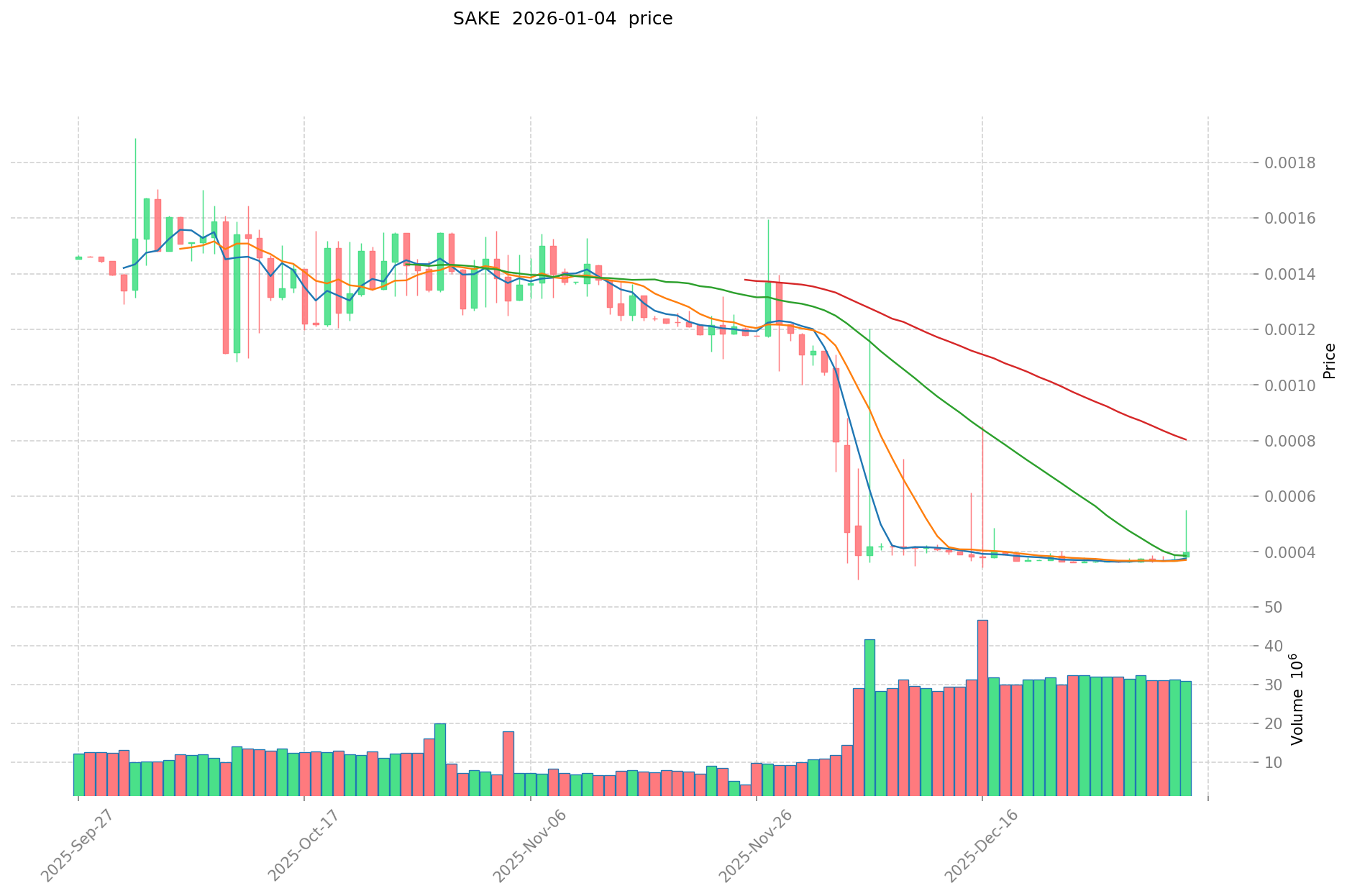
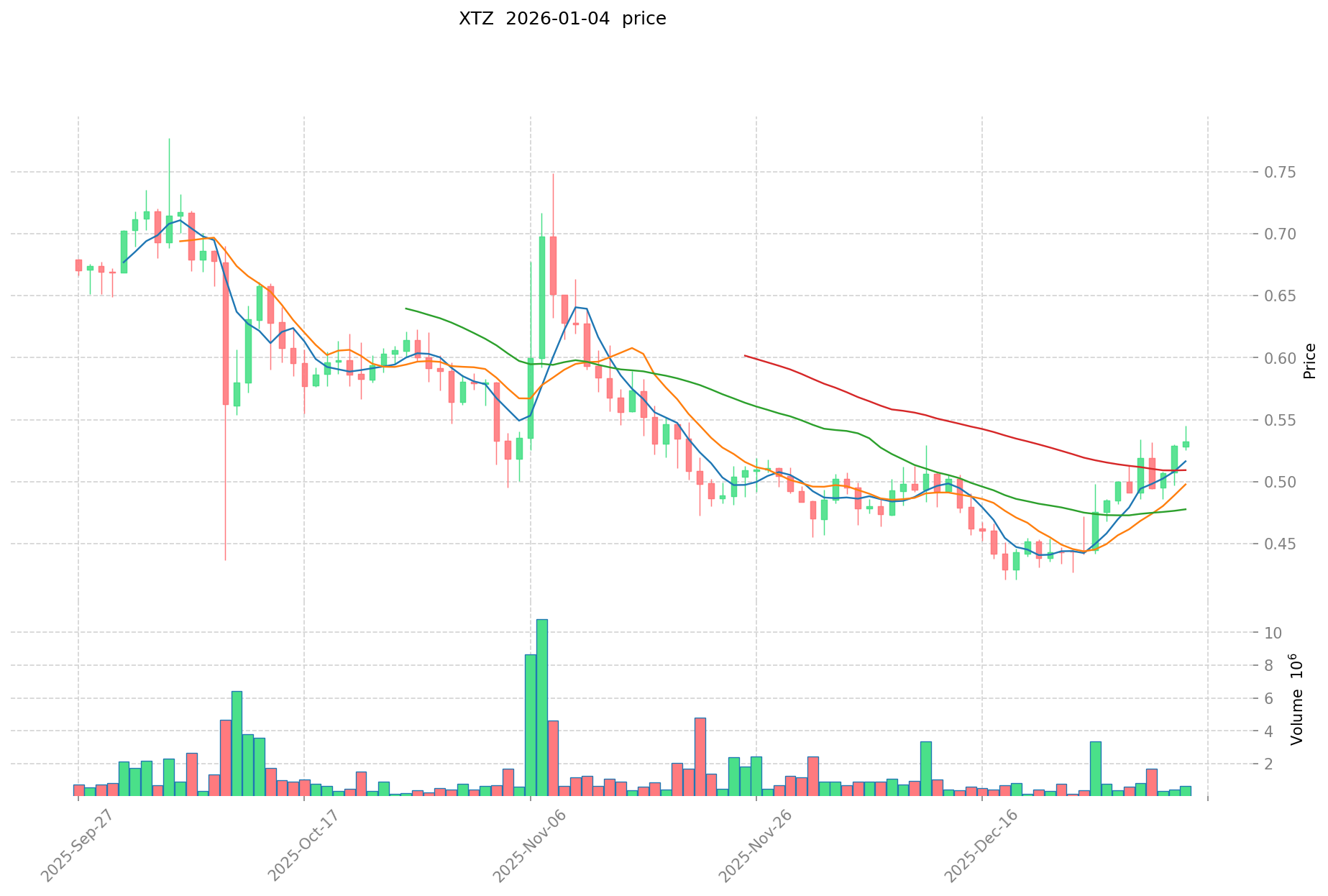
- Comparative Analysis: Over the market cycle from their respective peaks to present, SAKE has declined from $3.18 to $0.0004077, representing a significant downtrend. XTZ has similarly declined from $9.12 to $0.5503, though maintaining relatively higher market traction with a market cap of $600.37 million compared to SAKE's $83,744.64.
Current Market Status (January 4, 2026)
- SAKE current price: $0.0004077
- XTZ current price: $0.5503
- 24-hour trading volume: SAKE $12,792.98 vs XTZ $263,071.63
- Market Sentiment Index (Fear & Greed Index): 29 (Fear)
Click to view real-time prices:
II. Core Factors Influencing Investment Value of SAKE vs XTZ
Tokenomics and Supply Mechanism
- SAKE: Current exchange rate stands at 0.01561 UAH per token, with supply mechanism details not specified in available sources
- XTZ: Value dependent on its role within the blockchain ecosystem and technological innovation; specific tokenomics details require further investigation
- 📌 Historical Pattern: Supply mechanism dynamics influence price cycle movements through scarcity mechanisms and token distribution models
Institutional Adoption and Market Applications
- Institutional Holdings: Comparative market preference data between the two tokens is not available in current sources
- Enterprise Adoption: Specific applications of SAKE and XTZ in cross-border payments, settlement, and portfolio integration require further documentation
- Government Policies: Regulatory perspectives on both tokens vary by jurisdiction; detailed policy analysis requires additional sources
Technology Development and Ecosystem Building
- SAKE Technology Roadmap: Technical upgrade details and potential impact not specified in available resources
- XTZ Technology Development: Ecosystem role and technological innovation status require comprehensive analysis
- Ecosystem Comparison: DeFi, NFT, payment, and smart contract deployment status for both tokens not provided in current sources
Macroeconomic Factors and Market Cycles
- Performance in Inflationary Environments: Comparative inflation-hedging characteristics require further research
- Monetary Policy Impact: Effects of interest rates and US dollar index movements on both tokens need detailed analysis
- Geopolitical Considerations: Cross-border transaction demand and international developments influence token utility and adoption
III. 2026-2031 Year Price Forecast: SAKE vs XTZ
Short-term Forecast (2026)
- SAKE: Conservative $0.000368-$0.000409 | Optimistic $0.000409-$0.000421
- XTZ: Conservative $0.447-$0.552 | Optimistic $0.552-$0.718
Mid-term Forecast (2028-2029)
- SAKE could enter accumulation phase, with expected price range of $0.000264-$0.000557
- XTZ could enter growth phase, with expected price range of $0.637-$0.920
- Key drivers: institutional capital inflows, ETF developments, ecosystem expansion
Long-term Forecast (2030-2031)
- SAKE: Base case $0.000303-$0.000613 | Bullish case $0.000583-$0.000674
- XTZ: Base case $0.579-$0.891 | Bullish case $0.930-$1.230
View SAKE and XTZ detailed price predictions
SAKE:
| 年份 |
预测最高价 |
预测平均价格 |
预测最低价 |
涨跌幅 |
| 2026 |
0.00042127 |
0.000409 |
0.0003681 |
0 |
| 2027 |
0.000498162 |
0.000415135 |
0.00033625935 |
1 |
| 2028 |
0.00055711117 |
0.0004566485 |
0.000415550135 |
12 |
| 2029 |
0.0006386685921 |
0.000506879835 |
0.0002635775142 |
24 |
| 2030 |
0.000652962603447 |
0.00057277421355 |
0.000303570333181 |
40 |
| 2031 |
0.000674155249348 |
0.000612868408498 |
0.000582224988073 |
50 |
XTZ:
| 年份 |
预测最高价 |
预测平均价格 |
预测最低价 |
涨跌幅 |
| 2026 |
0.71786 |
0.5522 |
0.447282 |
0 |
| 2027 |
0.8699911 |
0.63503 |
0.5207246 |
15 |
| 2028 |
0.8202364995 |
0.75251055 |
0.722410128 |
36 |
| 2029 |
0.9200570239575 |
0.78637352475 |
0.6369625550475 |
42 |
| 2030 |
0.930004649045587 |
0.85321527435375 |
0.691104372226537 |
55 |
| 2031 |
1.230421747145542 |
0.891609961699668 |
0.579546475104784 |
62 |
IV. Investment Strategy Comparison: SAKE vs XTZ
Long-term vs Short-term Investment Strategy
- SAKE: Suitable for investors focusing on DeFi governance mechanisms and fee-sharing features, with expectations of ecosystem expansion and price recovery from historical lows
- XTZ: Suitable for investors seeking established blockchain infrastructure with formal verification capabilities and seeking relatively stable asset positioning within the broader ecosystem
Risk Management and Asset Allocation
- Conservative investors: SAKE 5% vs XTZ 20%
- Aggressive investors: SAKE 15% vs XTZ 25%
- Hedging tools: Stablecoin allocation, options strategies, cross-token portfolio diversification
V. Potential Risk Comparison
Market Risk
- SAKE: Significant price volatility with historical decline from $3.18 to $0.0004077, reflecting high sensitivity to DeFi market cycles and sentiment shifts
- XTZ: Relatively moderate volatility compared to SAKE, though still subject to broader cryptocurrency market fluctuations and institutional capital flows
Technology Risk
- SAKE: Scalability limitations in AMM mechanisms under high transaction volumes, network stability during peak DeFi activity periods
- XTZ: Algorithm complexity in formal verification processes, potential security audit requirements, network upgrade coordination challenges
Regulatory Risk
- Global regulatory policies impact both tokens differently based on their classification; DeFi governance tokens like SAKE face stricter scrutiny in certain jurisdictions, while blockchain infrastructure tokens like XTZ may encounter varying regulatory frameworks across regions depending on their operational classification
VI. Conclusion: Which Is the Better Buy?
📌 Investment Value Summary:
- SAKE Advantages: Improved AMM mechanism design, governance token utility, fee-sharing model for token holders, lower entry price point
- XTZ Advantages: Established since 2017 with proven blockchain infrastructure, formal verification security features, self-evolving protocol design, significantly larger market capitalization and trading volume
✅ Investment Recommendations:
- Novice investors: Consider XTZ for its established market presence, larger liquidity, and lower volatility profile relative to SAKE
- Experienced investors: SAKE presents accumulation opportunities given its current price levels and potential 2028-2031 growth forecasts; XTZ offers portfolio stability and infrastructure exposure
- Institutional investors: XTZ demonstrates superior institutional adoption indicators with $600.37 million market cap and higher daily trading volume ($263,071.63); SAKE requires patience for ecosystem development maturation
⚠️ Risk Disclaimer: The cryptocurrency market exhibits extreme volatility. This article does not constitute investment advice and is provided for informational purposes only.
FAQ
SAKE和XTZ分别是什么?它们各自的主要用途是什么?
SAKE是基于Solana链的DeFi代币,用于流动性挖矿和治理。XTZ是Tezos区块链原生代币,主要用于支付交易费用、质押验证和参与链上治理决策。
SAKE和XTZ在技术架构上有什么区别?
SAKE是去中心化金融平台,XTZ是Tezos区块链原生代币。Tezos采用自我升级机制,支持链上治理;SAKE主要服务DeFi生态。两者技术栈和应用场景不同。
SAKE和XTZ的共识机制分别是什么?各有什么优缺点?
SAKE采用工作量证明(PoW)共识机制,安全性强但能耗高。XTZ采用权益证明(PoS)共识机制,能效高且速度快,但对质押量有要求。
SAKE和XTZ哪个更适合DeFi应用?为什么?
XTZ更适合DeFi应用。XTZ具有更高的交易速度和更低的交易费用,能够支持更高效的DeFi交易和流动性提供,适合频繁的链上操作和复杂的智能合约交互。
SAKE和XTZ的市场流动性和交易额如何对比?
XTZ的市场流动性和交易额明显优于SAKE。XTZ作为成熟公链资产,日均交易额更高,流动性更充足,市场参与度更活跃。SAKE的交易活跃度相对较低,流动性深度有限。
投资SAKE和XTZ分别需要关注哪些风险因素?
SAKE需关注市场流动性、项目发展进度和社区活跃度。XTZ需关注技术更新、网络安全和市场竞争力。两者均需警惕市场波动和监管政策变化。
SAKE和XTZ的生态发展现状如何?未来前景哪个更看好?
SAKE在日本DeFi生态中保持活跃,XTZ作为Tezos公链在智能合约和NFT领域表现突出。XTZ生态应用更丰富、技术更成熟,未来前景相对更具竞争力。
SAKE和XTZ在安全性和去中心化程度上如何对比?
XTZ采用PoS机制,安全性由验证者质押保障,去中心化程度高。SAKE主要依赖社区治理,安全性基于网络分布。XTZ的协议层安全性更成熟,去中心化程度相当。
* The information is not intended to be and does not constitute financial advice or any other recommendation of any sort offered or endorsed by Gate.