Gate DEX: Closing the UX Gap That Holds Back Decentralized Trading

Last Updated 2026-03-25 07:00:36
Reading Time: 1m
This article examines how Gate DEX enhances on-chain trading by integrating workflows and optimizing its interface. Focusing on user experience and product processes, it explores how these improvements reduce entry barriers and elevate decentralized trading from simply being functional to genuinely user-friendly.

The Real Barrier to DEX Adoption: User Experience Gaps
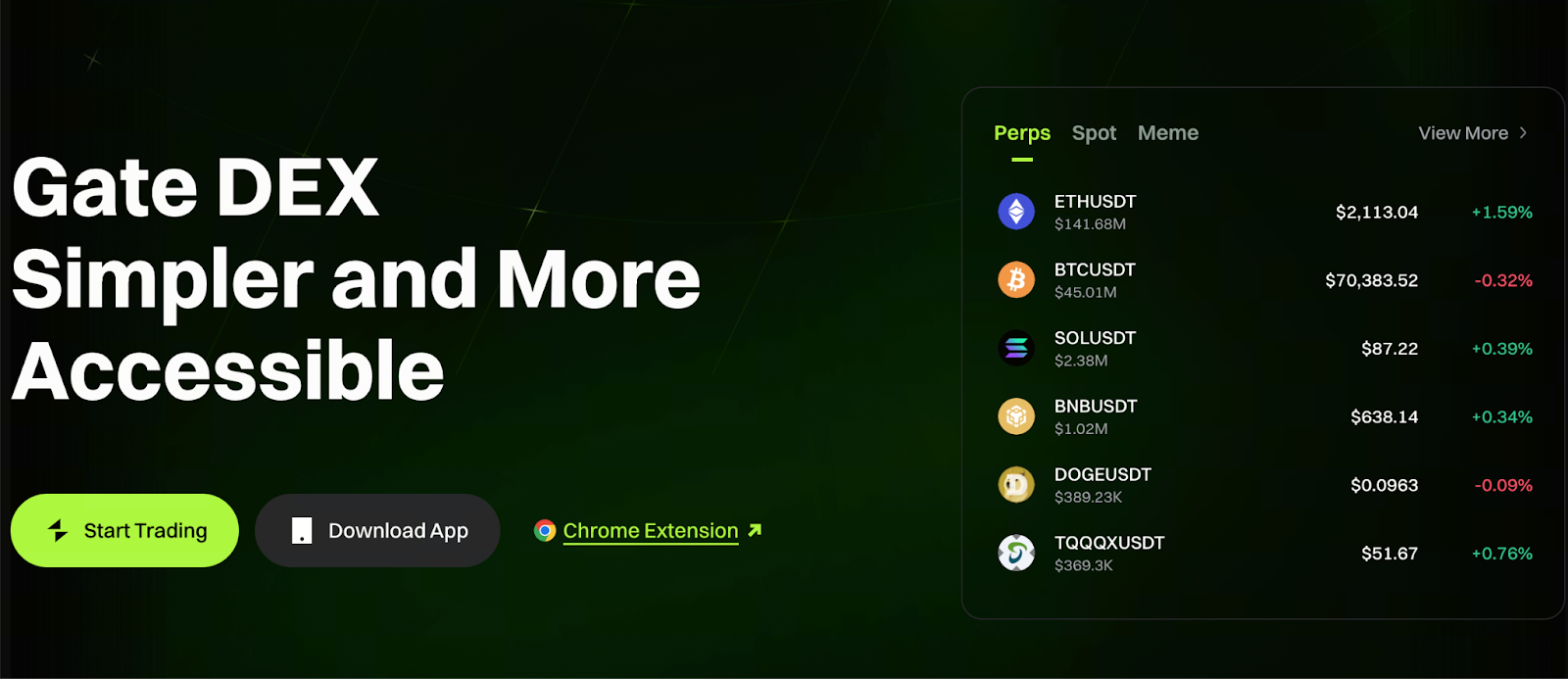
Decentralized trading has always been seen as a core pillar of Web3, yet most users haven’t developed the habit of consistently trading on DEXs. The problem isn’t with the underlying philosophy—it’s the experience: wallet processes are tedious, workflows are fragmented, and information is scattered across multiple tools, making the trading process feel disjointed and full of interruptions.

For most users, returning to a centralized platform after their first DEX experience isn’t a rejection of decentralization—it’s simply that the process is far from intuitive.

Gate DEX: A New Approach

Gate DEX isn’t just another swap interface. Its design rethinks the trading process from the ground up: What steps are truly essential for a complete on-chain transaction? Which can be integrated or streamlined?

Gate DEX unifies previously fragmented on-chain operations into a seamless system, covering:

  • On-chain spot trading
  • On-chain contract trading
  • Cross-chain asset swaps

It also integrates token launch scenarios from Gate Fun and market analysis and strategy tools from Meme Go, enabling users to discover assets, analyze, place orders, and manage portfolios—all within a single interface, eliminating the need to jump between multiple DApps.

Lowering the Entry Barrier Is Essential for Broader Adoption

For most users who aren’t native to Web3, the real challenge often comes before they even begin. Gate DEX deliberately lowers technical barriers with flexible login options, supporting Gate accounts, Google accounts, and wallet-based sign-ins. Users can access the trading environment directly—no need to first master private keys or seed phrases.

With clear prompts and familiar trading logic, even first-time on-chain traders can gradually learn advanced features like limit orders and sniping trades, instead of being discouraged at the outset by complex processes.

Non-Custodial by Design—Without the Complexity of Engineering Tools

Gate DEX uses a non-custodial architecture, so users always retain full control of their assets—there’s no need to entrust funds to the platform. At the same time, the platform leverages a wallet architecture built on TEE (Trusted Execution Environment) technology, maintaining robust security while delivering a trading experience nearly as smooth as a centralized exchange.

Spot trades execute entirely on-chain, giving users direct ownership of their assets. The platform supports a broad range of leading cryptocurrencies and select tokenized US equities. Because there’s no leverage or liquidation mechanism, the structure remains straightforward—ideal for those seeking long-term holdings or stable portfolio allocations.

Turning CEX Expertise into DEX Advantages

Gate’s years of experience as a centralized exchange haven’t been left behind with Gate DEX—they’ve been adapted to fit the on-chain environment. Clear information hierarchies, reliable liquidity, and a responsive interface ensure users don’t have to relearn everything when trading on-chain.

The platform’s built-in invitation and sharing features also help on-chain trading develop into a social network, turning it from a solitary activity into a potentially viral trading ecosystem.

Beyond a Product: The Gateway to Web3 Trading

Gate DEX isn’t just a one-time feature upgrade—it’s a cornerstone of Gate’s “All in Web3” strategy. By lowering entry barriers, reengineering the trading process, and integrating with foundational platforms like Gate Layer, Gate DEX aims to build a truly scalable user base for decentralized trading.

In an era where CeFi and DeFi experiences remain highly fragmented, Gate DEX stands out as a practical entry point—not just a theoretical bridge.

Explore Gate DEX: https://web3.gate.com/

Conclusion

Gate DEX’s value isn’t about how many features it offers, but whether it makes on-chain trading a routine activity. With a process-driven design, a non-custodial yet efficient security framework, and an experience aligned with established exchange standards, Gate DEX is redefining expectations for decentralized exchanges. Only when decentralization becomes a tool that’s naturally accessible to the majority will DEXs truly have the potential to go mainstream.

Author: Allen
Disclaimer
* The information is not intended to be and does not constitute financial advice or any other recommendation of any sort offered or endorsed by Gate.
* This article may not be reproduced, transmitted or copied without referencing Gate. Contravention is an infringement of Copyright Act and may be subject to legal action.

Related Articles

AI-Native Settlement Layers: How United Stables Is Building the Next Financial Rail
Beginner

AI-Native Settlement Layers: How United Stables Is Building the Next Financial Rail

Stablecoins were originally designed as dollar substitutes within exchanges, primarily used for asset pricing and trade settlement. As on-chain financial ecosystems have matured, their role has expanded beyond simple payments to include collateral assets, cross-chain liquidity mediums, and unified settlement units. In particular, as AI systems and automated agents begin to participate directly in economic activity, demand has risen sharply for programmable value units capable of instant settlement. This shift is pushing stablecoins toward the role of foundational financial infrastructure.
2026-03-25 03:16:17
The ve(3,3) Flywheel Explained: How AERO Tokenomics Powers Aerodrome’s DeFi Economy
Beginner

The ve(3,3) Flywheel Explained: How AERO Tokenomics Powers Aerodrome’s DeFi Economy

In the competition for DeFi liquidity, high-inflation mining alone is no longer enough to build lasting advantages. Aerodrome applies the ve(3,3) economic model to redesign token emissions, voting mechanisms, and revenue distribution, creating a liquidity flywheel centered on governance and cash flow. This article examines AERO tokenomics, the veAERO locking mechanism, and protocol revenue models to explain how Aerodrome builds a sustainable DeFi economic system.
2026-03-25 06:41:58
How Does PAXG Work? In-Depth Overview of the Physical Gold Tokenization Mechanism
Beginner

How Does PAXG Work? In-Depth Overview of the Physical Gold Tokenization Mechanism

PAXG (Pax Gold) is a tokenized asset backed by physical gold, issued by the fintech company Paxos and traded on the Ethereum blockchain as an ERC-20 token. The core concept is to tokenize physical gold on-chain, with each PAXG token representing ownership of a certain amount of gold. This structure enables investors to hold and trade gold in the form of a digital asset.
2026-03-24 19:12:51
Aerodrome Tokenomics: How ve(3,3) Powers Base's Most Profitable DEX
Beginner

Aerodrome Tokenomics: How ve(3,3) Powers Base's Most Profitable DEX

AERO is the native token of Aerodrome Finance, a core decentralized exchange and liquidity protocol in the Base ecosystem. It is primarily used for liquidity incentives and ecosystem operations. veAERO is a governance NFT that users receive by locking AERO, representing both voting power and the right to share protocol revenue. Through a dual track structure of AERO as a utility token and veAERO as a governance credential, Aerodrome separates liquidity usage value from long term governance power, allowing participants to act as liquidity providers, governance decision makers, and revenue sharers within the same system.
2026-03-25 06:40:31
How is the price of PAXG determined? Pegging mechanism, trading depth, and influencing factors
Beginner

How is the price of PAXG determined? Pegging mechanism, trading depth, and influencing factors

PAXG (Pax Gold) is a tokenized asset backed by physical gold reserves, launched by fintech firm Paxos and issued as an ERC-20 token on the Ethereum blockchain. The core concept is to digitally represent real-world gold assets, allowing investors to hold and trade gold via the blockchain network. Because each PAXG token corresponds to a specific quantity of physical gold, its price is theoretically expected to closely track the global gold market.
2026-03-24 19:11:40
Hybrid Collateral Stablecoins: Inside United Stables' Stability and Yield Architecture
Beginner

Hybrid Collateral Stablecoins: Inside United Stables' Stability and Yield Architecture

In the early stages of the crypto market, traditional stablecoins mainly relied on single-reserve or single-collateral models. Their primary focus was price stability and payment convenience, which allowed them to become foundational tools for on-chain trading and capital flows. As the market has entered a more mature financial phase, however, this structure has begun to reveal limitations, including high concentration risk and the difficulty of balancing liquidity with yield. These constraints have driven the evolution toward multi-layer collateral and portfolio-based designs, such as the dual-layer hybrid collateral architecture proposed by United Stables, which seeks to redefine the underlying logic of stable assets.
2026-03-25 03:17:39





