Gate Layer: Ushering in a New Era of Web3 Infrastructure

Beginner
Quick Reads
Last Updated 2026-03-28 03:57:01
Reading Time: 1m
Gate Layer supports Ethereum development tools, offers fast transactions and robust security, and dramatically lowers costs. As an open platform for a wide range of Web3 applications—including DeFi, GameFi, and real-world assets—it fosters innovation and growth across the decentralized ecosystem.

Web3 Infrastructure Evolution

As blockchain adoption enters the mainstream, the market’s demand for high-performance, low-cost, and scalable infrastructure is surging. Gate has introduced Gate Layer, a next-generation Layer 2 solution that marks not just a technological leap, but also Gate’s strategic commitment to expanding the decentralized ecosystem. Gate Layer centers on speed, security, and interoperability, designed to power the next wave of Web3 applications with a robust, efficient network.

High-Performance Architecture on OP Stack

Gate Layer leverages the OP Stack framework, positioning Gate Chain as the final settlement layer. This approach preserves Ethereum’s openness while further elevating transaction speed and security. Developers can deploy DApps rapidly using familiar tools like MetaMask, Remix, and Hardhat—no need to adjust to new environments. Key technical highlights:

  • Full EVM Compatibility: Effortless support for the Ethereum ecosystem, enabling frictionless DApp migration.
  • Dual Security Mechanism: Integrates Gate Chain’s consensus layer with GT staking for comprehensive asset protection.
  • Ultra-Fast Transactions: Average block time of one second, with throughput reaching 5,700 TPS.
  • Lowest Transaction Fees: Gas costs are highly competitive with other leading Layer 2 solutions.
  • Cross-Chain Connectivity: LayerZero protocol integration enables seamless interoperability with ETH, BSC, Polygon, and more.

This architecture positions Gate Layer as a true bridge for the multi-chain ecosystem.

Unleashing Web3 Innovation

Processing one million transactions on Gate Layer costs approximately $30, dramatically lowering barriers to development and deployment.

This creates an optimal environment for project teams in DeFi, GameFi, and RWA (Real World Asset Tokenization), among other verticals.
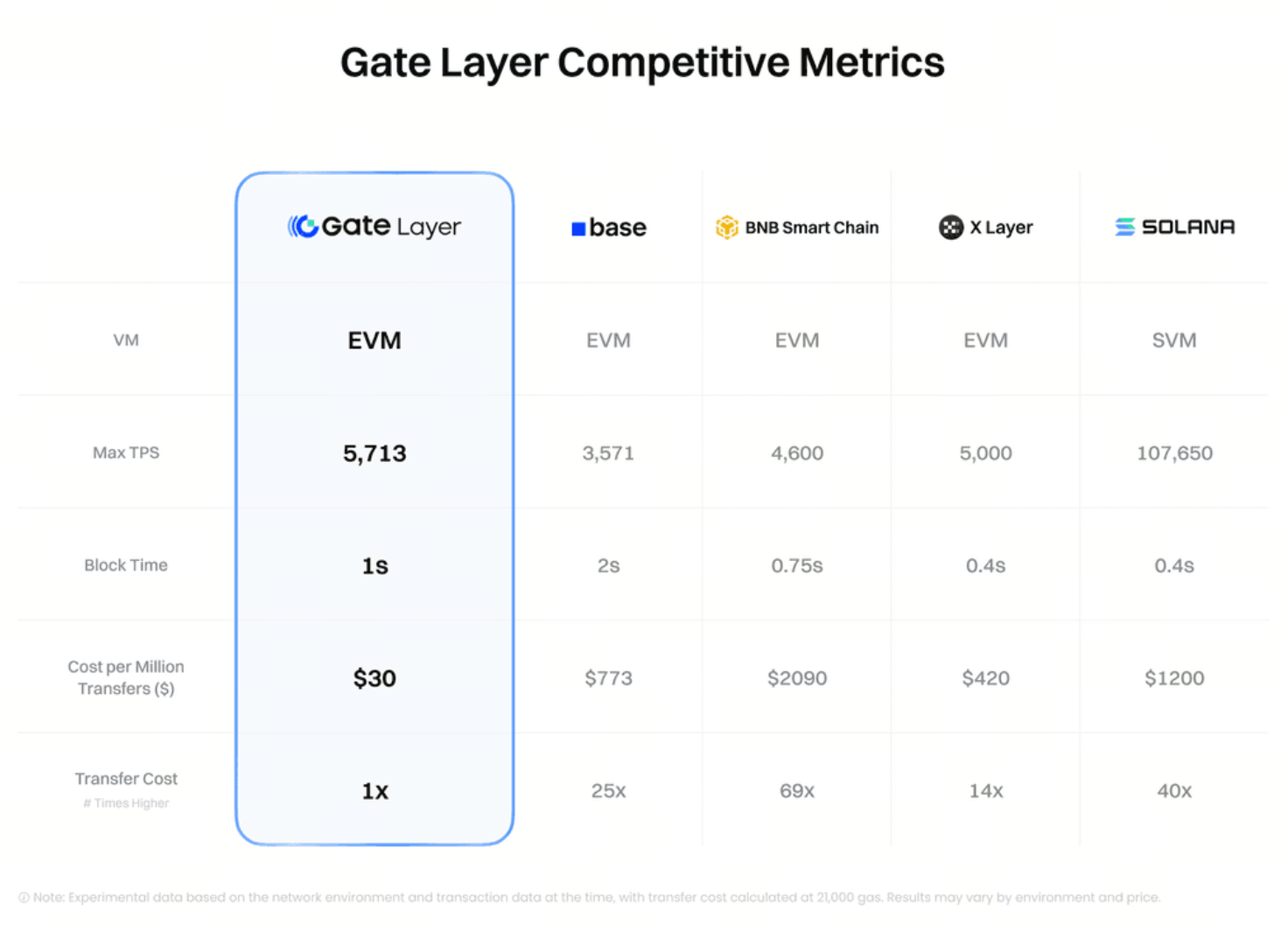
With a low-fee structure and high computational efficiency, Gate Layer removes the constraints of gas costs, allowing projects to reach the market faster and scale to mass adoption.

Building an Open Web3 Application Ecosystem

Gate Layer is not just another chain—it’s an open platform for creativity and application. Gate will launch a suite of native applications based on Gate Layer, spanning trading, entertainment, and social economy:

  • Perp DEX: A perpetual contract platform with high-speed matching and minimal slippage.
  • Gate Fun: No-code token issuance tools to empower creators to build independent communities and economies.
  • Meme Go: Aggregates cross-chain meme coin markets, delivering real-time market trends and data tracking.

With these offerings, Gate Layer will foster a diverse, interconnected, and thriving Web3 ecosystem.

Fueling the Gate Layer Ecosystem

The launch of Gate Layer transforms the role of GT (GateToken), elevating it from an exchange token to the driving force behind the Layer ecosystem:

  1. On-Chain Gas Token: GT is used for contract deployments, NFT transactions, and cross-chain operations.
  2. Dual Deflation Mechanism:
  • Scheduled Burns: Over 60% of total supply burned as of Q2 2025.
  • EIP-1559 Model: Base transaction fees are automatically burned, increasing GT scarcity.

GT thus becomes the economic engine sustaining the growth and longevity of the Gate Layer ecosystem.

Gate Chain Technology Upgrade

To power Gate Layer, the underlying Gate Chain has been upgraded to consensus version v1.20, delivering significant technical advancements:

  • Supports EIP-4844 blob transactions for enhanced data processing efficiency.
  • Upgraded to the EVM Cancun standard, keeping pace with Ethereum’s latest developments.
  • Compatible with multiple EIP enhancements (including 2565, 2929) for improved network stability and scalability.
  • Optimized RPC responsiveness, accelerating developer and node interactions.

These upgrades provide Gate Layer with a solid technical foundation for future large-scale application deployment.

Conclusion

Gate Layer is more than a technology upgrade—it’s a catalyst for the evolution of Web3. With high performance, low costs, and cross-chain interoperability at its core, Gate Layer empowers developers to innovate freely and enables users to participate effortlessly in the decentralized ecosystem. As the GT token economic model and application suite mature, Gate Layer will become a cornerstone of next-generation Web3 infrastructure, leading the industry toward a more open and mature future.

Author: Allen
Disclaimer
* The information is not intended to be and does not constitute financial advice or any other recommendation of any sort offered or endorsed by Gate.
* This article may not be reproduced, transmitted or copied without referencing Gate. Contravention is an infringement of Copyright Act and may be subject to legal action.

Related Articles

AI-Native Settlement Layers: How United Stables Is Building the Next Financial Rail
Beginner

AI-Native Settlement Layers: How United Stables Is Building the Next Financial Rail

Stablecoins were originally designed as dollar substitutes within exchanges, primarily used for asset pricing and trade settlement. As on-chain financial ecosystems have matured, their role has expanded beyond simple payments to include collateral assets, cross-chain liquidity mediums, and unified settlement units. In particular, as AI systems and automated agents begin to participate directly in economic activity, demand has risen sharply for programmable value units capable of instant settlement. This shift is pushing stablecoins toward the role of foundational financial infrastructure.
2026-03-25 03:16:17
The ve(3,3) Flywheel Explained: How AERO Tokenomics Powers Aerodrome’s DeFi Economy
Beginner

The ve(3,3) Flywheel Explained: How AERO Tokenomics Powers Aerodrome’s DeFi Economy

In the competition for DeFi liquidity, high-inflation mining alone is no longer enough to build lasting advantages. Aerodrome applies the ve(3,3) economic model to redesign token emissions, voting mechanisms, and revenue distribution, creating a liquidity flywheel centered on governance and cash flow. This article examines AERO tokenomics, the veAERO locking mechanism, and protocol revenue models to explain how Aerodrome builds a sustainable DeFi economic system.
2026-03-25 06:41:58
How Does PAXG Work? In-Depth Overview of the Physical Gold Tokenization Mechanism
Beginner

How Does PAXG Work? In-Depth Overview of the Physical Gold Tokenization Mechanism

PAXG (Pax Gold) is a tokenized asset backed by physical gold, issued by the fintech company Paxos and traded on the Ethereum blockchain as an ERC-20 token. The core concept is to tokenize physical gold on-chain, with each PAXG token representing ownership of a certain amount of gold. This structure enables investors to hold and trade gold in the form of a digital asset.
2026-03-24 19:12:51
Aerodrome Tokenomics: How ve(3,3) Powers Base's Most Profitable DEX
Beginner

Aerodrome Tokenomics: How ve(3,3) Powers Base's Most Profitable DEX

AERO is the native token of Aerodrome Finance, a core decentralized exchange and liquidity protocol in the Base ecosystem. It is primarily used for liquidity incentives and ecosystem operations. veAERO is a governance NFT that users receive by locking AERO, representing both voting power and the right to share protocol revenue. Through a dual track structure of AERO as a utility token and veAERO as a governance credential, Aerodrome separates liquidity usage value from long term governance power, allowing participants to act as liquidity providers, governance decision makers, and revenue sharers within the same system.
2026-03-25 06:40:31
How is the price of PAXG determined? Pegging mechanism, trading depth, and influencing factors
Beginner

How is the price of PAXG determined? Pegging mechanism, trading depth, and influencing factors

PAXG (Pax Gold) is a tokenized asset backed by physical gold reserves, launched by fintech firm Paxos and issued as an ERC-20 token on the Ethereum blockchain. The core concept is to digitally represent real-world gold assets, allowing investors to hold and trade gold via the blockchain network. Because each PAXG token corresponds to a specific quantity of physical gold, its price is theoretically expected to closely track the global gold market.
2026-03-24 19:11:40
Hybrid Collateral Stablecoins: Inside United Stables' Stability and Yield Architecture
Beginner

Hybrid Collateral Stablecoins: Inside United Stables' Stability and Yield Architecture

In the early stages of the crypto market, traditional stablecoins mainly relied on single-reserve or single-collateral models. Their primary focus was price stability and payment convenience, which allowed them to become foundational tools for on-chain trading and capital flows. As the market has entered a more mature financial phase, however, this structure has begun to reveal limitations, including high concentration risk and the difficulty of balancing liquidity with yield. These constraints have driven the evolution toward multi-layer collateral and portfolio-based designs, such as the dual-layer hybrid collateral architecture proposed by United Stables, which seeks to redefine the underlying logic of stable assets.
2026-03-25 03:17:39





