Gate Leveraged ETFs: A Smarter Way to Amplify Market Trends

Last Updated 2026-03-26 23:45:27
Reading Time: 1m
Leveraged ETFs use perpetual contract positions to maintain a constant leverage ratio—typically 3x or 5x. These tokenized products let users magnify market gains and losses through spot trading, eliminating the need for loans or margin management. As a result, they help users avoid the liquidation risks found in traditional derivatives contracts.

The Rise of Leveraged ETFs

Exchange-Traded Funds (ETFs) were designed to diversify risk by holding a basket of assets, enabling investors to buy and sell fund shares as easily as stocks. Their straightforward structure, efficiency, and high liquidity have made them a staple in traditional financial markets.

As investor demands have grown more sophisticated, simple index tracking no longer meets all needs. The market now seeks more strategic products that can directly amplify market trends. Leveraged ETFs emerged to address this demand. Investors can magnify the gains and losses of underlying assets by a set multiple—without accessing the derivatives market—unlocking greater profit potential.

What Are Gate Leveraged ETF Tokens?
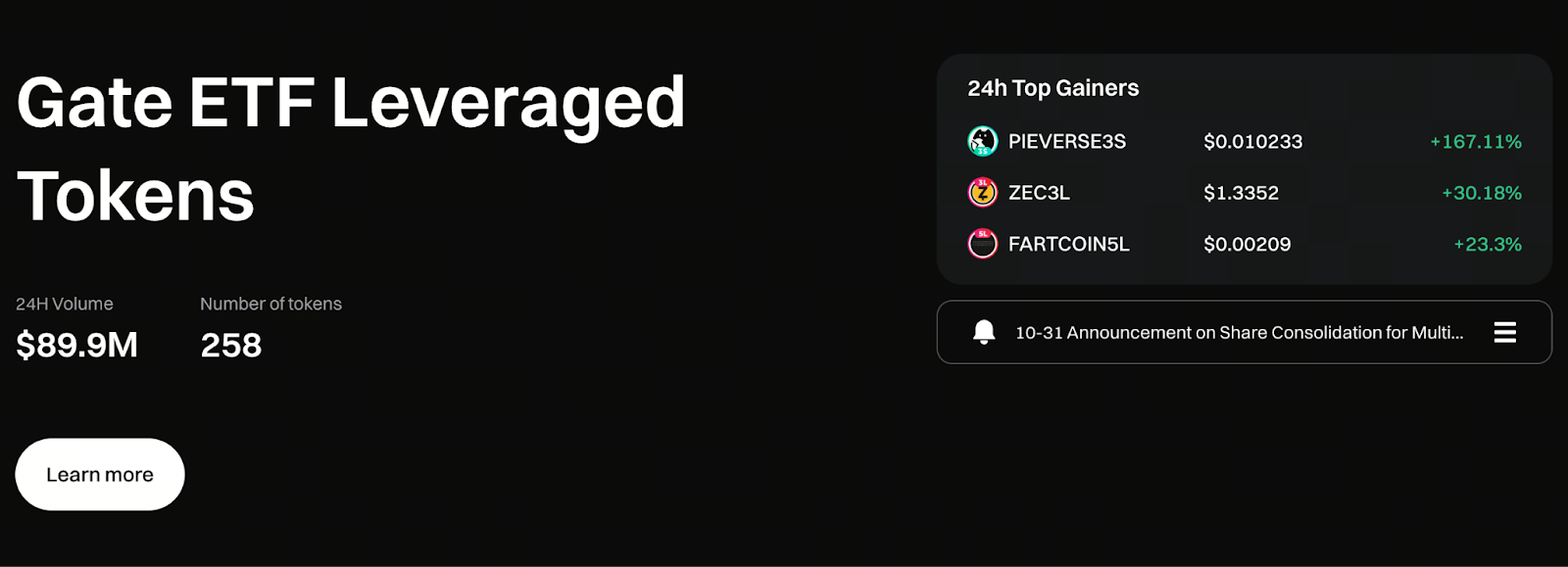
Gate’s leveraged ETFs are tokenized products that maintain a fixed leverage ratio—such as 3x or 5x—through perpetual contract positions. Users can access these effects simply by trading on the spot market, with no need for borrowing or margin management.

The standout feature is that the system fully manages the underlying contract positions, eliminating the risk of forced liquidation. For those unfamiliar with derivatives but seeking to capture amplified market moves, leveraged ETF tokens offer a safer and more accessible alternative.

Start trading Gate ETF leveraged tokens now: https://www.gate.com/leveraged-etf

How Gate Leveraged ETFs Operate

To ensure stable leverage ratios, the platform employs multiple risk and position management mechanisms:

  1. Leverage Maintained via Perpetual Contracts

Each leveraged token is backed by a corresponding futures position, keeping the leverage ratio steady despite market volatility.

  1. Automatic Rebalancing Based on Market Movements

The system adjusts positions according to price changes, ensuring the token’s leverage stays within a preset range.

  1. Leverage Configuration Through Spot Trading

All strategies are executed on the spot market, so users never need to interact with derivatives platforms to access leverage.

  1. Daily 0.1% Management Fee

This fee covers rebalancing, hedging, contract costs, and keeps the product structure operating smoothly.

Key Advantages of Leveraged ETFs

  1. Multiplying Profits in Trending Markets

When market direction is clear, leveraged ETFs can amplify returns by a fixed multiple, significantly enhancing capital efficiency.

  1. No Forced Liquidation from Margin Calls

The system automatically maintains positions, so users avoid the typical liquidation risks found in derivatives trading.

  1. Rebalancing Drives Compounding Gains

During sustained uptrends, rebalancing naturally increases profits, creating a compounding effect on returns.

  1. Zero Learning Curve

Trading is as simple as buying and selling. The process mirrors spot trading, making it ideal for beginners and short-term traders alike.

Risks to Consider Before Trading

While easy to use, leveraged ETFs are inherently more volatile. Please keep the following in mind:

  1. Gains and Losses Are Both Magnified

Leverage increases the impact of both upward and downward price movements.

  1. Rebalancing Drag in Sideways Markets

In choppy or range-bound markets, rebalancing may erode long-term returns.

  1. Actual Performance May Deviate from the Stated Multiple

Due to rebalancing, costs, and volatility, price movements do not always follow a perfectly linear multiplier effect.

  1. Accumulated Management Fees Affect Long-Term Returns

The daily management fee is reflected over time in the token price, making leveraged ETFs unsuitable for long-term passive investing.

In summary, leveraged ETFs are best suited for short-term strategies, swing trading, or strong trending markets.

How Management Fees Are Used

The platform’s daily 0.1% management fee covers:

  • Opening and closing contract positions
  • Funding rates
  • Hedging and slippage during leverage adjustments
  • System rebalancing operations

Compared to similar leveraged products, this fee is moderate to low, with the platform absorbing some costs directly.

Conclusion

Leveraged ETFs provide investors with a straightforward way to use leverage, removing the complexities of derivatives trading and avoiding liquidation risk. However, higher leverage isn’t always better. The real key is recognizing market trends, understanding the effects of rebalancing, and having a disciplined approach to risk and timing. When you know the product rules and can read the market, leveraged ETFs can genuinely boost your returns. Otherwise, lingering in sideways markets can quickly erode your capital.

Author:  Allen
Disclaimer
* The information is not intended to be and does not constitute financial advice or any other recommendation of any sort offered or endorsed by Gate.
* This article may not be reproduced, transmitted or copied without referencing Gate. Contravention is an infringement of Copyright Act and may be subject to legal action.

Related Articles

AI-Native Settlement Layers: How United Stables Is Building the Next Financial Rail
Beginner

AI-Native Settlement Layers: How United Stables Is Building the Next Financial Rail

Stablecoins were originally designed as dollar substitutes within exchanges, primarily used for asset pricing and trade settlement. As on-chain financial ecosystems have matured, their role has expanded beyond simple payments to include collateral assets, cross-chain liquidity mediums, and unified settlement units. In particular, as AI systems and automated agents begin to participate directly in economic activity, demand has risen sharply for programmable value units capable of instant settlement. This shift is pushing stablecoins toward the role of foundational financial infrastructure.
2026-03-25 03:16:17
The ve(3,3) Flywheel Explained: How AERO Tokenomics Powers Aerodrome’s DeFi Economy
Beginner

The ve(3,3) Flywheel Explained: How AERO Tokenomics Powers Aerodrome’s DeFi Economy

In the competition for DeFi liquidity, high-inflation mining alone is no longer enough to build lasting advantages. Aerodrome applies the ve(3,3) economic model to redesign token emissions, voting mechanisms, and revenue distribution, creating a liquidity flywheel centered on governance and cash flow. This article examines AERO tokenomics, the veAERO locking mechanism, and protocol revenue models to explain how Aerodrome builds a sustainable DeFi economic system.
2026-03-25 06:41:58
How Does PAXG Work? In-Depth Overview of the Physical Gold Tokenization Mechanism
Beginner

How Does PAXG Work? In-Depth Overview of the Physical Gold Tokenization Mechanism

PAXG (Pax Gold) is a tokenized asset backed by physical gold, issued by the fintech company Paxos and traded on the Ethereum blockchain as an ERC-20 token. The core concept is to tokenize physical gold on-chain, with each PAXG token representing ownership of a certain amount of gold. This structure enables investors to hold and trade gold in the form of a digital asset.
2026-03-24 19:12:51
Aerodrome Tokenomics: How ve(3,3) Powers Base's Most Profitable DEX
Beginner

Aerodrome Tokenomics: How ve(3,3) Powers Base's Most Profitable DEX

AERO is the native token of Aerodrome Finance, a core decentralized exchange and liquidity protocol in the Base ecosystem. It is primarily used for liquidity incentives and ecosystem operations. veAERO is a governance NFT that users receive by locking AERO, representing both voting power and the right to share protocol revenue. Through a dual track structure of AERO as a utility token and veAERO as a governance credential, Aerodrome separates liquidity usage value from long term governance power, allowing participants to act as liquidity providers, governance decision makers, and revenue sharers within the same system.
2026-03-25 06:40:31
How is the price of PAXG determined? Pegging mechanism, trading depth, and influencing factors
Beginner

How is the price of PAXG determined? Pegging mechanism, trading depth, and influencing factors

PAXG (Pax Gold) is a tokenized asset backed by physical gold reserves, launched by fintech firm Paxos and issued as an ERC-20 token on the Ethereum blockchain. The core concept is to digitally represent real-world gold assets, allowing investors to hold and trade gold via the blockchain network. Because each PAXG token corresponds to a specific quantity of physical gold, its price is theoretically expected to closely track the global gold market.
2026-03-24 19:11:40
Hybrid Collateral Stablecoins: Inside United Stables' Stability and Yield Architecture
Beginner

Hybrid Collateral Stablecoins: Inside United Stables' Stability and Yield Architecture

In the early stages of the crypto market, traditional stablecoins mainly relied on single-reserve or single-collateral models. Their primary focus was price stability and payment convenience, which allowed them to become foundational tools for on-chain trading and capital flows. As the market has entered a more mature financial phase, however, this structure has begun to reveal limitations, including high concentration risk and the difficulty of balancing liquidity with yield. These constraints have driven the evolution toward multi-layer collateral and portfolio-based designs, such as the dual-layer hybrid collateral architecture proposed by United Stables, which seeks to redefine the underlying logic of stable assets.
2026-03-25 03:17:39





