The blockchain industry is transitioning from single-chain to multi-chain ecosystems. Different public blockchains, Layer2, and Rollup networks each have their own independent state and execution environments. While this enables better scalability for applications, it also introduces new challenges. Because blockchains cannot communicate natively, developing cross-chain applications becomes highly complex.
In the field of cross-chain infrastructure, asset transfer is only one piece of the interoperability puzzle. More and more developers are looking to implement cross-chain lending, cross-chain governance, multi-chain gaming, and inter-chain automation. These scenarios require not just asset transfers across chains, but also the ability for smart contracts on different blockchains to communicate with each other. Celer Inter-chain Messaging (IM) emerged as a key cross-chain messaging protocol in this context.
What Is Celer Inter-chain Messaging (IM)?
As a cross-chain messaging protocol launched by Celer Network, Celer Inter-chain Messaging differs from cBridge, which focuses on asset transfers. IM's goal is to transmit arbitrary messages between different blockchains, enabling smart contracts to execute operations across multiple networks.
Developers can use IM to trigger smart contract logic on one chain from another chain, without relying on a centralized server for coordination.
This capability allows cross-chain applications to break free from single-chain limitations and implement more complex business logic.
What's the Difference Between Cross-Chain Asset Transfer and Cross-Chain Message Passing?
The goal of cross-chain asset transfer is to move value.
Users transfer tokens from the source chain to the destination chain via a cross-chain bridge, with the end result being a change in asset location.
Cross-chain message passing, on the other hand, focuses on information synchronization.
The message content can be a function call, governance instruction, state update, voting result, or any other arbitrary data—not necessarily involving asset movement.
As a result, the application scope of cross-chain messaging is typically broader than that of cross-chain asset transfer.
What Are the Core Components of Celer IM's Architecture?
Celer IM consists of three main parts: the Message Bus, State Guardian Network (SGN), and the destination chain execution module.
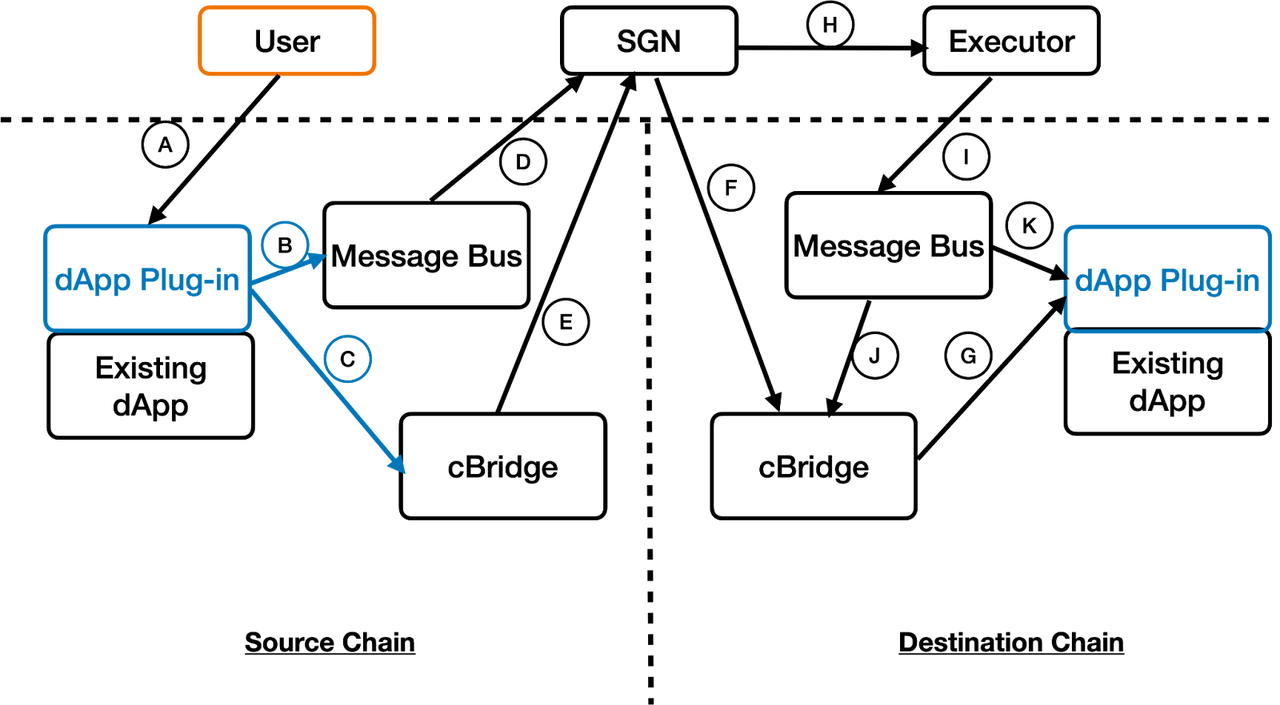
The Message Bus is the cross-chain message bus, responsible for receiving and transmitting cross-chain requests.
The SGN verifies the authenticity of messages and coordinates state synchronization across different blockchains.
The destination chain execution module receives messages and triggers execution on the corresponding smart contracts.
Together, these three components form a complete cross-chain communication system.
What Is the Message Bus?
The Message Bus is the core communication layer of Celer IM.
Think of it as a message transmission network between blockchains.
When an application wants to send instructions to another chain, the message is first submitted to the Message Bus.
The system then handles verification, transmission, and execution of the request.
Thanks to this unified message bus, developers don't need to build separate communication logic for each individual chain.
How Is a Cross-Chain Message Sent?
A cross-chain message is typically initiated by an application on the source chain.
When a user performs an action, the smart contract generates a cross-chain request and submits the relevant data to the Message Bus.
This data may include call parameters, the target contract address, and execution logic.
The message then enters the verification phase and waits for confirmation from the SGN.
The entire process is like sending a verified instruction to another blockchain.
How Does the SGN Verify Cross-Chain Messages?
The State Guardian Network (SGN) serves as the security layer of Celer IM.
When the Message Bus receives a new cross-chain request, SGN verification nodes monitor the relevant events and check whether the message is valid.
Verification covers information such as the message source, execution parameters, and on-chain state.
Only messages that pass verification proceed to the destination chain.
This mechanism prevents malicious message forgery and unauthorized cross-chain calls.
How Does the Message Reach the Destination Chain?
After the SGN completes verification, the message is synchronized to the destination chain.
The receiving module on the destination chain reads the message content and verifies the relevant proof information.
Upon successful verification, the destination chain smart contract begins executing the corresponding operations.
The execution result is then recorded in the destination chain's state.
From an application perspective, this is equivalent to remotely triggering a smart contract on another blockchain.
How Does the Destination Chain Smart Contract Execute a Cross-Chain Request?
Applications on the destination chain typically pre-deploy smart contracts that support cross-chain communication.
These contracts can recognize cross-chain messages coming from the Message Bus.
When a verified request is received, the contract performs the corresponding operations based on its preset logic—for example, updating user state, completing a governance vote, adjusting collateral data, or triggering asset management logic.
The entire execution process still follows the consensus rules of the destination chain.
How Does Celer IM Handle Failed Transactions?
Cross-chain communication can face issues such as network congestion, insufficient Gas, or execution failure on the destination chain.
To ensure system stability, Celer IM provides a message state management mechanism.
If execution fails on the destination chain, the relevant state is recorded, allowing applications to retry execution according to defined rules.
Some applications also include rollback logic to maintain consistency in cross-chain operations.
This design improves the reliability of complex cross-chain applications.
What Application Scenarios Can Celer IM Support?
Cross-chain DeFi is one of the most common application scenarios.
Lending protocols can synchronize collateral information across different chains, and liquidity protocols can enable cross-chain fund management.
DAOs can use IM to synchronize governance proposals and voting results across multiple blockchains.
Gaming projects can synchronize cross-chain character states and asset data.
Additionally, cross-chain identity systems, on-chain automation services, and multi-chain data markets can leverage IM to build more complex application architectures.
How Does Celer IM Differ From Other Cross-Chain Messaging Protocols?
Current cross-chain messaging protocols on the market include LayerZero, Axelar, Wormhole, and others.
What sets Celer IM apart is its deep integration with SGN and cBridge.
Developers can access both cross-chain liquidity and cross-chain communication capabilities without needing to deploy separate infrastructures.
This unified architecture reduces development complexity and improves the composability of multi-chain applications.
Summary
Celer Inter-chain Messaging (IM) is a cross-chain messaging protocol from Celer Network, designed to enable data synchronization and smart contract communication across different blockchains.
Its core architecture consists of the Message Bus, State Guardian Network (SGN), and destination chain execution module, processing cross-chain messages through three phases: verification, transmission, and execution.
FAQs
What's the Difference Between IM and cBridge?
cBridge handles cross-chain asset transfers, while IM handles cross-chain message passing and smart contract communication. Together, they form Celer's cross-chain interoperability system.
What Does the Message Bus Do in IM?
The Message Bus is the cross-chain message bus, responsible for receiving, transmitting, and managing cross-chain requests. It's the core communication layer in the IM architecture.
Why Is the SGN Important for IM?
The State Guardian Network (SGN) verifies the authenticity of cross-chain messages, synchronizes state, and coordinates execution. It's a vital component of IM's security model.
What Types of Messages Can IM Transmit?
IM can transmit any type of cross-chain message, including function calls, governance instructions, state updates, business logic requests, and other smart contract data.







