In Orca’s trading structure, the Swap process is mainly determined by three core elements: first, liquidity pools provide tradable assets; second, the pricing model dynamically adjusts prices based on asset ratios; and finally, the on chain execution mechanism completes transaction settlement. This combination of “liquidity + algorithmic pricing + on chain execution” forms one of the most typical trading paths in DeFi.
At its core, understanding Orca’s trading mechanism means understanding three key questions: how AMMs determine prices, how liquidity supports trade size, and how on chain transactions are executed and confirmed. Together, these three elements shape the trading experience, cost structure, and price stability.
Orca Swap: An AMM Based Trading Method on Solana
Orca Swap is an on chain trading method based on the AMM model. Its defining feature is that users complete token swaps by interacting with liquidity pools rather than being matched through an order book. In other words, the “counterparty” to a trade is effectively the assets in the pool, not a specific user.
Under this mechanism, as long as the liquidity pool contains enough assets, trades can be executed at any time. This solves the problem in traditional order book models where a lack of open orders can prevent execution. It gives the market continuously available liquidity and reduces the waiting cost of trading.
In addition, Orca runs on a high performance blockchain, which shortens confirmation times and lowers transaction fees, creating a near real time trading experience. This “low latency + low cost” structure makes it especially suitable for high frequency trading and small value swaps.
Therefore, Orca Swap can be understood as an “algorithm driven instant exchange system”: prices are determined by a model, liquidity is provided by users, and trades are executed automatically on chain. This model not only changes how trading works, but also provides the core entry point for understanding AMM mechanisms.
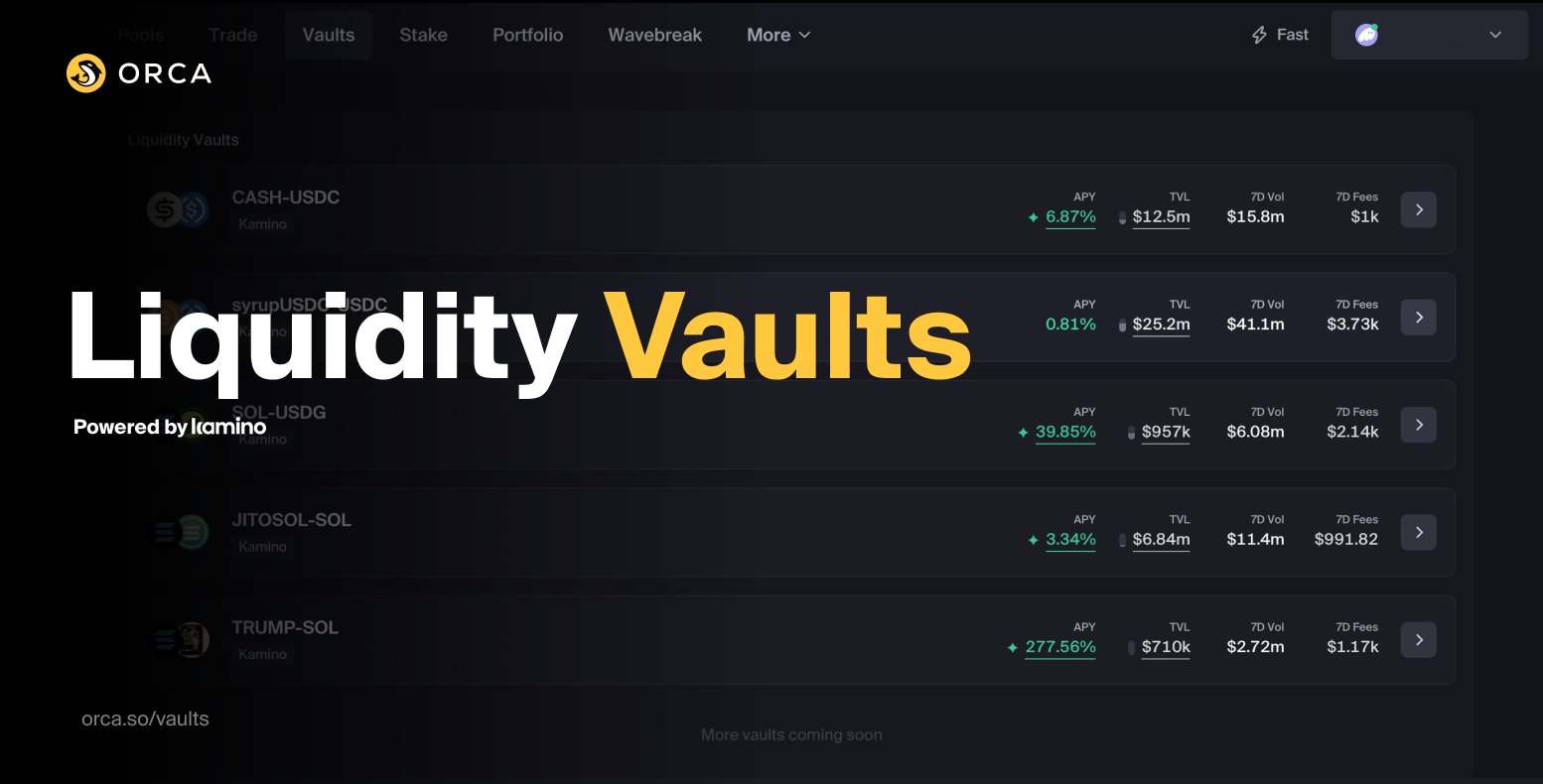
Source: orca.so
Orca AMM Mechanism Explained: How Automated Market Making Enables Token Swaps
The core of an AMM, or automated market maker, is that it replaces traditional market makers with algorithms. Prices are no longer determined by orders, but are automatically calculated based on the ratio of assets in the pool.
When a user makes a trade, they are essentially depositing one asset into the pool while withdrawing another. This process changes the asset ratio inside the pool, which in turn triggers a price adjustment.
Building on the traditional AMM model, Orca introduces concentrated liquidity, or CLMM, allowing liquidity to be concentrated within specific price ranges and thereby improving capital utilization. As a result, it can provide greater trading depth with the same amount of capital.
Therefore, Orca’s AMM mechanism can be understood as “asset ratios drive prices + liquidity structure improves efficiency.”
Liquidity Pool: How Trades Are Completed
Liquidity pools are the core infrastructure behind Orca trading. They consist of assets provided by users, known as LPs. For example, a SOL/USDC pool contains both assets at the same time.
When a user makes a swap, such as exchanging SOL for USDC, they are essentially adding SOL to the pool while taking out the corresponding amount of USDC. The entire process is executed automatically by a smart contract.
LPs earn trading fees by providing assets, which means they supply liquidity to the market. This mechanism creates an economic loop between “traders” and “liquidity providers.”
The larger the liquidity pool, the smaller the price impact of a trade. This is the core of the “relationship between slippage and liquidity depth.”
x*y=k Pricing Model: How Price and Slippage Are Calculated
Orca, in some pools, uses the classic AMM pricing model:
x⋅y=kx \cdot y = kx⋅y=k
Here, x and y represent the amounts of the two assets in the pool, while k is a constant.
When a user buys a given asset, the amount of that asset in the pool decreases while the amount of the other asset increases. This breaks the previous balance and causes the price to change. The change is continuous rather than a discrete jump.
Slippage essentially comes from the impact of trade size relative to pool size. If a trade is large, it significantly changes the asset ratio, causing the execution price to deviate from the initial price.
Therefore, understanding the x*y=k model means understanding “how prices change” and “why slippage occurs.”
Orca Trading Process: From Connecting a Wallet to Completing a Swap
The full Orca trading process can be broken down into several key steps.
First, the user connects a wallet and selects a trading pair, such as SOL/USDC. Then the user enters the trade amount, and the system calculates the expected price and slippage based on the current state of the pool.
After the transaction is confirmed, the Swap request is sent on chain, where the smart contract executes the asset exchange. This process is usually completed within a few seconds.
Once the trade is complete, the user’s asset balance is updated, and the entire process requires no intermediary. This “permissionless + automated execution” flow is one of the core features of DeFi.
Factors Affecting Slippage: Liquidity, Trade Size, and Price Changes
Slippage is a core concept in AMM trading, and its size is mainly determined by three factors.
The first is liquidity depth. The larger the pool, the smaller the price impact of a trade of the same size, and the lower the slippage.
The second is trade size. Large trades significantly change the asset ratio in the pool, causing prices to move quickly.
| Factor |
Explanation |
Impact on Slippage |
How It Works in Practice |
| Liquidity depth |
Total capital and asset distribution in the trading pool |
Deeper liquidity means lower slippage |
The larger the pool, the smaller the price impact of the same trade size |
| Trade size |
The amount of a user’s single transaction |
Larger trades mean higher slippage |
Large trades significantly change the ratio between the two assets in the pool |
| Price range distribution |
How concentrated liquidity is across different price ranges, especially in concentrated liquidity models |
The more liquidity is concentrated around the current price range, the lower the slippage |
In concentrated liquidity models such as Orca, slippage is significantly reduced when trades occur in dense liquidity ranges |
| Overall relationship |
Slippage is a functional relationship between trade size and liquidity structure |
The three factors jointly determine final slippage |
Slippage = f(trade size / liquidity depth and distribution) |
The final factor is price range distribution. In Orca’s concentrated liquidity model, if a trade occurs within a dense liquidity range, slippage will be lower. If it occurs outside that range, slippage will be higher.
Therefore, slippage is essentially a “functional relationship between trade size and liquidity structure.”
Orca Fee Mechanism: How Transaction Costs Are Structured
Orca’s fee mechanism is an important part of its trading system. Its core logic is to use trading fees to incentivize liquidity providers, or LPs, to keep supplying capital, thereby maintaining market liquidity. For every Swap transaction, users pay a certain percentage as a fee. This is also the foundation that allows the AMM model to operate over the long term.
In terms of structure, trading fees are usually charged at a fixed rate or at the rate set by the pool, and are distributed directly to the LPs in the corresponding liquidity pool. This means that the higher the trading volume, the more income LPs can earn, forming a positive cycle of “trading activity → increased liquidity → improved trading experience.”
In addition, under Orca’s concentrated liquidity model, or CLMM, fee distribution is closely tied to the price range where liquidity is placed. Only when a trade occurs within the price range provided by an LP will that portion of liquidity earn fee income. This further improves capital efficiency, while also placing higher demands on LP strategy selection.
Beyond trading fees, users also need to pay on chain execution costs, or gas. Since Orca runs on a high performance network, however, these costs are usually low and have limited impact on total trading cost. Orca’s cost structure can therefore be summarized as “trading fees + extremely low on chain costs,” giving it a clear cost advantage in most scenarios.
Advantages and Risks of Orca Trading
From an advantages perspective, Orca’s trading mechanism strikes a strong balance between efficiency and cost. Relying on a high performance base layer, it offers relatively fast transaction confirmation, making it suitable for high frequency trading and instant swaps. Its low fee structure also lowers the barrier for users entering DeFi.
In terms of liquidity design, the concentrated liquidity model significantly improves capital utilization, allowing limited capital to provide greater depth within key price ranges. This not only reduces slippage, but also increases the potential returns for LPs, making the entire system more capital efficient.
However, this structure also brings certain risks. For traders, when liquidity is insufficient or the market is highly volatile, slippage can expand quickly, causing the actual execution price to deviate from expectations. For LPs, concentrated liquidity improves potential returns, but also increases management complexity and strategy risk.
In addition, impermanent loss remains an issue that cannot be ignored in the AMM model. When asset prices fluctuate significantly, the value of an LP’s assets may be lower than it would have been from simply holding the assets. Therefore, when using Orca, users need to evaluate risk by considering “liquidity structure + market volatility + strategy selection” together.
Summary
Through its AMM mechanism and liquidity pool structure, Orca enables on chain token swaps without an order book. Its core lies in the combination of “algorithmic pricing + liquidity from capital pools.” This model not only lowers the barrier to trading, but also gives the market continuous liquidity.
From a more complete perspective, Orca’s trading system is jointly formed by its pricing model, liquidity structure, fee mechanism, and on chain execution. Understanding how these elements interact helps build a systematic understanding of DeFi trading mechanisms and supports a more rational assessment of their costs and risks.
FAQ
- How does Orca complete token swaps?
Through the AMM mechanism, users trade by swapping assets with liquidity pools.
- Why does Orca not have an order book?
Because prices are determined by algorithms, so buy and sell orders do not need to be matched.
- What determines the transaction price?
It is determined by the ratio of assets in the liquidity pool.
- Why does slippage occur?
Because a trade changes the asset ratio in the pool, which affects the price.







