For sharing economy and DePIN projects, the key question is not only whether devices can be brought on-chain. It is also whether device data can be trusted, how order revenue is recorded, and how on-chain participants can understand the path of revenue distribution.
This usually involves six layers: device onboarding, data verification, order mapping, revenue records, PowerPass, and user participation.
ShareX’s Overall Operating Mechanism
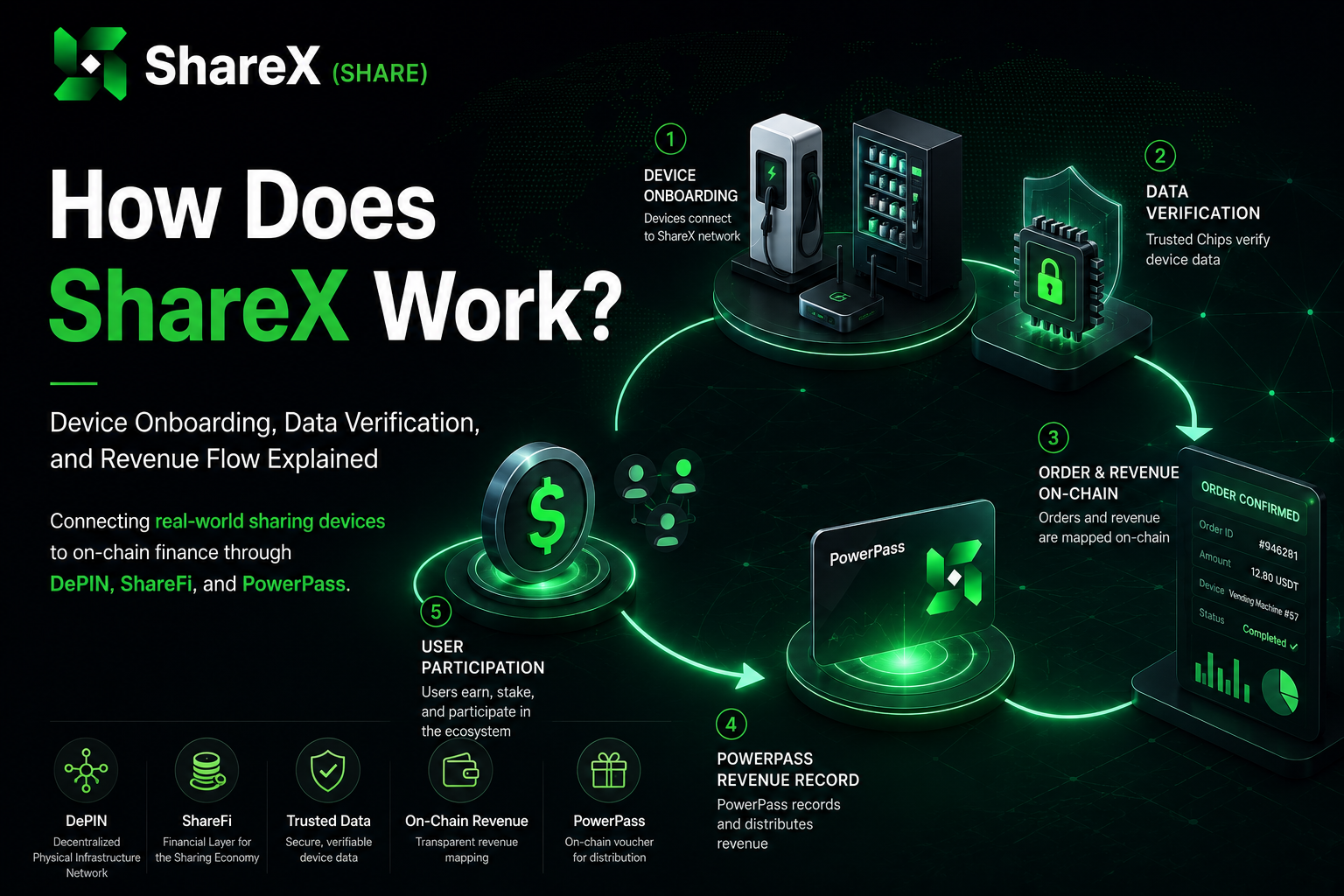
The operating mechanism of ShareX can be understood as a DePIN process that connects real world shared devices, on-chain data records, and revenue distribution. Its core purpose is to turn real world consumer behavior into an on-chain data structure that can be verified, recorded, and participated in.
Structurally, ShareX consists of modules such as Deshare, Trusted Chips, ShareFi, and PowerPass. First, device operators connect shared charging devices, vending machines, or other IoT terminals to the ShareX network. Then, the devices generate orders, usage records, and revenue data. Next, Trusted Chips or other onboarding methods verify the data source. Finally, the on-chain system creates records based on order and revenue data, then completes distribution through PowerPass or related mechanisms.
The importance of this mechanism lies in the fact that ShareX does not simply record device names on-chain. Instead, it builds a full closed loop around device usage, data trust, and revenue mapping. For a consumer DePIN project, real orders and verifiable data form the foundation of ecosystem operations.
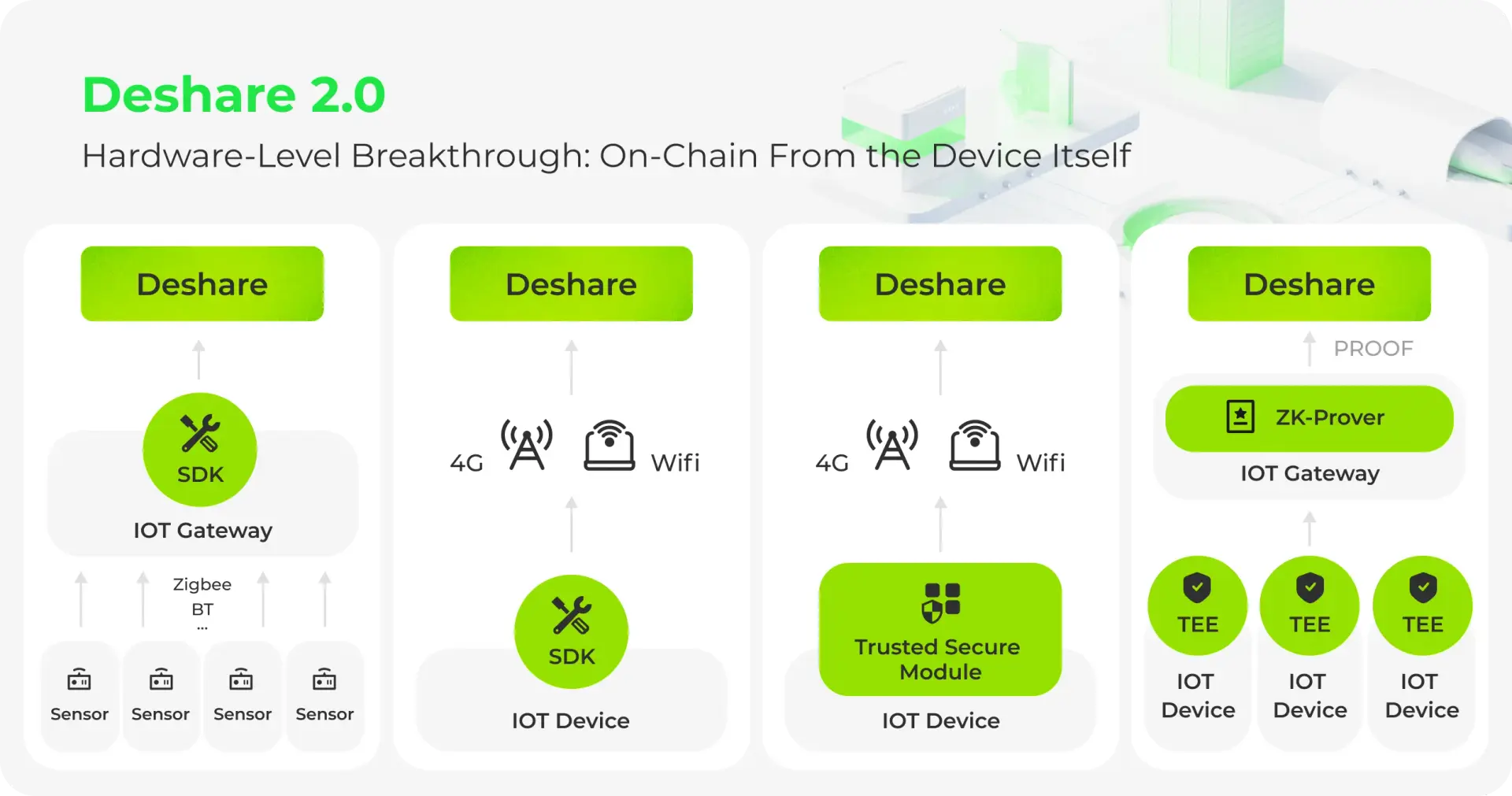
The core of connecting shared devices to the ShareX network is using Deshare to link real world devices with the on-chain system. Deshare can be understood as ShareX’s device onboarding protocol, responsible for handling data entry points and authentication methods for different types of devices.
In the actual process, device operators first choose an onboarding method, such as Cloud Gateway, Edge SDK, Trusted Chips, or Native On-chain. The system then completes the onboarding configuration based on the device type and technical conditions. Next, the device begins uploading order, status, location, or usage data. Finally, this data enters ShareX’s on-chain record and revenue calculation process.
| Onboarding Method |
Applicable Object |
Core Function |
| Cloud Gateway |
Existing cloud systems |
Connect traditional IoT platforms |
| Edge SDK |
Edge devices |
Allow the device side to generate data |
| Trusted Chips |
Trusted hardware |
Verify the source of device data |
| Native On-chain |
Native on-chain devices |
Connect directly to the on-chain system |
This table shows that ShareX’s device onboarding does not rely on a single method. Instead, it uses a layered design based on device maturity and trust requirements. This allows it to support older devices while also enabling newer devices with higher trust standards.
How Trusted Chips Verify Device Data
Trusted Chips are a key mechanism ShareX uses to improve the trustworthiness of device data. In simple terms, Trusted Chips use hardware-level data signatures to help confirm whether device data comes from a real device, rather than being manually fabricated or tampered with on the backend.
In the operating process, the device first generates order or usage data in a real world scenario. Trusted Chips then sign or authenticate the device data. Next, the system reads the verified data and uses it for on-chain records. Finally, this data can support order statistics, revenue distribution, and PowerPass-related processes.
This mechanism matters because one of the biggest challenges for DePIN projects is whether real world data can be trusted. If device revenue, order volume, or usage status cannot be verified, the on-chain revenue structure lacks a reliable foundation. The role of Trusted Chips is to reduce the room for data falsification and allow real world devices to become more trustworthy sources of on-chain assets.
How Orders and Revenue Are Mapped On-chain
Order and revenue mapping is the key step through which ShareX connects real world business activity with on-chain finance. Its core purpose is to turn consumer data generated by devices into revenue indicators that can be recorded on-chain.
More specifically, users first use shared devices in the real world and complete payment. The device then records the order amount, usage time, device status, and other related data. Next, the system verifies and structures this data. Finally, order and revenue information is mapped on-chain for revenue records, distribution, or ShareFi-related processes.
The importance of this process is that it brings real world consumer data into the on-chain financial system. Data on traditional sharing platforms is usually stored by centralized companies, while ShareX attempts to give orders and revenue greater transparency. For scenarios that combine RWA and DePIN, revenue mapping is the core step in determining whether an on-chain asset has real world support.
How PowerPass Records Revenue Distribution
PowerPass is an important credential in the ShareX ecosystem for connecting device revenue with on-chain records. Its core function is to record user participation, staking, and distribution-related rights through an on-chain voucher or NFT structure.
From an operating perspective, real world devices first generate orders and revenue. The system then converts verified data into revenue records. Next, PowerPass holders can participate in the corresponding staking or distribution structure. Finally, the on-chain system completes revenue distribution records based on device revenue, order indicators, and recording rules.
The impact of this design is that PowerPass is not an ordinary collectible NFT. It is closer to a revenue record and participation credential. It connects real world device revenue, on-chain identity, and distribution processes, allowing users to understand their participation in the ShareX ecosystem through a clearer on-chain structure.
How Users Can Participate in the ShareX Ecosystem
Users can participate in the ShareX ecosystem mainly by using shared devices, holding PowerPass, participating in staking, following distribution records, and using the SHARE token for payments or ecosystem incentives. The core idea is that users can enter the ecosystem both as real world consumers and as on-chain participants.
In the participation process, users can first use shared devices in real world settings, such as shared charging devices or vending machines. The devices then generate order data, which is verified and recorded through the ShareX network. Next, on-chain users can participate in revenue records through PowerPass or related mechanisms. Finally, ShareFi connects device revenue, on-chain credentials, and ecosystem incentives.
This participation model matters because ShareX links ordinary consumer behavior with on-chain financial structures. Users are not just interacting with an on-chain protocol. They may also understand how DePIN works in practice through real devices, order data, and revenue credentials.
Conclusion
ShareX’s operating process revolves around device onboarding, data verification, order mapping, and revenue records. Shared devices first connect to the network through Deshare. Their data is then verified through Trusted Chips or other methods. Orders and revenue are then mapped on-chain, and finally PowerPass and ShareFi create revenue records and distribution flows.
From an overall structural perspective, ShareX is not focused simply on bringing devices on-chain. Its real focus is making real world consumer data verifiable on-chain. Device authenticity, order data, revenue mapping, and user participation are the core elements for understanding how ShareX works.
FAQs
How Does ShareX Work?
ShareX connects real world shared devices through Deshare and uses Trusted Chips to verify device data. Orders and revenue generated by the devices are mapped on-chain, then turned into revenue records through PowerPass and ShareFi.
What Role Does Deshare Play in ShareX?
Deshare is ShareX’s device onboarding layer. It allows shared devices, IoT terminals, and real world devices to enter the on-chain network, while supporting multiple onboarding methods.
Why Are Trusted Chips Important?
Trusted Chips are used to verify the source of device data and reduce the risk of manual falsification or data tampering. They are an important foundation for making device data trustworthy in ShareX.
How Does PowerPass Participate in Revenue Distribution?
As an on-chain revenue credential, PowerPass can be used to record device revenue, staking, and distribution-related rights, helping users understand their participation relationship within the ShareX ecosystem.
Ordinary sharing economy platforms are usually managed by centralized companies that control device and revenue data. ShareX attempts to improve data transparency and revenue verifiability through DePIN, on-chain records, and ShareFi mechanisms.







