How to Read Key Parameters in Futures Trading? A Comprehensive Guide Using Gate as an Example

Beginner
Quick Reads
Last Updated 2026-03-26 15:32:13
Reading Time: 1m
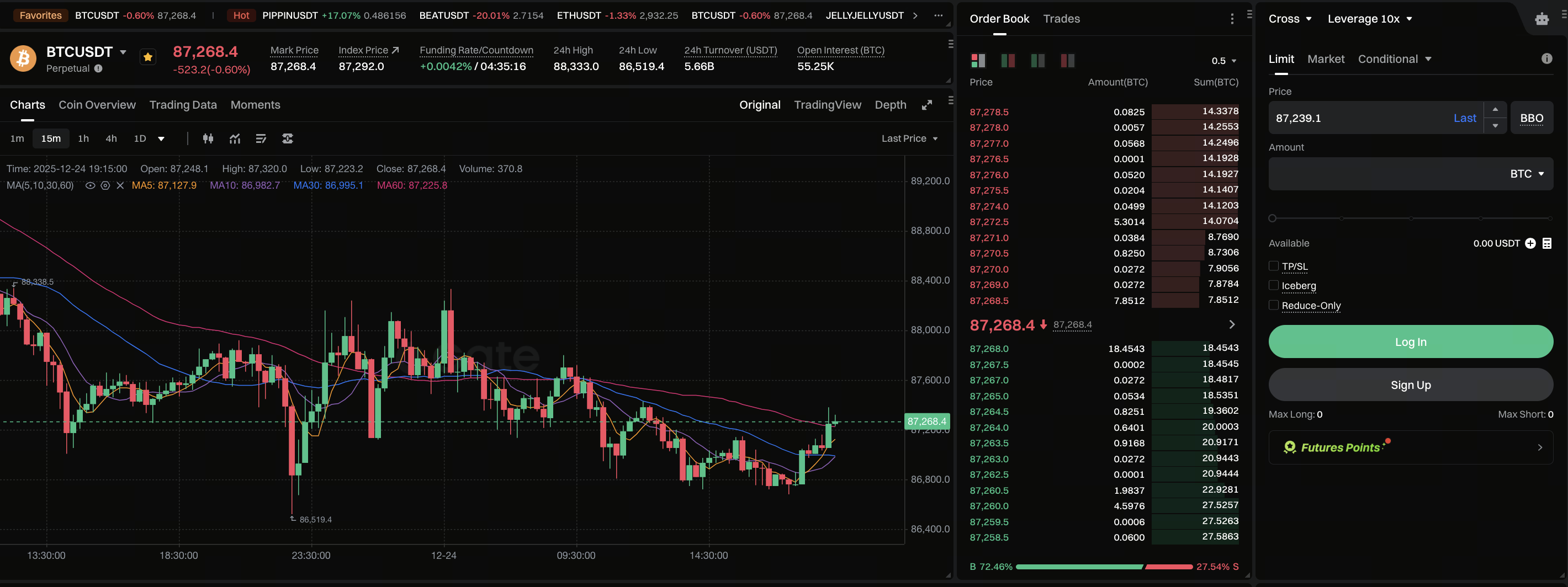
The parameters found on the contract trading interface can be daunting for beginners. Using Gate as a case study, this article provides a systematic explanation of the key parameters in contract trading, such as leverage, margin, liquidation price, and unrealized P&L. This guide aims to help new users gain a clear understanding of the contract trading interface.


Image: https://www.gate.com/futures/USDT/BTC_USDT

Why It’s Critical to Understand Contract Trading Parameters

When beginners first encounter contract trading, they often find the interface packed with numbers and technical jargon. Placing orders without grasping their meaning can magnify the impact of poor decisions, given the mechanics of contract trading.

Unlike spot trading, every parameter in contract trading directly affects your risk exposure, costs, and outcomes.

A Quick Guide to Common Parameters on Contract Trading Interfaces

Using Gate’s contract trading platform as an example, the most common parameters include:

  • Leverage
  • Position Direction (Long / Short)
  • Margin
  • Liquidation Price
  • Risk Rate
  • Unrealized P&L
  • Order Price and Quantity

Together, these parameters form the backbone of a comprehensive contract trading system.

What Leverage Really Means in Contract Trading

Leverage isn’t just about “making more.” It means:

  • Controlling a larger position with less margin
  • Amplifying both potential gains and losses

Gate’s contract trading platform allows you to adjust leverage, but higher leverage isn’t always better. For newcomers, low leverage makes it easier to understand how price movements affect account balances.

The Difference Between Margin and Available Balance

This is one of the most commonly misunderstood concepts for contract trading beginners.

  • Margin: The funds required to maintain your current position
  • Available Balance: Funds in your account that are not yet allocated

On Gate’s contract trading platform, both values update in real time. Misinterpreting them can lead to serious risk misjudgments.

How Liquidation Price Is Calculated and Changes

Liquidation price isn’t static. In contract trading, it’s affected by:

  • Your current position size
  • Leverage used
  • Adding or reducing margin
  • Market price fluctuations

So, beginners shouldn’t memorize a single liquidation price. Instead, it’s essential to understand how and why it changes.

Unrealized vs. Realized P&L: What’s the Difference?

On Gate’s contract trading interface, profit and loss (P&L) is typically split into two categories:

  • Unrealized P&L: Floating results for open positions
  • Realized P&L: Profits or losses after the position is settled

Many beginners mistakenly believe unrealized P&L is “already earned,” which is a risky misconception in contract trading.

How Order Types Impact Trading Outcomes

Different order types on contract trading platforms follow distinct execution rules:

  • Limit Order
  • Market Order
  • Conditional Order
  • Take-Profit/Stop-Loss Order

Understanding these parameters helps users select the most effective order type for varying market conditions, instead of trading blindly.

The Most Common Mistakes Beginners Make When Reading Parameters

Typical pitfalls include:

  • Focusing only on returns, while ignoring risk rates
  • Overlooking trading fees and funding rates
  • Failing to understand what triggers parameter changes

These mistakes usually stem from a lack of understanding about contract trading features, rather than poor market judgment.

Conclusion: Mastering Parameters Is the First Step in Contract Trading

Contract trading itself isn’t complicated; the real challenge lies in misunderstanding its features and parameters. Once you can confidently interpret every key parameter on Gate’s contract trading platform, you’ll have much greater control over your trades.

For beginners, learning to “read the interface” is more important than chasing profits.

Author: Max
Disclaimer
* The information is not intended to be and does not constitute financial advice or any other recommendation of any sort offered or endorsed by Gate.
* This article may not be reproduced, transmitted or copied without referencing Gate. Contravention is an infringement of Copyright Act and may be subject to legal action.

Related Articles

AI-Native Settlement Layers: How United Stables Is Building the Next Financial Rail
Beginner

AI-Native Settlement Layers: How United Stables Is Building the Next Financial Rail

Stablecoins were originally designed as dollar substitutes within exchanges, primarily used for asset pricing and trade settlement. As on-chain financial ecosystems have matured, their role has expanded beyond simple payments to include collateral assets, cross-chain liquidity mediums, and unified settlement units. In particular, as AI systems and automated agents begin to participate directly in economic activity, demand has risen sharply for programmable value units capable of instant settlement. This shift is pushing stablecoins toward the role of foundational financial infrastructure.
2026-03-25 03:16:17
The ve(3,3) Flywheel Explained: How AERO Tokenomics Powers Aerodrome’s DeFi Economy
Beginner

The ve(3,3) Flywheel Explained: How AERO Tokenomics Powers Aerodrome’s DeFi Economy

In the competition for DeFi liquidity, high-inflation mining alone is no longer enough to build lasting advantages. Aerodrome applies the ve(3,3) economic model to redesign token emissions, voting mechanisms, and revenue distribution, creating a liquidity flywheel centered on governance and cash flow. This article examines AERO tokenomics, the veAERO locking mechanism, and protocol revenue models to explain how Aerodrome builds a sustainable DeFi economic system.
2026-03-25 06:41:58
Aerodrome Tokenomics: How ve(3,3) Powers Base's Most Profitable DEX
Beginner

Aerodrome Tokenomics: How ve(3,3) Powers Base's Most Profitable DEX

AERO is the native token of Aerodrome Finance, a core decentralized exchange and liquidity protocol in the Base ecosystem. It is primarily used for liquidity incentives and ecosystem operations. veAERO is a governance NFT that users receive by locking AERO, representing both voting power and the right to share protocol revenue. Through a dual track structure of AERO as a utility token and veAERO as a governance credential, Aerodrome separates liquidity usage value from long term governance power, allowing participants to act as liquidity providers, governance decision makers, and revenue sharers within the same system.
2026-03-25 06:40:31
How Does PAXG Work? In-Depth Overview of the Physical Gold Tokenization Mechanism
Beginner

How Does PAXG Work? In-Depth Overview of the Physical Gold Tokenization Mechanism

PAXG (Pax Gold) is a tokenized asset backed by physical gold, issued by the fintech company Paxos and traded on the Ethereum blockchain as an ERC-20 token. The core concept is to tokenize physical gold on-chain, with each PAXG token representing ownership of a certain amount of gold. This structure enables investors to hold and trade gold in the form of a digital asset.
2026-03-24 19:12:51
How is the price of PAXG determined? Pegging mechanism, trading depth, and influencing factors
Beginner

How is the price of PAXG determined? Pegging mechanism, trading depth, and influencing factors

PAXG (Pax Gold) is a tokenized asset backed by physical gold reserves, launched by fintech firm Paxos and issued as an ERC-20 token on the Ethereum blockchain. The core concept is to digitally represent real-world gold assets, allowing investors to hold and trade gold via the blockchain network. Because each PAXG token corresponds to a specific quantity of physical gold, its price is theoretically expected to closely track the global gold market.
2026-03-24 19:11:40
Aster vs Hyperliquid: Which Perp DEX Will Prevail?
Beginner

Aster vs Hyperliquid: Which Perp DEX Will Prevail?

Aster and Hyperliquid are the two representative protocols of the "purpose-built L1 path" within the current decentralized perpetual exchange (Perp DEX) sector. As a pioneer in the field, Hyperliquid has built a deep liquidity moat through its highly mature order book architecture and strong community consensus. Conversely, Aster, as a rising challenger, seeks to leapfrog the competition in high-performance trading through more aggressive multi-chain aggregation logic, private transaction modules, and an underlying execution environment optimized for 2026 market demands.
2026-03-24 11:58:33





