The evolution of investment markets has steadily lowered the barriers for ordinary investors to access global capital markets. In the past, stock investing demanded continuous analysis of company fundamentals, industry trends, and market conditions. Index funds changed that paradigm entirely. By tracking a specific market index, these funds allow investors to gain broad exposure to an entire market or selected sectors at a relatively low cost.
From the U.S. S&P 500 and NAS100 indices to Germany's DAX40 and composite indices covering global markets, vast amounts of capital are allocated through index funds.
What Is an Index Fund?
An index fund is an investment vehicle designed to replicate the performance of a specific market index. Unlike actively managed funds, index funds do not rely on fund managers to pick stocks in pursuit of excess returns. Instead, they hold the constituent assets according to the index rules. For example, a fund tracking the S&P 500 holds U.S. large-cap stocks in proportion to their index weights; a fund tracking the NAS100 primarily allocates to large non-financial companies listed on the Nasdaq.
The core objective of an index fund is not to beat the market, but to closely mirror the target index's overall performance after deducting necessary fees. This is why index funds are also known as passive investment tools.
How Do Index Funds Work?
Index funds achieve index tracking by replicating the constituent structure of the index.
Fund managers build a portfolio based on the target index's constituent list and their respective weights. When the index composition changes, the fund adjusts its holdings accordingly to maintain a high degree of alignment.
Different indices have different construction rules. For instance, the NAS100 uses specific selection criteria and weighting mechanisms, while the German DAX40 applies a free-float market capitalization weighting method.
A slight deviation between the fund and the index, known as tracking error, is normal. For index funds, a lower tracking error typically indicates higher replication efficiency.
What Types of Index Funds Are Common?
Index funds cover stocks, bonds, and various markets and industries globally, catering to different investment goals.
Broad-market stock index funds are the most common type. They track an entire market or a group of large companies, such as the S&P 500, the Total Market Index, or the MSCI World. Due to their wide holdings, broad-market index funds are often considered a cornerstone of long-term portfolios.
Sector index funds focus on a specific industry, such as technology, healthcare, financials, or energy. Compared to broad-based indices, sector funds are more concentrated and tend to be more volatile.
International index funds provide exposure to overseas markets. A single product can give investors access to Europe, Asia, emerging markets, or global equities. For example, the German DAX40 has long been regarded as a key barometer of the European economy.
Bond index funds track government, corporate, or composite bond indices. They generally exhibit lower volatility than stock index funds and are frequently used to balance risk in long-term asset allocation.
How to Choose the Right Index Fund for You?
There is no one-size-fits-all approach to selecting an index fund. Different investment objectives call for different indices and fund products.
First, investors need to define the market scope they want to target. For U.S. large-cap exposure, consider funds tracking the S&P 500 or NAS100. For global diversification, look into global equity index funds that cover multiple countries and regions.
The expense ratio is a key metric. Although index funds generally have low fees, they vary across products. Over the long term, even small fee differences can significantly impact final returns through compounding.
Fund size also matters. Larger index funds typically offer better liquidity, more mature management systems, and greater operational stability, making them more likely to deliver consistent index tracking.
Tracking error is another critical quality indicator. The lower the tracking error, the closer the fund's performance aligns with the target index.
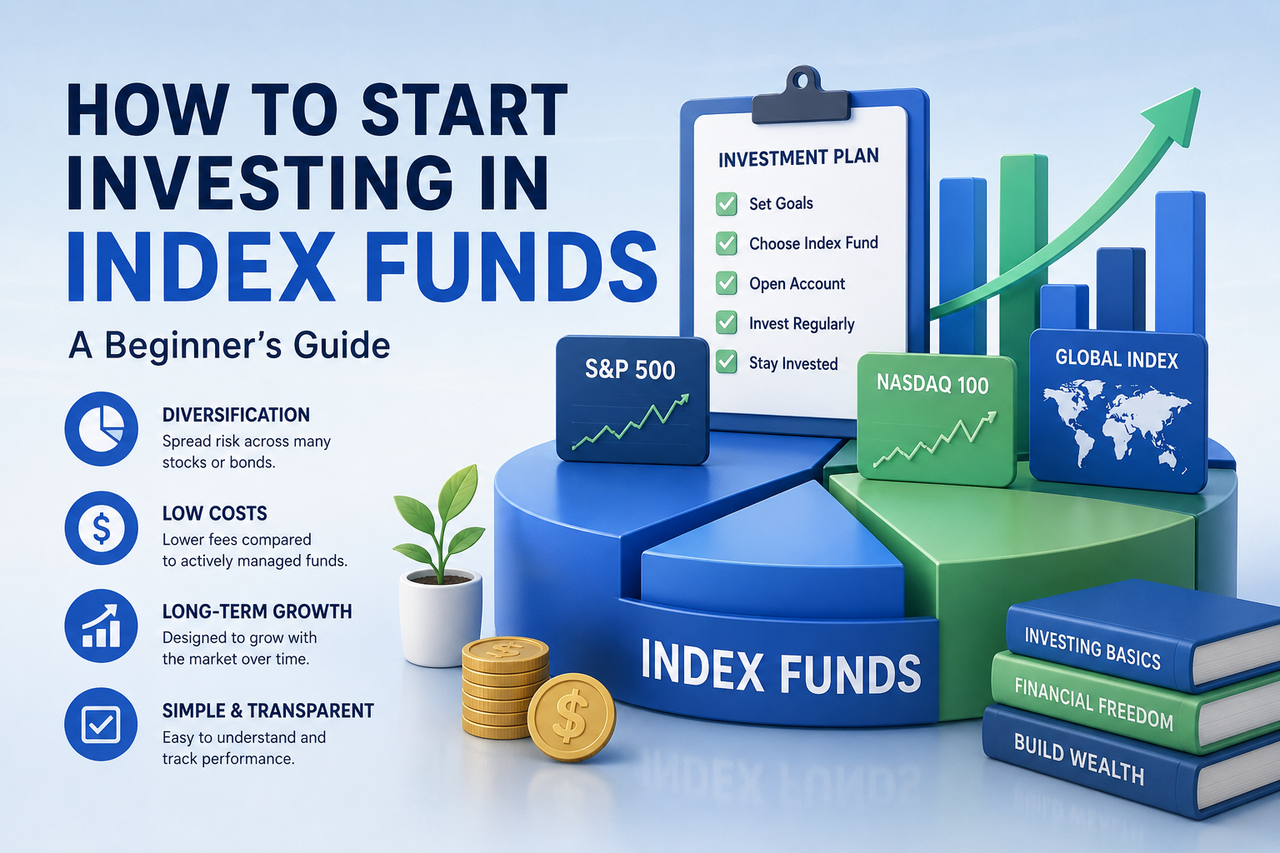
How to Start Investing in Index Funds?
The process is relatively straightforward, but building a sound investment framework remains essential.
Investors first need to open an investment account through a brokerage or fund distribution platform. Different platforms offer varying product selections and trading methods, so choose based on your needs.
After opening an account, determine your investment amount based on your financial situation. Many index funds have low minimum investment requirements, making the barrier to entry much lower than building a stock portfolio directly.
Then, select the index fund that matches your goals. Those interested in the U.S. tech sector often study the NAS100's composition; those focused on European markets may look into the GER40's industry structure and representative companies.
Establishing a long-term investment plan is crucial. Many investors use a dollar-cost averaging strategy—investing a fixed amount regularly—to reduce the impact of short-term market volatility.
What's the Difference Between Index Funds and Index Trading Products?
Many people confuse index funds with index trading products, but they are fundamentally different financial instruments.
Index funds replicate index performance by holding real assets, so investors essentially own fund shares. The fund's net asset value (NAV) fluctuates with changes in the underlying asset prices.
Index trading products, on the other hand, provide price exposure to an index, often using derivatives to achieve tracking. Their trading mechanisms, risk profiles, and use cases differ significantly from index funds.
For example, major global indices like NAS100, SPX500, and US30 can be accessed through index funds or other index trading instruments.
What Are the Risks of Investing in Index Funds?
Index funds reduce single-stock risk but do not eliminate market risk.
When the overall market declines, the NAV of index funds will also drop. For funds tracking a single sector or a specific region, volatility may be higher than that of broad-based funds.
Other factors—such as economic cycles, interest rate changes, industry concentration, and currency fluctuations—can also affect performance.
The core advantage of index funds is diversification, not risk elimination. Understanding the sources of risk is an essential part of long-term investing.
What's the Difference Between Index Funds and ETFs?
Both index funds and ETFs are index-based investment vehicles that can track the same index.
The main difference lies in trading mechanics. Traditional index funds are bought and sold at the daily NAV, while ETFs trade on exchanges throughout the day like stocks.
ETFs generally offer more trading flexibility, while traditional index funds are better suited for long-term, systematic investing. Neither is inherently superior; the choice depends on the investor's needs and approach.
Summary
Index funds are fund products that achieve diversification by replicating market index performance. By holding index funds, investors can participate in stock, bond, and global capital markets at a relatively low cost—without the need to research and select individual securities.
From the S&P 500 and NAS100 to the GER40, different indices reflect varying market structures, industry compositions, and economic characteristics. Understanding how index funds work, the logic behind index composition, selection criteria, and risk sources helps build a more systematic framework for long-term investing and provides a foundation for subsequent asset allocation decisions.
FAQs
Are index funds suitable for beginner investors?
Index funds are widely considered one of the best entry points for new investors to understand capital markets. Because they hold a broad basket of securities, they reduce the complexity of stock picking and individual company analysis.
Can index funds lose money?
Yes, index funds can lose money. When the overall market declines, the fund's NAV will also be affected. Index funds can reduce single-stock risk but cannot avoid systemic market risk.
What's the difference between index funds and stocks?
A stock represents ownership in a single company, while an index fund represents a diversified portfolio of securities. Due to broader diversification, index funds generally carry lower risk than individual stocks.
Are index funds and ETFs the same product?
ETFs are a popular form of index fund, but not all index funds are ETFs. The key differences lie in trading mechanisms and liquidity structures.
Do I need a lot of money to invest in index funds?
Most index funds have low minimum investment requirements, and some allow you to build positions gradually through regular fixed contributions. The capital barrier is typically low.
What's the difference between NAS100 and S&P 500 index funds?
The NAS100 primarily covers large non-financial companies on the Nasdaq, with a heavy weighting in technology. The S&P 500 covers large U.S. companies across multiple industries, resulting in a more balanced sector distribution.
What's the difference between the NAS100 and crypto market index contracts?
The NAS100 reflects the performance of major U.S. tech companies, while crypto market index contracts track the price movements of multiple digital assets. Their underlying assets, market structures, and risk sources are fundamentally different.