As the tokenization of Real World Assets (RWA) progresses, more and more traditional financial assets are entering the digital asset ecosystem in on-chain form.
In the tokenized stock market, crypto trading platforms play a vital role in connecting investors, liquidity, and the underlying assets. Platforms like Gate TradFi offer a new way to trade and circulate traditional stock assets using digital asset accounts, stablecoin settlement, and on-chain infrastructure. As a result, they serve as one of the key gateways between traditional finance and digital finance.
What Is Gate TradFi and Tokenized Stock Trading?
Gate TradFi is a trading infrastructure module that bridges traditional financial assets with the digital asset market. It allows users to trade products linked to stocks, ETFs, indices, and other traditional financial assets through their digital asset accounts.
Unlike traditional securities markets that require separate brokerage accounts, bank accounts, and custody systems, digital asset platforms typically combine account management, fund management, and trading into a single environment. Users can handle fund transfers, asset management, and market operations all from one digital asset account.
For tokenized stocks, investors trade digital assets tied to the price or rights of real stocks, while the underlying stocks are managed and maintained by issuers and custodians.
What Preparations Are Needed Before Trading?
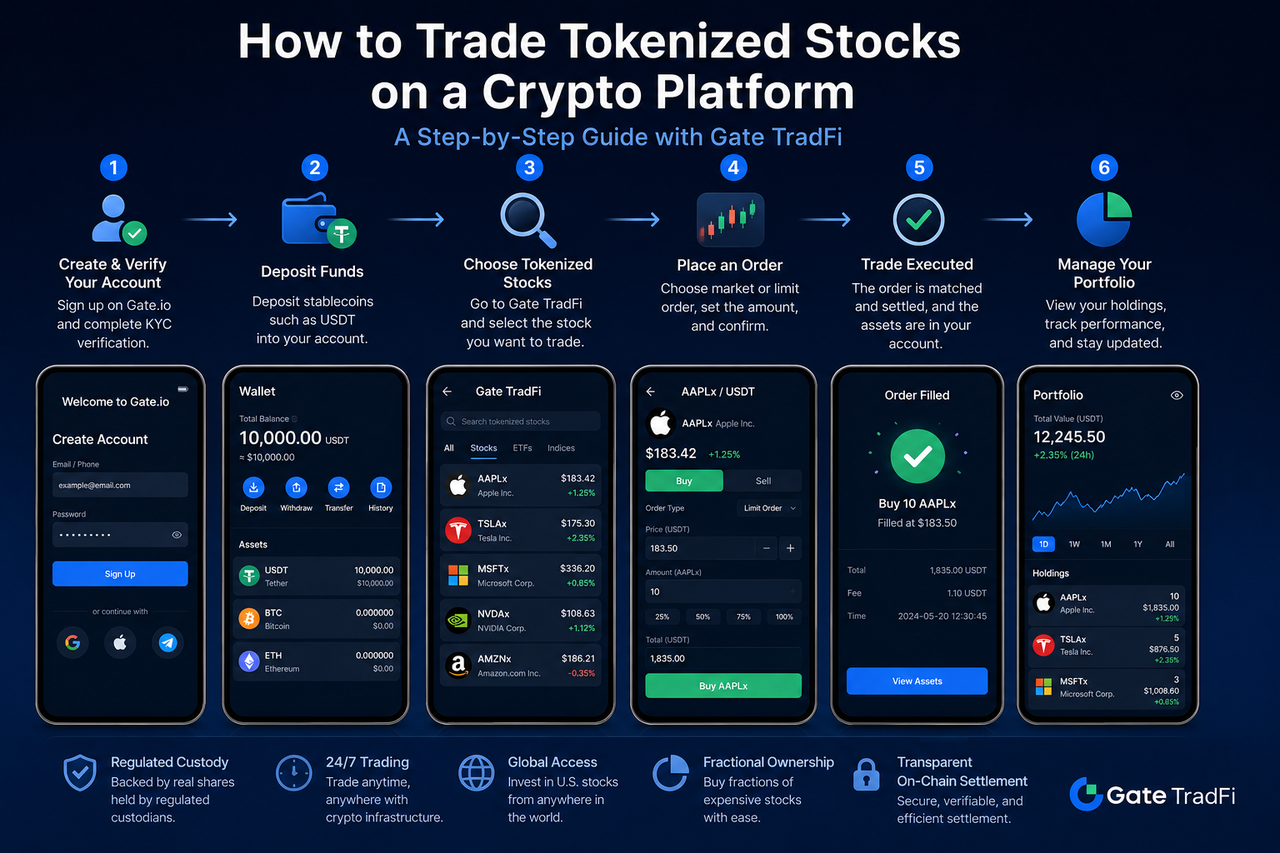
Before trading tokenized stocks, users must complete account verification and prepare funds. Most platforms that support tokenized stocks require users to go through the KYC (Know Your Customer) process to meet regulatory and compliance standards. Identity verification typically involves reviewing ID documents, conducting facial recognition, and confirming residency.
After verification, users need to fund their accounts. Unlike traditional securities markets that mainly settle in fiat currency, tokenized stock markets typically use stablecoins like USDT and USDC as the primary settlement assets. Once funds are in the trading account, they can be used to buy or sell stock tokens.
Different platforms may have varying rules regarding eligible regions, account levels, and trading permissions. Users should check the platform's requirements to ensure they meet the necessary conditions.
How to Choose Tokenized Stock Products?
The range of tokenized stocks varies by platform. Some platforms focus on stocks of major U.S. listed companies, such as Apple, Microsoft, Nvidia, and Tesla, while others expand to include ETFs, index products, or other real-world asset classes.
When selecting specific products, consider the asset backing method, issuer, settlement rules, and the rights structure available to investors. Products may differ in dividend distribution, redemption mechanisms, and how corporate actions are handled—all of which affect how closely the tokenized stock tracks the underlying asset.
How Are Tokenized Stock Orders Placed?
After selecting a trading target, users can enter the trading interface to submit buy or sell orders. The process is similar to traditional stock markets, with two main order types: market orders and limit orders.
Market orders are executed immediately at the best available price, making them ideal for fast execution. Limit orders allow users to set a specific buy or sell price, and the order will only execute when the market price reaches that level, giving users more control over pricing.
Once submitted, orders enter the platform's matching system. When buyer and seller prices and quantities match, the trade is completed, and the result is updated in the account's position page.
What Happens After a Tokenized Stock Trade Is Completed?
When a tokenized stock trade is executed, the buyer's account receives the corresponding number of stock tokens, and the seller's account receives the settlement funds. The platform updates both accounts' asset records and trade history.
Unlike traditional securities markets that rely on brokers, clearinghouses, and central securities depositories, digital asset platforms use on-chain or digital ledgers to record asset changes. This means position updates are reflected in user accounts much faster.
From the user's perspective, tokenized stock trading feels similar to trading digital assets, but the underlying assets represent real-world stock interests or price exposure.
How to View and Manage Positions?
After trading, tokenized stocks appear on the account's asset page. Users can view their current position quantity, market price changes, and historical trade records. Some platforms also offer tools like price alerts, asset analysis, and risk management features to help manage positions.
Because tokenized stocks are digital representations of securities, the management experience is closer to a crypto trading platform than a traditional brokerage account. Users can manage cryptocurrencies, stablecoins, and stock tokens all in one interface.
As platforms evolve, many now offer features like asset categorization, income tracking, and multi-market unified views to improve asset management efficiency.
How Are Dividends and Corporate Actions Reflected in Accounts?
Tokenized stocks do more than just track prices. When the underlying company pays dividends, splits its stock, merges, or delists, those changes must be reflected in the token system.
When the underlying company issues a cash dividend, the issuer distributes the corresponding returns to token holders according to the product's rules. This can be done via stablecoin payouts, account balance adjustments, or other mapping methods. The specific rules are outlined in the issuance documents or platform guidelines.
When a stock split occurs, the number of tokens is adjusted proportionally, while the total asset value remains unchanged. In cases of mergers, privatization, or delisting, the issuer will restructure the token and adjust investor rights based on changes in the underlying assets.
Gate TradFi vs. Traditional Broker: Trading Process Comparison
| Comparison Item |
Gate TradFi |
Traditional Broker |
| Account System |
Digital asset account |
Securities account |
| Fund Type |
Stablecoin |
Fiat currency |
| Deposit Method |
Digital asset transfer |
Bank transfer |
| Trading Platform |
Crypto platform |
Securities trading software |
| Asset Type |
Tokenized stock |
Traditional stock |
| Settlement System |
On-chain or digital settlement |
Central clearing system |
| Market Connection |
Digital asset ecosystem |
Traditional capital market |
| Technical Architecture |
Blockchain infrastructure |
Traditional financial infrastructure |
What Risks Should You Consider When Trading Tokenized Stocks?
Tokenized stocks improve global asset circulation efficiency, but they still come with risks. Regulatory frameworks differ across jurisdictions, and rules may evolve as the digital securities market develops.
Investors should also evaluate the reliability of the issuer and custodian. The ability of tokenized stocks to maintain a one-to-one link with real stocks depends heavily on the transparency of the custody and issuance mechanisms. Additionally, low market liquidity can widen bid-ask spreads, affecting the trading experience.
Platform operational risks, technical risks, and cross-border compliance risks are also important factors to monitor in the tokenized stock market.
Conclusion
Trading tokenized stocks through crypto platforms means participating in asset transactions tied to real stock values within the digital asset infrastructure. The full process typically includes account verification, fund preparation, target selection, order submission, trade matching, position management, and handling corporate actions.
Platforms like Gate TradFi are driving the convergence of traditional financial assets and blockchain networks. Tokenized stocks not only expand the range of assets in the digital market but also explore new ways to issue, circulate, and settle stock-like assets.
FAQs
Do I Need a Securities Account to Trade Tokenized Stocks?
Tokenized stock trading is usually done through digital asset platforms. Whether a traditional securities account is required depends on the platform's design and regulatory requirements. Most tokenized stock products allow users to trade using a digital asset account without needing a separate brokerage account.
What Currency Is Used for Settlement When Trading Stocks on Gate TradFi?
Platforms like Gate TradFi typically use stablecoins such as USDT as the primary settlement asset. Users manage funds, trade, and hold positions through their digital asset accounts.
Are Tokenized Stock Prices the Same as Real Stock Prices?
Tokenized stocks generally track the value of the underlying stocks, but short-term price differences may occur due to market supply and demand, liquidity, and platform mechanics. Therefore, token prices and underlying stock prices may not always be perfectly aligned.
Do Tokenized Stocks Support Fractional Investment?
Yes, most tokenized stocks support small transactions and fractional holdings. Investors can gain exposure to an asset without buying a full share, which is a key feature of tokenized stocks.
Are Tokenized Stock Trading Hours the Same as Traditional Stock Markets?
Some tokenized stock platforms support extended or even 24/7 trading. The specific trading hours depend on the platform's rules and the operating hours of the underlying asset market.
Are Tokenized Stocks Considered RWA Assets?
Yes, tokenized stocks are a key component of Real World Assets (RWA) tokenization. Their core feature is mapping traditional stock assets onto blockchain networks for digital circulation, enabling trading and settlement via on-chain infrastructure.