In the AI semiconductor supply chain, equipment makers typically lead the rally over chip designers—and this trend is especially pronounced in the current AI cycle.
When DRAM, HBM, and advanced logic processes all enter expansion phases simultaneously, wafer fab equipment demand gets amplified first, since any capacity increase requires upfront equipment investment. HPSP stands out as one of the clearest "high-barrier equipment beneficiaries" in this cycle.
Its core technology, high-pressure hydrogen annealing (HPA), is a back-end process that plays a decisive role in chip yield, making it irreplaceable in advanced manufacturing.
AI Chip Expansion Intensifies, Equipment Makers Emerge as First Beneficiaries
The global semiconductor industry is undergoing a structural shift: Growing AI chip demand isn't just fueling design innovation—it's directly driving up manufacturing capex.
Against the backdrop of surging HBM (High Bandwidth Memory) demand, Samsung Electronics and SK hynix are ramping up DRAM and HBM production-line investments. Under recent Korean policies and industry roadmaps, South Korea plans to significantly expand semiconductor investment over the next few years to cement its AI chip supply chain advantage.
The defining feature of this expansion cycle: equipment investment leads capacity output, and HPSP sits at one of the most sensitive nodes in the equipment chain.
HPSP's Core Technology: How High-Pressure Hydrogen Annealing (HPA) Boosts Yield
HPSP's flagship product is high-pressure hydrogen annealing (HPA) equipment, used for defect repair during wafer manufacturing.
In advanced processes, smaller crystal structures have lower defect tolerance. HPA technology repairs crystal defects in a high-pressure hydrogen environment, enhancing chip performance and yield—directly impacting final-chip stability and performance.
Technically, HPSP doesn't directly manufacture chips; it sits at a critical juncture that "determines manufacturing quality."
Thus, its equipment boasts two hallmarks: high technological barriers with steep replacement costs, and strong customer dependency through deep ties with leading fabs.
Why the Recent Surge: Equipment Cycle + HBM Investment Double Catalyst
HPSP's recent strong stock performance isn't driven by a single factor but by converging cycles.
- DRAM and HBM expansion cycles have kicked off, lifting equipment demand expectations.
- The market is reassessing its profitability, as the company has long maintained an exceptionally high gross margin (some reports show operating margins exceeding 50%).
- Capital is rotating from traditional chip companies to "equipment-first" plays, amplifying the volatility of small- to mid-cap equipment stocks.
On some trading days, the stock has even rallied near the daily limit, signaling it has entered a classic "expectation-driven phase."
Structural Shifts in Korea's Equipment Chain and Capital Repricing Logic
Korea's semiconductor industry is forming a clear structure: chip companies generate demand, equipment companies deliver capacity. In the AI cycle, this shift is stark—equipment makers often react ahead of chip companies. HPSP's equipment chain is "high-barrier + high-margin," and such assets typically see rapid valuation expansion during upcycles.
The market's core focus isn't "current earnings" but "equipment order visibility over the next two years."
Gate's Korean Stock Trading Opens the Door to HPSP
With Gate's launch of Korean stock trading, KOSDAQ semiconductor equipment assets like HPSP have entered a global unified trading system.
The system's key innovations:
- USDT as the unified pricing and settlement asset
- Integration of U.S., Hong Kong, and Korean stocks
- Lowered cross-market investment barriers
- Enhanced portfolio management efficiency
For investors, this means Korean equipment stocks are no longer just regional plays—they're now part of the global AI supply chain allocation.
Trading Path and Mechanism for Investing in HPSP on Gate
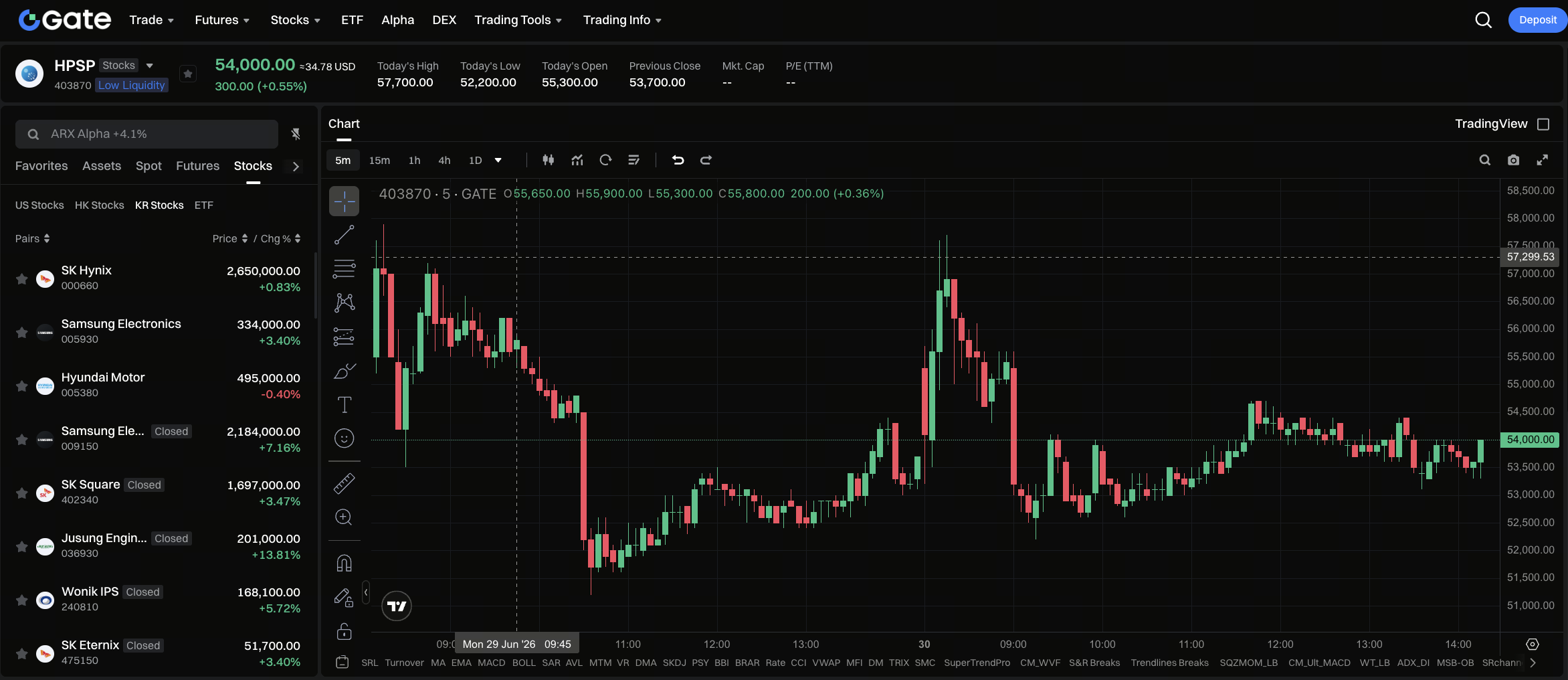
After registering and verifying identity, users transfer USDT to their stock account as trading capital. Then they enter Gate Korean Stock Trading and search for HPSP or code 403870 to access the trading interface.
Orders support both market and limit prices. Upon execution, positions are automatically folded into the unified asset system for cross-market management. This setup effectively lowers cross-border investment hurdles, making equipment-chain assets more accessible in a global allocation framework.
The Financial Structure of High-Margin Equipment Companies: Why the Market Pays Up
A standout feature of HPSP is its extremely high profit margin structure.
Financial data shows the company has long maintained high gross and net margins, thanks to its highly monopolistic, customized equipment. This gives it characteristics akin to "industrial software assets" rather than traditional manufacturing.
The market's pricing logic for such assets: order visibility + tech barrier + low competitive intensity = high valuation premium.
Risk Profile: Single Technology Route and Customer Concentration
Despite strong barriers, HPSP faces typical equipment-stock risks.
First, customer concentration is high, tied to the capex cycles of leading fabs. Second, its technology is focused on HPA—if future process paths shift, demand could be impacted.
Additionally, the equipment industry is inherently cyclical: if DRAM or HBM investment slows, order fluctuations will quickly hit the stock price.
Conclusion: The "Invisible High-Barrier Asset" Deep in AI Manufacturing
HPSP isn't a short-term theme; it represents a critical infrastructure node in the AI semiconductor manufacturing system.
As AI computing power expands, equipment makers are becoming the earliest beneficiaries, and high-barrier equipment firms are the core targets of capital revaluation.
By integrating Korean KOSDAQ equipment assets into a unified trading system, Gate is bringing these previously hard-to-reach industrial deep assets into the global investment spotlight.
FAQs
-
Q1: What does HPSP do?
It's a semiconductor equipment company whose core product is high-pressure hydrogen annealing (HPA) equipment.
-
Q2: Why is it affected by AI?
AI drives DRAM and HBM expansion, which increases equipment demand.
-
Q3: What are its core advantages?
High technological barriers and a very high gross margin structure.
-
Q4: Do I need a Korean broker to trade on Gate?
No. Korean stocks can be traded directly through the unified account.
-
Q5: Is it a growth stock or a cyclical stock?
It's a "strong-cycle + high-tech-barrier growth equipment asset."