South Korea is a global powerhouse for memory and logic chip manufacturing, where equipment vendors operate across a structured hierarchy of "front-end → packaging → back-end testing." The technology barriers, customer qualification cycles, and intensity of global competition vary significantly across these segments, making it unwise to treat Korean semiconductor equipment stocks as a homogeneous group.
From a cross-border securities standpoint, PSK (319660)—a KOSDAQ-listed front-end niche supplier—should be compared with other Korean firms based on process segment rather than the generic "Korean equipment stock" label.
Types of Korean Semiconductor Equipment Stocks
Korean semiconductor equipment stocks fall into three layers by process position: front-end wafer fab equipment (lithography, etching, deposition, cleaning, stripping, CMP), advanced packaging equipment (3D packaging, reflow, plasma pretreatment), and back-end/testing equipment (probe testing, high-temperature annealing, assembly). Global front-end main tracks are largely dominated by U.S., European, and Japanese leaders, with Korean vendors typically carving out competitiveness in specific niche processes.
| Sector Layer |
Typical Processes |
Representative Korean Sectors (Category Level) |
| Front-End Wafer Fab |
Etching, Deposition, Cleaning, Stripping |
Wonik IPS (Plasma/Etching), PSK (Dry Strip/Cleaning) |
| Advanced Packaging |
3D Packaging, Fluxless Reflow |
PSK (SEMIgear), Dedicated Packaging Equipment Vendors |
| Back-End/Testing |
Probe Testing, High-Temperature Annealing |
HPSP (High-Pressure Annealing), Testing Equipment Vendors |
The table above summarizes sector layering by process position. Korean equipment vendors rarely cover the full process chain; most specialize in a single or adjacent process node. Comparability between companies hinges on whether they operate at the same process node.
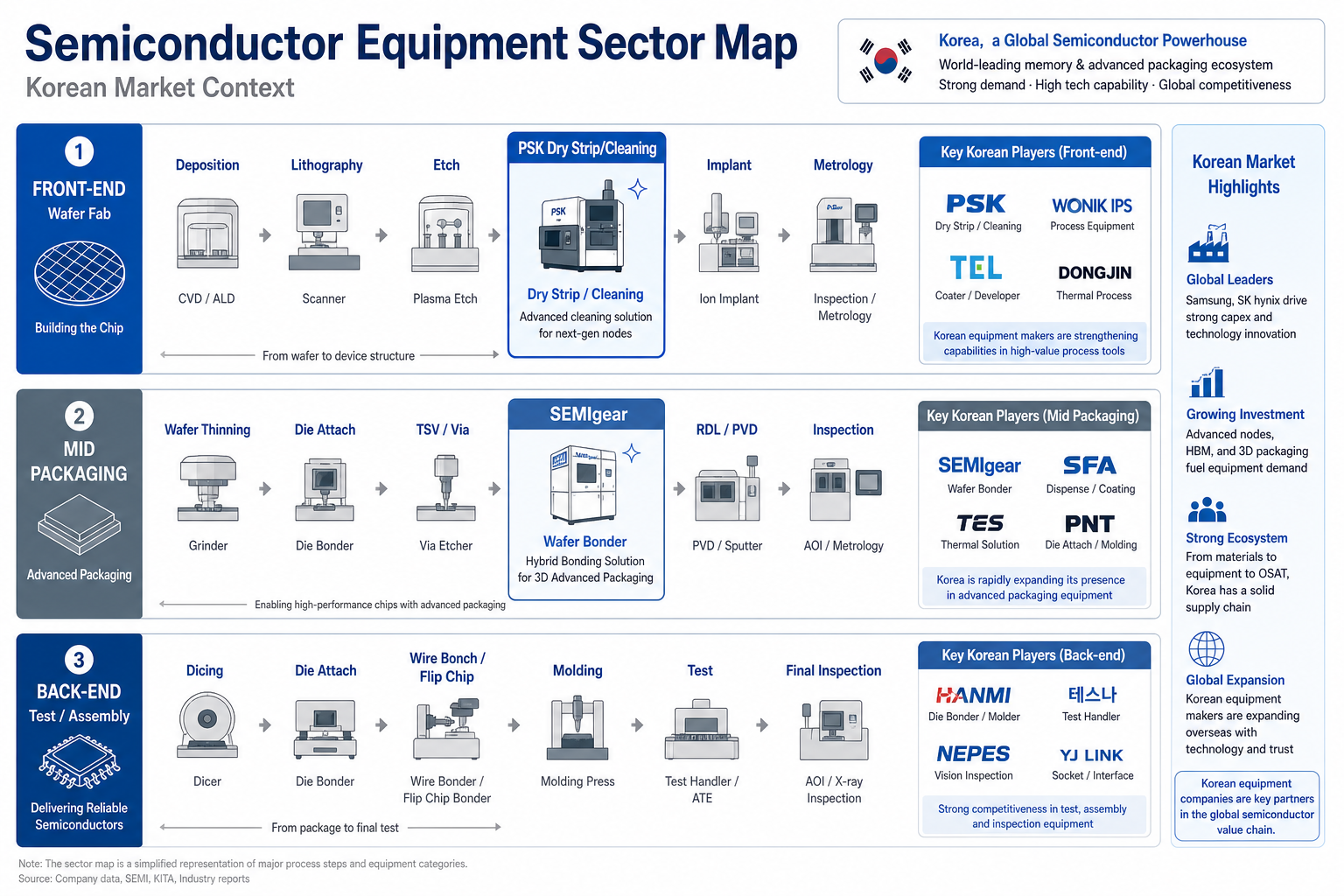 Figure 1. Korean semiconductor equipment sector map: PSK positioning in front-end dry strip/cleaning and SEMIgear advanced packaging.
PSK's Semiconductor Equipment and Dry Strip Product Line Breakdown
PSK's front-end focus is on the stripping and cleaning niche, rather than main tracks such as lithography, main etching, or deposition, which command higher CapEx shares. Core products include Dry Strip (flagship platform SUPRA), Dry Cleaning, New Hard Mask Strip, and Bevel Etch, performing stripping, cleaning, and edge defect control during wafer patterning.
The technical threshold for Dry Strip covers plasma uniformity, particle control, and multi-process compatibility. PSK has long served domestic and overseas wafer fabs, building strong brand equity in the Dry Strip track. All four product lines belong to the "stripping–cleaning–edge treatment" cluster, differing in process node from front-end vendors like Wonik IPS that focus on etching/deposition.
How PSK Differs from Equipment Vendors Like Wonik IPS and HPSP
Difference from Front-End Main Process Vendors (Wonik IPS, etc.): Wonik IPS focuses on main process equipment such as plasma etching and CVD/PVD, which typically require longer qualification cycles and higher per-unit value, with competition dominated by global giants. Although PSK is also front-end, it operates in the Dry Strip/Cleaning niche, with different equipment types and replacement cycles.
Difference from Back-End Vendors (HPSP, etc.): HPSP specializes in post-packaging high-pressure annealing (HPA), serving packaging houses. PSK's front-end equipment serves wafer fabs for patterning and cleaning, with different downstream customers and order drivers.
Difference from Packaging/Testing Equipment Vendors: Probe testing, die bonders, and other equipment vendors serve packaging and testing houses. While PSK's SEMIgear extends into 3D packaging (Fluxless Reflow, Descum), front-end Dry Strip remains its business foundation.
| Comparison Dimension |
PSK |
Front-End Main Process Vendors |
Back-End Vendors (HPSP, etc.) |
| Process Position |
Front-End Stripping/Cleaning + Packaging Extension |
Front-End Etching/Deposition |
Back-End Thermal Treatment |
| Core Processes |
Dry Strip, Dry Cleaning |
Plasma Etching, Thin Film Deposition |
High-Pressure Annealing |
| Typical Customers |
Wafer Fabs + Packaging Houses |
Wafer Fabs |
Packaging Houses |
The table above compares PSK with other sector companies across three dimensions: process position, process, and customers. PSK's uniqueness lies in its dual-track structure of "front-end stripping/cleaning specialization + SEMIgear packaging extension."
Why PSK's Listing Structure Is Unique Within the Sector
PSK Inc. was spun off from PSK Holdings in April 2019 and listed independently on KOSDAQ under 319660. After the spin-off, PSK Inc. independently operates front-end equipment and SEMIgear packaging, while PSK Holdings retains other group businesses. Most Korean equipment stocks are single-listed entities; PSK's listing structure requires investors to distinguish the business boundaries and disclosure documents of the two legal entities.
Quick Reference: PSK's Positioning in the Korean Equipment Sector
| Cognitive Question |
PSK Answer |
General Sector Situation |
| Which layer? |
Front-End Stripping/Cleaning + Packaging Extension |
Belongs to front-end/packaging/back-end layers |
| Core differentiating process? |
Dry Strip (SUPRA), SEMIgear |
Etching, Deposition, Annealing, Testing, etc. |
| Listing structure? |
Spin-off in 2019, KOSDAQ 319660 |
Mostly single-listed entities |
| Global competition benchmark? |
Applied Materials, LAM (Dry Strip niche) |
Varies by process category |
The table above provides a quick positioning framework for PSK within the sector. When researching 319660, first confirm whether the comparison target operates at the same process node, then evaluate the competitive landscape and cyclical sensitivity.
Limitations When Comparing with Korean Equipment Peers
Sector Comparison Limitations: Korean equipment companies have large process differences; simple horizontal comparisons easily overlook process position discrepancies. Public data granularity for PSK's Dry Strip niche is limited.
Competition Limitations: Both Dry Strip and packaging equipment face competition from global giants and local peers. As a KOSDAQ growth company, PSK's scale is typically smaller than global leaders.
Structural Limitations: The business boundaries between PSK Inc. and PSK Holdings after the spin-off require continuous tracking. Front-end revenue is highly correlated with the global wafer fab CapEx cycle.
Cognitive Limitations: 319660 refers to the KOSDAQ-listed shares of PSK Inc., not a cryptocurrency. Information should be based on official KRX disclosures and pskinc.com.
The above factors are structural descriptions and do not constitute investment advice.
Summary
PSK is positioned in the front-end Dry Strip/Cleaning niche within the Korean semiconductor equipment sector, with SEMIgear extending into 3D packaging. It has clear differences from front-end main process vendors like Wonik IPS and back-end thermal treatment vendors like HPSP in both process position and core processes. The spin-off and independent listing from PSK Holdings in 2019 constitute a structural feature of PSK. Understanding PSK requires first establishing a "front-end → packaging → back-end" layering framework, then comparing specific process nodes.
FAQ
Which category does PSK belong to in the Korean semiconductor equipment sector?
PSK is a front-end wafer fab equipment supplier specializing in the stripping and cleaning niche. Its core products are Dry Strip, Dry Cleaning, New Hard Mask Strip, and Bevel Etch, and it provides 3D packaging equipment via SEMIgear. PSK does not belong to the main tracks of lithography/main etching/deposition, nor to back-end thermal treatment or probe testing categories.
What is the difference between PSK and Wonik IPS?
Wonik IPS focuses on main process equipment like plasma etching and deposition, while PSK focuses on Dry Strip/Cleaning nodes. Both are front-end, but their process segments and competitors differ and should not be directly compared.
What is the difference between PSK and HPSP?
HPSP is a back-end equipment vendor specializing in post-packaging high-pressure annealing, serving packaging houses. PSK's front-end equipment serves wafer fabs for stripping and cleaning. Their process positions and downstream customer types are different.
Why is PSK's listing structure unique within the sector?
PSK Inc. was spun off from PSK Holdings in April 2019 and listed independently on KOSDAQ under 319660. Investors must distinguish the business boundaries and disclosure documents of the two legal entities: PSK Inc. and PSK Holdings.
How can a framework quickly position PSK's role in the sector?
First confirm the process layer (front-end/packaging/back-end), then confirm the process node (stripping/cleaning vs. etching/deposition vs. annealing/testing). PSK's coordinates are: "front-end stripping/cleaning specialization + SEMIgear packaging extension + 2019 spin-off listing."
What are common misconceptions when researching Korean equipment stocks?
Common misconceptions include: grouping PSK with etching/deposition leaders in the same competitive group; ignoring the legal entity distinction between PSK Inc. and PSK Holdings; substituting the "Korean equipment stock" label for fine-grained comparison at the process node level.