Because both ETFs employ a daily rebalancing mechanism, their return directions differ, as do their long-term performance, risk sources, and suitable market environments. For investors looking to participate in the semiconductor market, understanding the distinctions between the two is more important than simply predicting market movements.
What Are SOXL and SOXS?
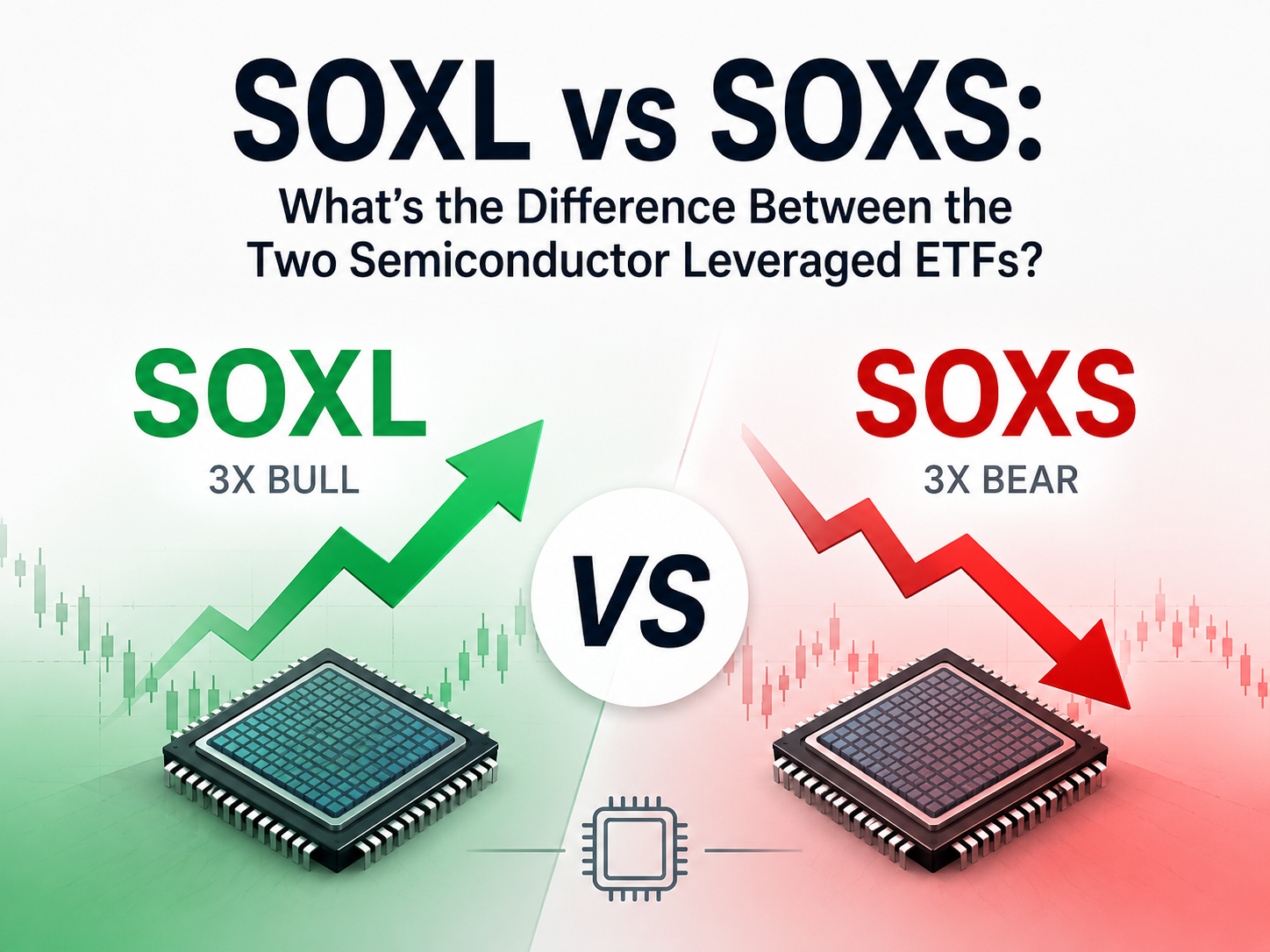
SOXL and SOXS are both daily 3x leveraged ETFs tracking the U.S. semiconductor industry index. Their primary difference lies in return direction: SOXL targets roughly three times the daily long return, while SOXS targets roughly three times the daily short return.
Although both are built around the semiconductor industry, they are not long-term investments. They are designed for short-term trend trading and risk management. The prospectus emphasizes daily return targets, not cumulative long-term performance.
For detailed information on the product structure, holdings, and basic principles of SOXL or SOXS, please refer to their respective dedicated pages.
| Product |
SOXL |
SOXS |
| Product Type |
Leveraged ETF |
Inverse Leveraged ETF |
| Investment Direction |
Approximately +3× daily |
Approximately -3× daily |
| Tracking Target |
U.S. Semiconductor Industry Index |
U.S. Semiconductor Industry Index |
| Primary Use |
Amplify upside returns |
Amplify downside returns |
Grasping this difference is essential for analyzing the leverage mechanism and risk-return profiles.
How Do the Leverage Mechanisms of SOXL and SOXS Differ?
The leverage implementation for SOXL and SOXS is nearly identical. Neither directly buys or sells short three times the number of semiconductor stocks. Instead, they use financial derivatives such as swap contracts and stock index futures to establish the desired risk exposure.
The fund manager rebalances the portfolio at the end of each trading day to maintain roughly three times leverage for the next day. Regardless of market fluctuations, the goal of both ETFs is to track the index's daily percentage change, not cumulative long-term returns.
The real difference is in risk direction. SOXL establishes a long exposure, suitable for a bullish outlook on semiconductors. SOXS establishes a short exposure, better for bearish scenarios or hedging existing positions.
Thus, the difference between SOXL and SOXS is not in the leverage mechanism itself, but in providing opposite market exposures within the same product framework.
| Comparison Dimension |
SOXL |
SOXS |
| Leverage Direction |
Long |
Short |
| Leverage Multiple |
Approximately +3× daily |
Approximately -3× daily |
| Leverage Implementation |
Swaps, futures, and other derivatives |
Swaps, futures, and other derivatives |
| Daily Rebalancing |
Yes |
Yes |
How Do the Risk-Return Characteristics Differ?
Both SOXL and SOXS are high-volatility products, so amplified returns come with amplified risks. The key difference is the market environment each relies on for gains.
SOXL works best when the semiconductor industry is in a sustained uptrend. For example, rising AI chip demand, increased data center investment, or improving industry profitability can drive strong short-term performance.
SOXS is better suited for correction phases—when risk appetite declines, valuations fall, or the macro environment weakens. It allows investors to profit from index declines and is often used for short-term hedging.
Importantly, both ETFs employ a daily leverage reset, so long-term returns are affected by compounding and volatility decay. Even if the market returns to its starting point, the NAV of both SOXL and SOXS could decline due to persistent volatility.
This means that returns depend not only on market direction but also on the path. The more continuous the trend, the better leveraged ETFs perform; the more frequent the volatility, the more significant the NAV erosion.
Which Market Environment Favors SOXL? Which Favors SOXS?
There is no absolute winner between SOXL and SOXS—they correspond to different market outlooks. The choice depends on the investor's expectation for the semiconductor industry, not on the product itself.
If the market is in a clear uptrend—e.g., AI infrastructure investment rising, semiconductor earnings improving, or the industry cycle on an upswing—SOXL can effectively amplify gains. In a continuous uptrend, daily compounding may further boost cumulative returns.
If the market is in a correction—e.g., overvaluation, earnings misses, rapid rate hikes, or declining risk appetite—SOXS is more suitable as a short-term trading tool. Beyond capturing inverse returns, some investors use SOXS to hedge existing semiconductor positions.
Regardless of choice, both ETFs are best used in trending markets. If the semiconductor sector moves sideways or oscillates frequently, both could suffer NAV erosion from daily rebalancing and volatility decay.
| Market Environment |
More Suitable for SOXL |
More Suitable for SOXS |
| Semiconductor industry sustained rally |
✓ |
|
| AI, data center, and other positive catalysts |
✓ |
|
| Semiconductor industry sustained pullback |
|
✓ |
| Declining risk appetite |
|
✓ |
| Hedging existing semiconductor holdings |
|
✓ |
| Long-term volatile market |
Not recommended |
Not recommended |
Thus, trend judgment is often more important than product selection. For leveraged ETFs, market sustainability determines the final trading outcome.
How to Choose Between SOXL and SOXS?
Choosing between SOXL and SOXS is essentially a choice of market direction, not a choice of higher returns. Both use the same leverage mechanism and are high-risk instruments, so neither consistently outperforms the other long-term.
If an investor expects the semiconductor industry to continue rising over the next few trading days, SOXL fits the need. If a pullback is anticipated, SOXS offers inverse return opportunities. For those already holding substantial semiconductor stocks, SOXS can serve as a temporary hedge.
Whichever ETF is used, it should be part of a clear trading plan covering holding period, take-profit and stop-loss levels, and position management. Because both reset leverage daily, long-term holding does not guarantee three times the return; compounding and volatility decay can cause significant deviations.
For investors seeking long-term exposure to the semiconductor industry, a regular semiconductor ETF is usually better as a core position. SOXL and SOXS are better used as short-term tactical tools for capturing trends or hedging portfolio risk.
Summary
SOXL and SOXS are both daily 3x leveraged ETFs based on the U.S. semiconductor industry index. They share the same structure and leverage mechanism but have opposite investment directions: SOXL amplifies upside, SOXS amplifies downside. Therefore, they suit different market expectations.
Both rely on daily rebalancing to maintain target leverage, so long-term returns may be affected by compounding and volatility decay. For investors, understanding the product mechanics, clarifying market trends, and selecting the appropriate tool based on their own trading goals is more important than simply pursuing higher leverage.
FAQ
What is the biggest difference between SOXL and SOXS?
SOXL targets roughly three times the daily long return of the semiconductor index, while SOXS targets roughly three times the daily short return. Their investment directions are completely opposite.
Are the leverage mechanisms of SOXL and SOXS the same?
Both use financial derivatives to establish roughly three times risk exposure and rebalance daily to maintain target leverage. The only difference is that one is long and the other is short.
Can SOXL and SOXS be held long-term?
Long-term holding is generally not recommended. Due to daily leverage resets and compounding effects, the long-term returns of both ETFs can deviate significantly from the index's cumulative performance. They are better suited as short-term trading tools.
Which has higher risk, SOXL or SOXS?
Both have the same three-times leverage structure and similar overall risk levels, but the risk is tied to opposite market directions.
How to choose between SOXL and SOXS?
If you expect the semiconductor industry to continue rising, consider SOXL. If you expect a pullback or want to hedge existing semiconductor holdings, SOXS is more appropriate.