As AI Agent, GameFi, and entertainment-focused Web3 products grow rapidly, more projects are exploring new models that blend "AI + social + on-chain interaction." The InfoFi direction represented by SUPERFORTUNE offers advantages in cultural narrative and virality, but it also faces challenges from its dual-token structure, user retention, competitive dynamics, and the lifecycle of entertainment products.
What Are SUPERFORTUNE's Core Risks?
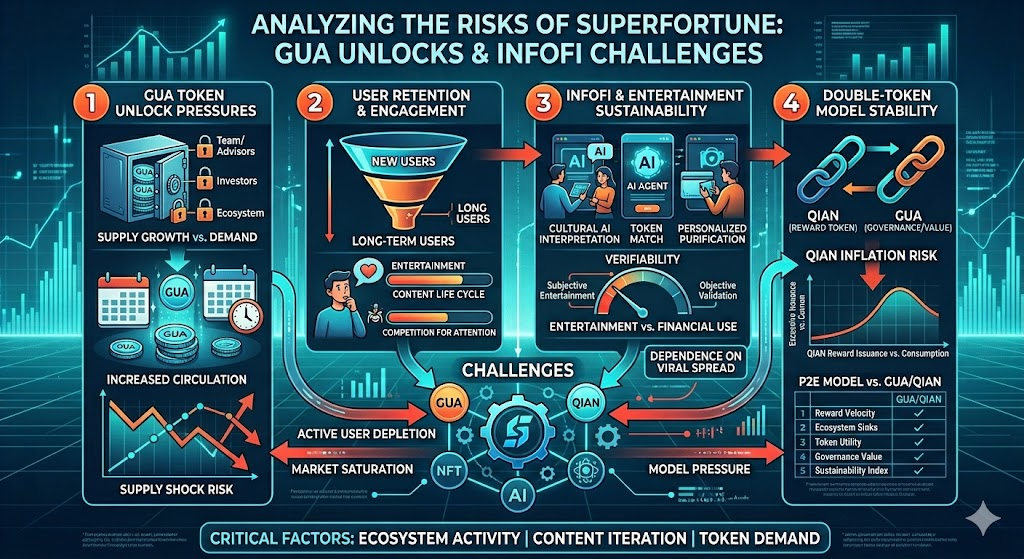
SUPERFORTUNE's primary risks typically revolve around its tokenomics, user activity levels, product sustainability, and competitive landscape.
Because SUPERFORTUNE leans heavily into AI-powered entertainment and interactive platforms, its ecosystem depends on active user engagement. If user activity declines, demand for NFT purchases, Fortune Reading, and social sharing on the platform may also drop.
At the same time, GUA, the ecosystem's core token, derives its long-term value from frequent use of platform features. If consumption scenarios within the ecosystem are insufficient, GUA's ability to hold value could be compromised.
AI entertainment products also tend to have short lifecycles. This means SUPERFORTUNE must continuously expand its interactive content and gameplay features.
Why Does the GUA Unlock Mechanism Impact the Ecosystem?
GUA is SUPERFORTUNE's core governance and ecosystem token, so its unlock schedule directly affects market circulation dynamics.
In many Web3 projects, tokens allocated to teams, investors, and ecosystem incentives are released gradually on a predetermined schedule. If the circulating supply grows faster than ecosystem demand, the token's supply-demand balance can shift.
SUPERFORTUNE's ecosystem value depends on functional consumption, NFT interactions, and user activity. If platform usage doesn't keep pace with new token supply, the added circulating tokens can strain the ecosystem.
While the dual-token structure helps reduce inflation from internal reward assets, GUA still relies on sustained ecosystem activity to maintain its utility.
Why Is User Retention Critical for InfoFi Projects?
InfoFi and AI entertainment projects depend on continuous user interaction rather than the rigid demand seen in traditional financial protocols.
Traditional DeFi protocols build stable demand around lending, trading, or yield tools. In contrast, entertainment platforms rely on user interest and social sharing. Without regular content updates, user activity cycles may be short.
SUPERFORTUNE's Fortune Reading, Token Match, and Wallet Qi Purification are all highly interactive features. They attract users quickly, but long-term retention requires ongoing community management and content iteration.
Web3 entertainment products commonly face the challenge of "fast initial adoption but difficult long-term retention," making user return rate a key indicator of ecosystem health.
Why Do AI Fortune-Telling and On-Chain Predictions Face Verifiability Challenges?
SUPERFORTUNE's core features are built on AI fortune-telling and on-chain behavior analysis, so their results are more about entertainment than traditional financial analysis.
AI fortune-telling systems combine cultural narratives, behavioral models, and algorithms to generate interactive content. However, these outputs lack the clear verification standards of traditional financial protocols. Users generally see them as fun experiences rather than objective prediction tools.
While on-chain prediction features reference wallet behavior and asset data, the results are still shaped by algorithm design and model logic.
This "entertainment-over-finance" nature is a key difference between InfoFi projects and traditional prediction markets.
Can the Dual-Token Model Solve GameFi Inflation?
SUPERFORTUNE uses a dual-token structure with GUA and QIAN, with a core goal of reducing the high inflation risk found in traditional Play-to-Earn (P2E) models.
Traditional GameFi projects often rely on a single reward token to sustain their ecosystem. When users earn rewards but have limited ways to spend them, token supply can increase rapidly.
SUPERFORTUNE separates platform rewards from ecosystem value: QIAN handles daily interaction loops, while GUA is used for governance and premium features. This design helps cushion the direct impact of reward assets on the core ecosystem token.
But the dual-token model isn't a silver bullet. If user growth stalls or consumption drops, the platform can still face declining activity.
| Comparison Dimension |
Traditional P2E Model |
SUPERFORTUNE Dual-Token Model |
| Reward Asset |
Single Token |
QIAN |
| Core Value Asset |
Same Token |
GUA |
| Inflation Pressure |
High |
Relatively Low |
| Ecosystem Stability |
Depends on New Users |
Depends on Interaction & Spending Loop |
What Competitive Pressures Does SUPERFORTUNE Face?
The AI entertainment and InfoFi space SUPERFORTUNE operates in is expanding fast, with competition coming from AI Agent, GameFi, and social finance projects.
AI Agent projects emphasize automated interaction and digital identities, while traditional prediction markets focus on trading real-world event probabilities. SUPERFORTUNE sits between an AI entertainment platform and on-chain social interaction.
At the same time, more Web3 projects are incorporating AI, NFTs, and social sharing features, making user attention a scarce resource.
In entertainment ecosystems, cultural narrative and community virality often determine user acquisition speed. SUPERFORTUNE's Eastern fortune-telling angle gives it a unique edge, but long-term competitiveness depends on content updates and ecosystem expansion.
How Does SUPERFORTUNE Try to Mitigate Ecosystem Risks?
SUPERFORTUNE uses its dual-token structure, NFT feature system, and interactive mechanics to boost ecosystem stability and user participation.
QIAN fuels the platform's internal interaction loop, while GUA is reserved for governance and premium consumption, reducing economic strain from a single reward asset.
Modules like Fortune Charm, Lucky Charm NFT, and Wallet Qi Purification are designed to encourage social sharing and user stickiness.
Meanwhile, SUPERFORTUNE differentiates itself with Eastern fortune-telling culture and AI-driven narratives to build recognition and community spread.
Summary
SUPERFORTUNE, a Web3 interactive platform combining AI fortune-telling, InfoFi, and on-chain entertainment, faces core challenges: GUA unlock pressure, user retention, dual-token model stability, and competition in the AI entertainment space.
Unlike traditional financial protocols, SUPERFORTUNE depends on social sharing, entertainment interaction, and user participation. So long-term ecosystem stability relies heavily on community activity.
The GUA-QIAN dual-token structure can somewhat ease the high inflation typical of traditional GameFi, but the ecosystem still needs ongoing interaction and content updates to stay viable.
FAQs
What is SUPERFORTUNE's biggest risk?
SUPERFORTUNE's main risks include GUA unlock pressure, user retention issues, declining ecosystem activity, and the short lifecycle of entertainment products.
Why does SUPERFORTUNE depend on user activity?
SUPERFORTUNE is an AI entertainment and InfoFi platform. Its core features are built on interaction, social sharing, and user participation, so user activity directly affects ecosystem health.
Can the dual-token model solve all economic problems?
The dual-token model can reduce the high inflation risk of traditional GameFi, but it cannot eliminate all ecosystem pressures. The platform still needs long-term user growth and consistent spending scenarios.
Why does the AI fortune-telling system have verifiability issues?
AI fortune-telling is entertainment-oriented. Its results rely on algorithm models and cultural narratives, lacking the unified verification standards of traditional financial predictions.