Stage 2 Output (Native Excellence & Cultural Adaptation)
Traditional brokerages have long served as the primary gateway for global investors to access U.S. securities markets. For decades, international investors followed a standard path: open an account with a securities broker, complete currency conversion, and connect to a stock exchange. As global capital markets evolved, traditional brokerages built mature systems for account management, trade execution, and asset custody.
In recent years, the digital asset industry has begun exploring bridges between crypto assets and traditional financial markets. New services like Gate Stocks let users invest in U.S. stocks and ETFs using USDT, managing both digital assets and securities on a single platform. This model represents a key direction for TradFi and Crypto Finance integration and has become an important real-world application in the context of Real World Assets (RWA).
Traditional brokerage platforms are licensed financial institutions that provide trading services for stocks, ETFs, bonds, and other securities.
Under the traditional model, investors typically need a separate securities account and use a bank account for deposits and withdrawals. International investors may also deal with cross-border remittances, foreign exchange conversion, and tax reporting.
Traditional brokerages are critical infrastructure in modern capital markets, acting as the link between investors and exchanges while providing order execution, asset custody, and account management.
Buying U.S. stocks on a crypto platform means a digital asset platform connects to securities market infrastructure to offer users U.S. stock and ETF trading.
With Gate Stocks, for example, users can open a stock account through their digital asset account and use USDT as a funding gateway to invest in U.S. securities. Stock and digital assets are managed together on one platform.
This model doesn’t change how the stock market works—it innovates in how users enter the market.
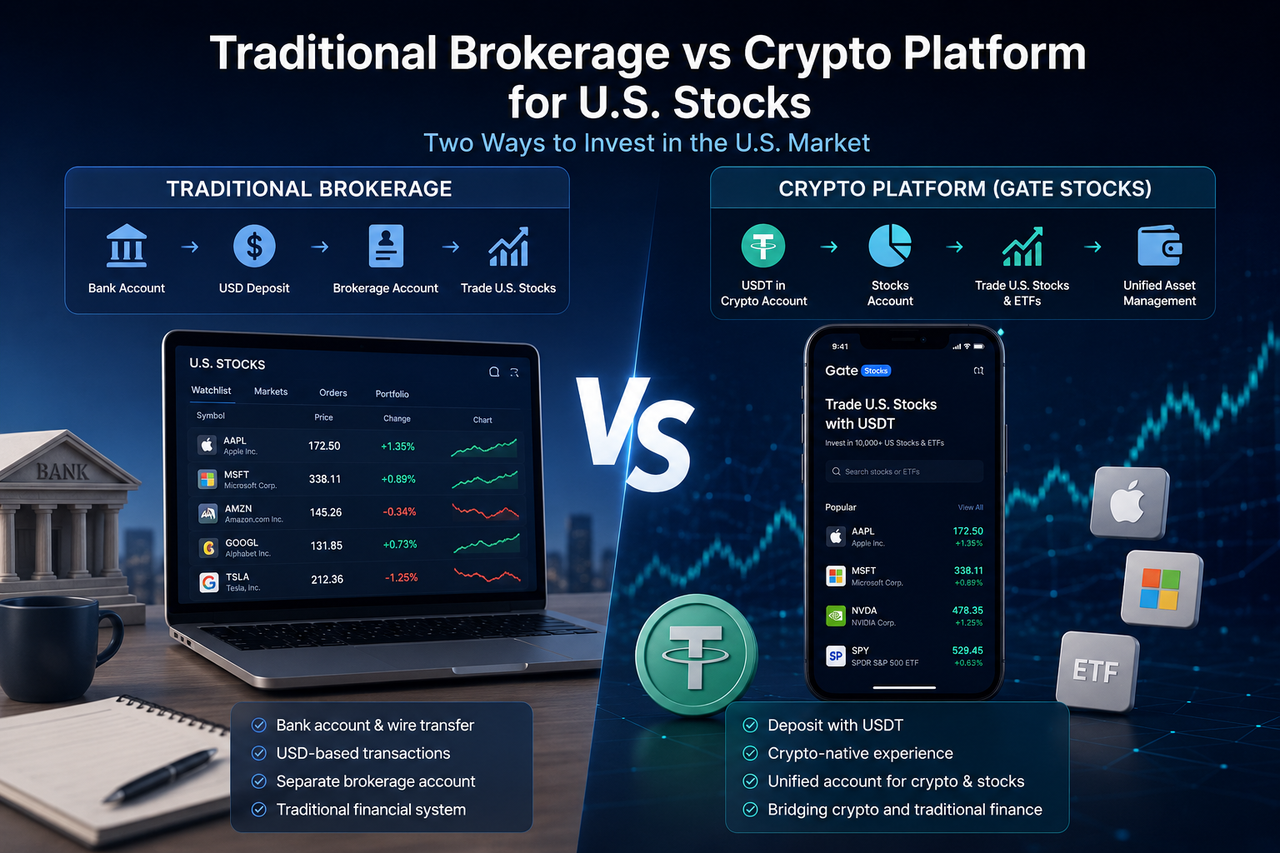
Traditional brokerages use a “bank account + securities account” structure. Investors must transfer funds from a bank account to a securities account before trading stocks.
Crypto platforms use a “digital asset account + stock account” structure. Users manage funds from their existing digital asset accounts and complete stock trading within the platform.
Both models require identity verification and compliance checks, but their account design logic differs significantly. Traditional brokerages are built around the fiat financial system, while crypto platforms are built on digital asset infrastructure.
Fund management is one of the most noticeable differences for users.
Traditional brokerages typically require deposits via bank transfer or wire transfer, with USD as the primary trading currency. International users often need to convert currencies before funds can enter the market.
Crypto platforms allow users to use digital assets like USDT as their funding tool. Transfers happen within the digital asset account system, eliminating the need for separate USD conversion.
This difference reflects that one model is rooted in the fiat system and the other in the digital asset ecosystem.
Are Trade Execution Mechanisms the Same?
Although access points differ, both models ultimately connect to the securities market to execute trades.
When investors place buy/sell orders, those orders go to the securities market for execution, matching, and execution under standard rules. Stock prices are still determined by supply and demand, and trading hours, liquidity, and pricing follow market norms.
Buying U.S. stocks on a crypto platform does not create a separate stock market—it simply connects to existing infrastructure.
How Asset Management Experiences Differ
With traditional brokerages, stock assets are typically held in separate platforms and accounts from digital assets.
Investors holding both stocks and crypto must manage securities and digital asset accounts separately, checking balances across different platforms.
Crypto platforms aim for a unified asset management experience. Users can see their stock, ETF, and digital asset holdings in one ecosystem and manage their overall allocation.
This unified approach is a key feature of digital asset platforms entering traditional finance.
How Supported Investment Products Differ
Traditional brokerages have long specialized in securities, offering a wide range of products: stocks, ETFs, bonds, funds, options, and other derivatives.
Crypto platforms often cover both digital assets and select traditional products. With Gate Stocks, users can invest in U.S. stocks and ETFs while also accessing the crypto market on the same platform.
Traditional brokerages emphasize securities market coverage; crypto platforms emphasize cross-asset integration.
How Risk Structures Differ
Both models face stock market price volatility.
But their risk sources differ. Traditional brokerage users may deal with exchange rate fluctuations, cross-border fund movements, and international settlement issues.
Crypto platform users face not only stock market risks but also digital asset volatility, stablecoin liquidity concerns, and changes in the crypto ecosystem.
Understanding these risk differences helps investors better assess each model.
| Dimension |
Traditional Brokerage |
Crypto Platform (Buying U.S. Stocks) |
| Funding Gateway |
Bank Account |
Digital Asset Account |
| Trading Currency |
USD |
Digital Assets (e.g., USDT) |
| Deposit Method |
Bank Transfer, Wire Transfer |
Digital Asset Transfer |
| Account Structure |
Securities Account |
Digital Asset + Stock Account |
| Asset Management |
Stocks Managed Separately |
Unified Management (Stocks + Crypto) |
| Product Scope |
Stocks, ETFs, Bonds, etc. |
Stocks, ETFs, Digital Assets, etc. |
| User Base |
Traditional Investors |
Digital Asset Users |
As the digital asset market matures, demand for diversified asset allocation grows.
At the same time, the push for Real World Assets (RWA) and TradFi-blockchain convergence is leading platforms to connect digital assets with securities markets.
Offering U.S. stock trading lets crypto platforms break down asset class boundaries, allowing users to manage a broader portfolio within a single account.
Summary
Both traditional brokerages and crypto platforms provide access to U.S. stock investing, but their underlying logic differs. Traditional brokerages are built on bank and securities accounts; crypto platforms use digital asset accounts as the funding gateway, integrating stock investing and digital asset management into one ecosystem.
In terms of trade execution, both connect to the securities market and follow its rules. In terms of user experience, the two differ significantly in account opening, fund management, and asset allocation.
FAQs
What’s the biggest difference between buying U.S. stocks through a traditional brokerage versus a crypto platform?
The biggest difference is the funding gateway and account system. Traditional brokerages rely on bank accounts and USD, while crypto platforms use digital asset accounts and digital assets like USDT as the entry point.
Is Gate Stocks a traditional brokerage?
Gate Stocks is not a traditional overseas brokerage; it's a digital asset platform that connects to the U.S. securities market for trading.
Does buying U.S. stocks with USDT mean I’m buying tokenized stocks?
No. Gate Stocks provides access to U.S. securities market trading. Tokenized stocks are blockchain-based digital representations of securities, and their underlying structures are different.
Do crypto platforms follow U.S. market trading rules when buying stocks?
Yes. Whether accessed via a traditional brokerage or a crypto platform, stock trades must follow the relevant market rules, trading hours, and pricing mechanisms.
Which is better for investing in U.S. stocks: a traditional brokerage or a crypto platform?
Both are different ways to access the market, and there’s no universal answer. Understanding the account structures, fund management approaches, and asset allocation features of each is more valuable than a simple comparison of better or worse.
Source (for reference only):
传统券商长期是全球投资者进入美国证券市场的主要渠道。通过证券经纪商开设账户、完成资金汇兑并接入证券交易所,是过去数十年国际投资者参与美股市场的标准路径。随着全球资本市场的发展,传统券商逐渐建立起成熟的账户管理、交易执行和资产托管体系。
近年来,数字资产行业开始探索加密资产与传统金融市场之间的连接方式。以 Gate Stocks 为代表的新型服务允许用户使用 USDT 投资美国股票和 ETF,在同一平台中管理数字资产与证券资产。这种模式代表了传统金融(TradFi)与加密金融(Crypto Finance)融合的重要方向,也成为现实世界资产(RWA)发展背景下的重要实践场景。
传统券商与加密货币平台定位差异
传统券商平台是获得证券业务资质的金融机构,为投资者提供股票、ETF、债券及其他证券产品的交易服务。
在传统模式下,投资者通常需要开设独立证券账户,并通过银行账户完成资金存取。对于国际投资者而言,还可能涉及跨境汇款、外汇兑换以及税务信息申报等流程。
传统券商构成了现代资本市场的重要基础设施,其核心功能是连接投资者与证券交易所,并提供订单执行、资产托管和账户管理服务。
加密平台买美股指的是数字资产平台通过接入证券市场基础设施,为用户提供美国股票和 ETF 交易服务。
以 Gate Stocks 为例,用户可以通过数字资产账户完成股票账户开通,并使用 USDT 作为资金入口参与美国证券市场投资。股票资产与数字资产能够在同一平台中进行统一管理。
这种模式并未改变股票市场本身的运作规则,而是在用户进入市场的方式上进行了创新。
传统券商与加密货币平台两种模式的账户体系有什么区别?
传统券商采用“银行账户 + 证券账户”的结构。投资者通常需要将资金从银行账户转入证券账户,再进行股票交易。
加密平台则采用“数字资产账户 + 股票账户”的结构。用户可以利用已有的数字资产账户管理资金,并在平台内部完成股票交易相关操作。
两种模式最终都需要完成身份认证和合规审核,但账户体系的设计逻辑存在明显差异。传统券商围绕法币金融体系构建,而加密平台则建立在数字资产基础设施之上。
传统券商与加密货币平台的资金管理方式有什么区别?
资金管理是两种模式最容易被用户感知的差异之一。
传统券商通常要求投资者通过银行转账或电汇方式入金,并以美元作为主要交易货币。对于国际用户而言,资金进入市场之前往往需要经过换汇流程。
加密平台则允许用户使用 USDT 等数字资产作为资金管理工具。资金划转通常在数字资产账户体系内完成,无需单独进行美元兑换。
这种差异反映了两种模式分别建立在法币金融体系与数字资产体系之上的特点。
传统券商与加密货币平台的交易执行机制是否相同?
虽然用户入口不同,但两种模式最终都需要连接证券市场完成交易。
当投资者提交买卖指令后,订单需要进入证券市场进行执行,并按照市场规则完成撮合与成交。股票价格仍然由市场供需关系决定,交易时间、流动性和报价机制也遵循相应市场规则。
因此,加密平台买美股并不意味着形成独立的股票市场,其本质仍然是连接现有证券市场基础设施。
传统券商与加密货币平台的资产管理体验有什么区别?
传统券商模式下,股票资产通常与数字资产分别保存在不同平台和账户之中。
如果投资者同时持有股票和加密货币,需要分别管理证券账户和数字资产账户,并在不同平台之间查看资产状况。
加密平台则尝试提供统一的资产管理体验。用户能够在同一生态内查看股票、ETF 和数字资产持仓,并进行整体资产配置管理。
这种统一管理模式是数字资产平台进入传统金融领域的重要特点之一。
传统券商与加密货币平台的支持的投资产品有什么区别?
传统券商长期深耕证券市场,产品体系通常较为丰富,覆盖股票、ETF、债券、基金、期权以及其他金融衍生品。
加密平台则往往同时覆盖数字资产与部分传统金融产品。以 Gate Stocks 为例,用户不仅能够投资美国股票和 ETF,还可以在同一平台接触数字资产市场。
从资产类别角度来看,传统券商强调证券市场覆盖能力,而加密平台则强调跨资产类别整合能力。
传统券商与加密货币平台的风险结构有什么区别?
传统券商与加密平台都面临股票市场本身的价格波动风险。
不过,两种模式的风险来源仍然存在差异。传统券商投资者可能面临汇率波动、跨境资金流动以及国际结算等问题。
加密平台用户除了股票市场风险外,还可能受到数字资产市场波动、稳定币流动性以及数字资产生态变化等因素影响。
理解不同风险来源,有助于更准确地认识两种投资模式的特点。
传统券商与加密平台买美股对比
| 对比维度 |
传统券商平台 |
加密平台买美股 |
| 资金入口 |
银行账户 |
数字资产账户 |
| 交易货币 |
美元 |
USDT等数字资产 |
| 入金方式 |
银行转账、电汇 |
数字资产划转 |
| 账户结构 |
证券账户体系 |
数字资产账户+股票账户 |
| 资产管理 |
股票资产独立管理 |
股票与数字资产统一管理 |
| 产品范围 |
股票、ETF、债券等 |
股票、ETF、数字资产等 |
| 用户基础 |
传统投资者 |
数字资产用户 |
为什么加密平台开始提供美股交易?
随着数字资产市场逐渐成熟,用户对于多元化资产配置的需求不断增加。
与此同时,现实世界资产(RWA)和传统金融与区块链融合的发展趋势,推动越来越多平台探索数字资产与证券市场之间的连接方式。
加密平台提供美股交易服务,本质上是为了打通不同资产类别之间的边界,使用户能够在统一账户体系中管理更广泛的投资组合。
总结
传统券商平台和加密平台都能够提供美国股票投资渠道,但两者的底层逻辑存在明显差异。传统券商建立在银行账户和证券账户体系之上,而加密平台则以数字资产账户作为资金入口,将股票投资与数字资产管理整合到同一生态中。
从交易执行角度来看,两种模式最终都需要连接证券市场并遵循相应市场规则;从用户体验角度来看,两者在开户流程、资金管理和资产配置方式上存在显著区别。
FAQs
传统券商和加密平台买美股最大的区别是什么?
最大的区别在于资金入口和账户体系。传统券商主要依赖银行账户和美元体系,而加密平台则以数字资产账户和 USDT 等数字资产作为资金入口。
Gate Stocks 属于传统券商吗?
Gate Stocks 不属于传统意义上的海外券商模式,而是数字资产平台连接美国证券市场的一种新型交易服务。
使用 USDT 买美股是否等于购买代币化股票?
不等于。Gate Stocks 提供的是美国证券市场交易接入,而代币化股票则是区块链上的数字化证券映射,两者的底层结构不同。
加密平台买美股是否遵循美国市场交易规则?
是。无论通过传统券商还是加密平台接入,股票交易都需要遵循相关市场规则、交易时间和报价机制。
传统券商和加密平台哪一种更适合投资美股?
两者属于不同的市场接入方式,并不存在统一适用于所有用户的答案。理解两种模式的账户结构、资金管理方式和资产配置特点,比简单比较优劣更有参考价值。







