As artificial intelligence develops rapidly, AI systems have gradually evolved from simple text generation tools into intelligent agents capable of executing tasks autonomously. In particular, as large language models, or LLMs, automation workflows, and blockchain technology continue to converge, AI Agent is becoming one of the key development directions in the AI industry.
At the same time, the growth of Web3 and multichain ecosystems has also increased the demand for on-chain automation. Scenarios such as DAOs, DeFi, and the Agent Economy require more efficient forms of governance and collaboration, and AI Agents are seen as capable of playing an important role in information analysis, on-chain execution, and automated decision making.
The emergence of AI Agents means AI is no longer limited to “answering questions” or “generating content.” Instead, it can actively perceive its environment, analyze objectives, and complete complex tasks. In the blockchain industry, AI Agents are gradually becoming one of the important infrastructure layers for automated governance, intelligent collaboration, and on-chain operations.
What Is an AI Agent?
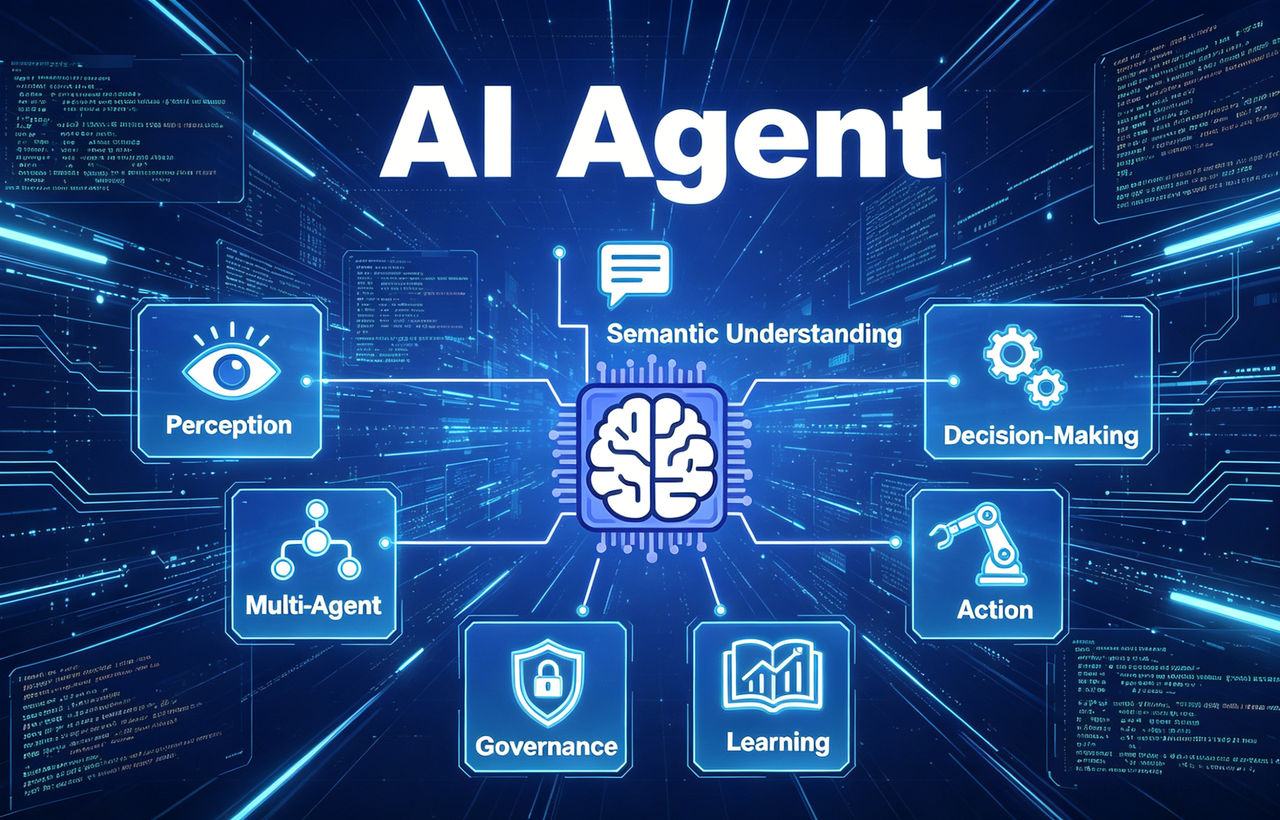
An AI Agent is an artificial intelligence system that can autonomously perceive its environment, analyze information, and execute tasks. Compared with traditional AI tools, the defining feature of an AI Agent is autonomy. It can not only process information provided by users, but also plan around a goal, call tools, and complete continuous tasks.
For example, an ordinary chatbot can only answer questions, while an AI Agent can automatically perform searches, analyze data, execute trades, or coordinate tasks based on the user’s objective.
In Web3 scenarios, AI Agents can also connect to on-chain protocols, wallets, and smart contracts, allowing them to participate in DAO governance, automated execution, and on-chain collaboration workflows.
How Does an AI Agent Work?
The operation of an AI Agent usually includes several stages: perception, analysis, planning, execution, and feedback.
First, an AI Agent receives information from users, systems, or the external environment. This may include on-chain data, governance proposals, or market information.
The AI model then analyzes this information and creates an execution plan based on predefined goals.
During the execution stage, an AI Agent can call APIs, smart contracts, databases, or other tools to complete specific tasks. For example, it may automatically generate a governance summary, execute an on-chain transaction, or synchronize cross chain data.
After completing a task, the AI Agent can also use the results as feedback to improve future task efficiency.
Traditional AI tools are usually based on passive responses, while AI Agents place greater emphasis on autonomous execution.
Ordinary AI tools usually complete a single task, such as text generation or image generation. By contrast, AI Agents can complete multiple steps in sequence and dynamically adjust their workflow as conditions change.
The biggest difference between the two lies in how tasks are executed and the degree of automation involved.
| Dimension |
Traditional AI Tools |
AI Agent |
| Work Mode |
Passive response |
Active execution |
| Task Capability |
Single task |
Continuous tasks |
| Tool Calling |
Limited |
Can call external systems |
| Autonomous Planning |
Relatively weak |
Relatively strong |
| on-chain Interaction |
Usually not supported |
Can connect to smart contracts |
What Are the Web3 Use Cases for AI Agents?
As AI and blockchain continue to converge, the use cases for AI Agents in Web3 are increasing.
In DAO Governance, AI Agents can be used for governance proposal analysis, community information organization, and automated execution.
In DeFi, AI Agents can assist with on-chain data analysis, yield strategy management, and automated trading.
For multichain ecosystems, AI Agents can also be used for cross chain data synchronization, protocol coordination, and automated operations.
In addition, across areas such as RWA, GameFi, and SocialFi, AI Agents are beginning to take on tasks such as content generation, user collaboration, and on-chain interaction.
What Is the Agent Economy?
The Agent Economy refers to a digital economic system in which large numbers of AI Agents participate in collaboration, transactions, and task execution.
In this system, AI Agents are no longer just tools. They become “digital participants” capable of completing tasks and exchanging value autonomously.
For example, one AI Agent may be responsible for on-chain analysis, while another handles trade execution or coordinates a governance process. These Agents can collaborate through smart contracts and on-chain rules.
As Web3 and AI Infrastructure continue to develop, the Agent Economy is seen as a potential key component of the future automated internet.
How Can AI Agents Participate in DAO Governance?
DAO Governance is one of the important application directions for AI Agents in Web3.
Traditional DAO governance usually requires community members to manually read proposals, analyze risks, and execute on-chain operations, which can reduce governance efficiency.
AI Agents can help generate proposal summaries, conduct risk analysis, and support automated execution. For example, a Proposal Agent can automatically organize governance content, while an Execution Agent can complete on-chain operations after a proposal is approved.
This model can help improve governance efficiency and reduce the cost of manual coordination in multichain environments.
Why Do AI Agents Need a Policy Engine?
As AI Agents become capable of performing more on-chain operations, permission management becomes increasingly important.
Without rule based constraints, AI Agents may perform actions beyond their authorized scope, creating governance risks.
The role of a Policy Engine is to set clear execution boundaries for AI Agents. For example, a DAO can limit the amount of funds that may be moved, the time window for operations, or the conditions required for execution.
This mechanism helps improve the controllability and governance security of AI Agents.
What Challenges Do AI Agents Face?
Although AI Agents are seen as an important direction for the integration of AI and Web3, they still face several challenges.
First, the trustworthiness of AI Agent decision making needs long term validation. If an AI model produces biased outputs, it may affect analysis results and execution logic.
Second, automated execution involves permission and security issues. In an on-chain environment in particular, incorrect execution may create asset risks.
In addition, rule coordination, data consistency, and execution verification in multi Agent collaboration are issues the Agent Economy still needs to keep improving.
What Is the Relationship Between AI Agents and AI Governance?
AI Governance refers to a governance system that uses AI technology to optimize on-chain governance and automated collaboration.
AI Agents are one of the core execution entities in AI Governance. Their main role is to analyze information, assist decision making, and carry out automated workflows.
For example, in an AI Governance Layer, AI Agents can handle governance proposal analysis, risk monitoring, and cross chain execution, while the Policy Engine defines the limits of their permissions.
Therefore, AI Agents are not only automation tools, but also an important part of future intelligent on-chain collaboration.
Conclusion
An AI Agent is an artificial intelligence system capable of autonomously perceiving, analyzing, and executing tasks. Its application scope has expanded from traditional AI tools into Web3, DAOs, the Agent Economy, and other fields.
As AI Infrastructure and blockchain ecosystems continue to develop, AI Agents are playing a growing role in on-chain governance, automated execution, and cross chain collaboration. Their core value lies not only in improving efficiency, but also in pushing on-chain systems toward greater intelligence and automation.
In the future, AI Agents may gradually become important infrastructure for the Web3 automation ecosystem, while the Agent Economy and AI Governance may also become major development directions in the blockchain industry.
FAQs
Ordinary AI tools usually complete only a single task, while AI Agents can plan autonomously and execute multiple tasks in sequence.
Can AI Agents Participate in on-chain Operations?
After connecting to smart contracts and wallet systems, AI Agents can execute certain on-chain operations and automated workflows.
What Is the Agent Economy?
The Agent Economy is a digital economic system in which large numbers of AI Agents participate in collaboration, transactions, and automated execution.
How Can AI Agents Be Used in DAO Governance?
AI Agents can be used in governance workflows such as proposal analysis, risk identification, governance summary generation, and automated execution.
Do AI Agents Have Risks?
AI Agents may face risks related to permission management, model bias, and automated execution security. For that reason, they usually require rule engines and permission control mechanisms.