What Is Chainlink? A Full Breakdown of the Latest Price and Ecosystem Developments

Beginner
Quick Reads
Last Updated 2026-03-29 23:56:12
Reading Time: 1m
Beginning with the core principles of Chainlink and incorporating real-time price data alongside the latest ecosystem developments, this article delivers an in-depth analysis of Chainlink's technical strengths, market performance, and outlook for the future.

Chainlink Project Overview

Chainlink is a decentralized oracle network built on Ethereum, designed to bring real-world, off-chain data onto smart contracts. In essence, it serves as the “eyes and ears” of the blockchain ecosystem, supplying blockchains with real-time data feeds such as financial market prices, weather reports, and sports outcomes.

Sergey Nazarov founded the project in 2017, and it officially launched its mainnet in 2019. LINK is the network’s native token, used for paying node operators, staking as collateral, and other functions.

LINK Token Price and Market Data
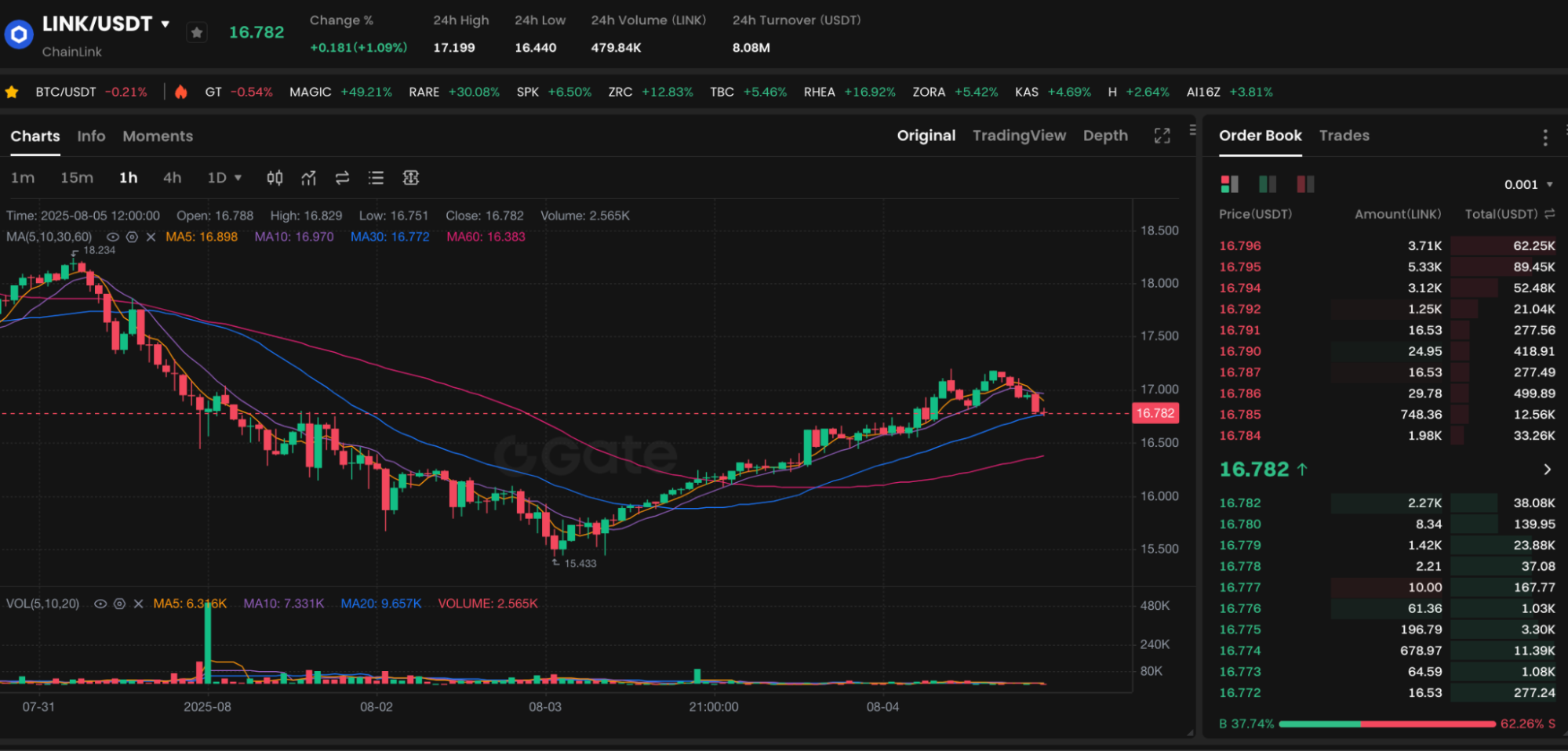

Chart: https://www.gate.com/trade/LINK_USDT

Based on Gate’s real-time market data, as of August 5, 2025, LINK/USDT is trading at 18.13 USDT, with a 24-hour gain of +0.42%.

Trading volume remains elevated, and market capitalization has surpassed $10 billion, firmly placing LINK as one of the top 15 cryptocurrencies globally. Since the start of 2025, LINK has rallied more than 35%. It has outperformed most other altcoins.

Latest Developments: Cross-Chain, Compliance, and Institutional Collaborations

1. JPMorgan integrates Chainlink: In July 2025, JPMorgan—one of the world’s largest investment banks—announced it is piloting Chainlink’s CCIP protocol to enable interoperability between blockchains and traditional financial networks. This marks a major endorsement of Web3 infrastructure by the legacy finance sector.

2. CCIP cross-chain protocol goes live: Chainlink’s Cross-Chain Interoperability Protocol (CCIP)—a core innovation—has launched on leading blockchains including Arbitrum, Polygon, and Avalanche, enabling seamless asset transfers and data synchronization across chains.

3. Compliance tools for institutions: Chainlink recently launched its “Automated Compliance Engine,” which helps institutions meet KYC and AML regulatory requirements. This tool is essential for deploying real-world assets (RWA) on-chain.

Chainlink’s Core Technical Advantages

  • Decentralized oracle network: eliminates single points of failure and prevents data tampering
  • Multi-chain compatibility: supports major networks such as Ethereum, BSC, Solana, and Optimism
  • CCIP cross-chain protocol: building an “on-chain SWIFT” for secure multi-chain data and asset communication
  • Extensive partnership ecosystem: including Aave, Synthetix, SWIFT, Google Cloud, and others

These advantages have driven Chainlink’s adoption across DeFi, insurance, gaming, data markets, and more.

Investment Recommendations and Risk Disclaimer

Short-term: LINK is currently fluctuating around $18. Consider positioning within the $17.20–$18.00 USDT range, with upside targets at $20.00–$22.00 USDT.

Medium to long term: If the crypto market as a whole enters a new bull phase, LINK could return to previous highs above $30.

Disclaimer:

  • The project faces competition from API3, Band, and similar protocols
  • A Bitcoin correction could result in a short-term dip in on-chain activity
  • Governance features for LINK have not yet been implemented, leaving room for additional value capture

Conclusion: Chainlink’s Growth Outlook

As demand for off-chain data rises across Web3, Chainlink is well positioned to expand its role as core infrastructure. Whether it’s powering price oracles, enabling cross-chain communication, or supporting real-world asset deployment, Chainlink continues to lead in innovation. For new investors, LINK represents a high-quality investment opportunity offering both strong utility and significant growth potential.

Author:  Max
Disclaimer
* The information is not intended to be and does not constitute financial advice or any other recommendation of any sort offered or endorsed by Gate.
* This article may not be reproduced, transmitted or copied without referencing Gate. Contravention is an infringement of Copyright Act and may be subject to legal action.

Related Articles

AI-Native Settlement Layers: How United Stables Is Building the Next Financial Rail
Beginner

AI-Native Settlement Layers: How United Stables Is Building the Next Financial Rail

Stablecoins were originally designed as dollar substitutes within exchanges, primarily used for asset pricing and trade settlement. As on-chain financial ecosystems have matured, their role has expanded beyond simple payments to include collateral assets, cross-chain liquidity mediums, and unified settlement units. In particular, as AI systems and automated agents begin to participate directly in economic activity, demand has risen sharply for programmable value units capable of instant settlement. This shift is pushing stablecoins toward the role of foundational financial infrastructure.
2026-03-25 03:16:17
The ve(3,3) Flywheel Explained: How AERO Tokenomics Powers Aerodrome’s DeFi Economy
Beginner

The ve(3,3) Flywheel Explained: How AERO Tokenomics Powers Aerodrome’s DeFi Economy

In the competition for DeFi liquidity, high-inflation mining alone is no longer enough to build lasting advantages. Aerodrome applies the ve(3,3) economic model to redesign token emissions, voting mechanisms, and revenue distribution, creating a liquidity flywheel centered on governance and cash flow. This article examines AERO tokenomics, the veAERO locking mechanism, and protocol revenue models to explain how Aerodrome builds a sustainable DeFi economic system.
2026-03-25 06:41:58
How Does PAXG Work? In-Depth Overview of the Physical Gold Tokenization Mechanism
Beginner

How Does PAXG Work? In-Depth Overview of the Physical Gold Tokenization Mechanism

PAXG (Pax Gold) is a tokenized asset backed by physical gold, issued by the fintech company Paxos and traded on the Ethereum blockchain as an ERC-20 token. The core concept is to tokenize physical gold on-chain, with each PAXG token representing ownership of a certain amount of gold. This structure enables investors to hold and trade gold in the form of a digital asset.
2026-03-24 19:12:51
Aerodrome Tokenomics: How ve(3,3) Powers Base's Most Profitable DEX
Beginner

Aerodrome Tokenomics: How ve(3,3) Powers Base's Most Profitable DEX

AERO is the native token of Aerodrome Finance, a core decentralized exchange and liquidity protocol in the Base ecosystem. It is primarily used for liquidity incentives and ecosystem operations. veAERO is a governance NFT that users receive by locking AERO, representing both voting power and the right to share protocol revenue. Through a dual track structure of AERO as a utility token and veAERO as a governance credential, Aerodrome separates liquidity usage value from long term governance power, allowing participants to act as liquidity providers, governance decision makers, and revenue sharers within the same system.
2026-03-25 06:40:31
How is the price of PAXG determined? Pegging mechanism, trading depth, and influencing factors
Beginner

How is the price of PAXG determined? Pegging mechanism, trading depth, and influencing factors

PAXG (Pax Gold) is a tokenized asset backed by physical gold reserves, launched by fintech firm Paxos and issued as an ERC-20 token on the Ethereum blockchain. The core concept is to digitally represent real-world gold assets, allowing investors to hold and trade gold via the blockchain network. Because each PAXG token corresponds to a specific quantity of physical gold, its price is theoretically expected to closely track the global gold market.
2026-03-24 19:11:40
Hybrid Collateral Stablecoins: Inside United Stables' Stability and Yield Architecture
Beginner

Hybrid Collateral Stablecoins: Inside United Stables' Stability and Yield Architecture

In the early stages of the crypto market, traditional stablecoins mainly relied on single-reserve or single-collateral models. Their primary focus was price stability and payment convenience, which allowed them to become foundational tools for on-chain trading and capital flows. As the market has entered a more mature financial phase, however, this structure has begun to reveal limitations, including high concentration risk and the difficulty of balancing liquidity with yield. These constraints have driven the evolution toward multi-layer collateral and portfolio-based designs, such as the dual-layer hybrid collateral architecture proposed by United Stables, which seeks to redefine the underlying logic of stable assets.
2026-03-25 03:17:39





