As decentralized finance has evolved, the on-chain trading landscape has grown from a single platform into a complex network of automated market makers (AMMs), decentralized exchanges, and liquidity pools. While this rich protocol ecosystem offers users more choices, it has also introduced a new challenge: liquidity is fragmented across different markets, making it difficult for users to quickly find the best available price.
Against this backdrop, liquidity aggregators have become a vital part of DeFi infrastructure. As a key product within the Folks Finance ecosystem, the Folks Router integrates multiple liquidity sources to automatically find better trading routes for users. It not only boosts trading efficiency but also plays a critical role in reducing slippage and improving capital utilization.

What Is the Core Positioning of Folks Router?
Folks Router serves as the trading routing layer within the Folks Finance ecosystem. If Folks Finance's lending market manages capital, then Folks Router optimizes asset exchanges.
When a user wants to execute a token swap, the system automatically connects to multiple liquidity sources, analyzes execution costs across different routes, and identifies the best option. Users no longer need to hop between platforms or manually compare prices—trades are completed through a single unified interface.
Unlike traditional trading platforms, Folks Router does not rely on any single liquidity pool. Instead, it connects multiple markets into one routing system. This design reduces trading complexity and ensures that liquidity across the entire ecosystem is used more effectively.
How Does Folks Router Find the Optimal Trading Route?
Optimal route calculation is one of Folks Router's most important features.
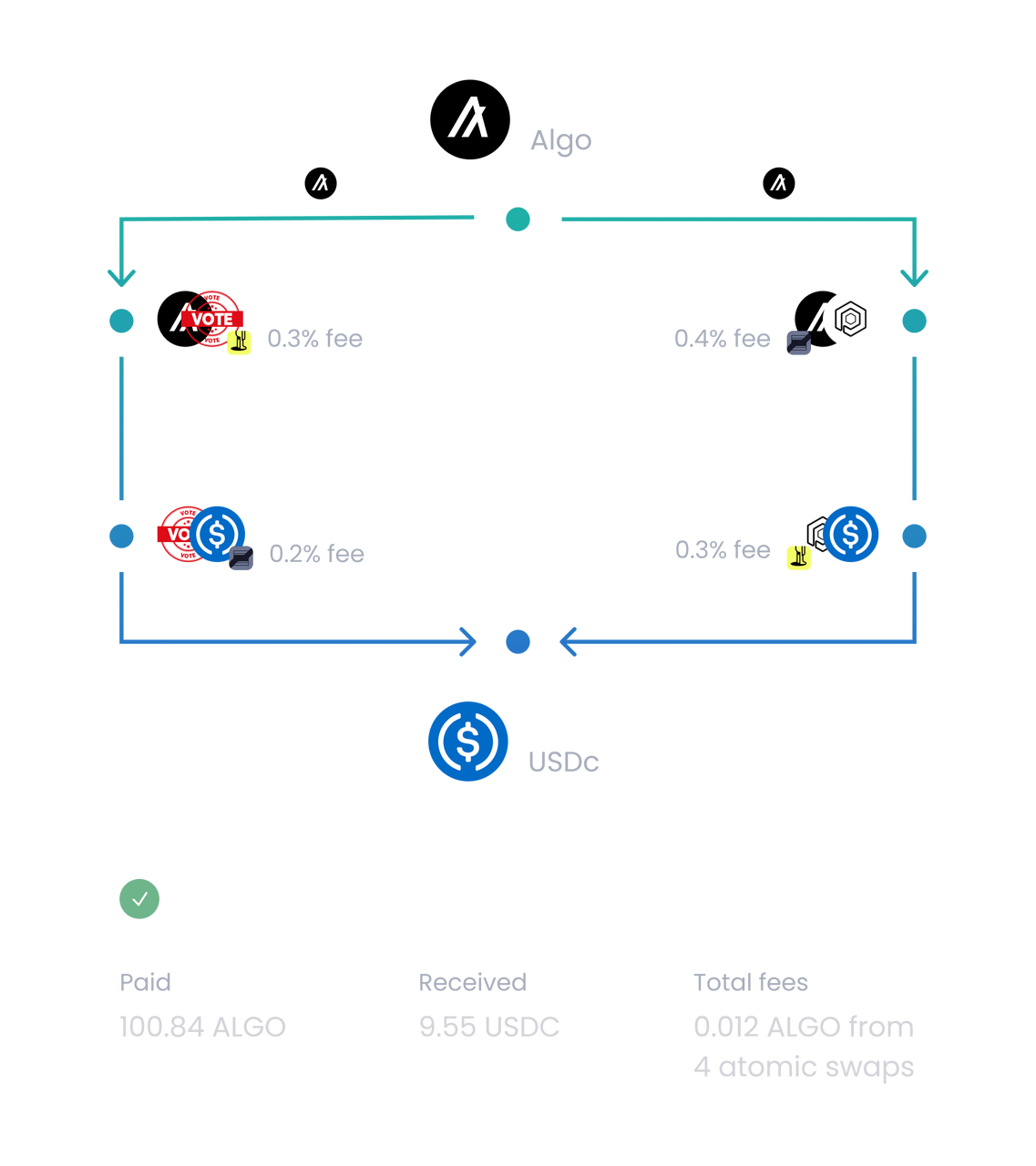
When a user submits a trade request, the system simultaneously analyzes multiple liquidity sources, including various decentralized exchanges, automated market maker pools, and other accessible trading venues. Beyond comparing asset prices, it also considers liquidity depth, trading fees, and potential slippage.
Take a user swapping USDC for ETH: the Router generates multiple possible trading paths and calculates the total cost of each. In some cases, a direct swap yields the best price; in others, routing through an intermediate asset actually lowers the overall cost.
For example, USDC could first be swapped to ALGO, then to ETH. While the route is longer, if the intermediate market has deeper liquidity, the final result may be better than a direct swap. The entire process is handled automatically by the algorithm—no manual intervention needed.
Why Are Orders Split for Execution?
In on-chain trading, a single route is not always the best option.
When a trade is large, routing the entire order through a single liquidity pool often causes price shifts and increases slippage costs. To mitigate this, Folks Router can automatically split the order across multiple markets.
For instance, a large trade might be executed simultaneously across several DEXs, with each market handling a portion of the order. This reduces the price impact on any single pool.
This multi-route execution fully leverages liquidity from different markets and improves overall execution quality. For users making large trades, order splitting typically results in more stable execution prices.
How Is Folks Router Different From a Traditional DEX?
Folks Router is often confused with a decentralized exchange, but they serve different purposes.
A traditional DEX operates its own liquidity pool, and users trade directly against that pool. Prices are determined internally, so the available liquidity is limited.
Folks Router, on the other hand, does not provide its own liquidity. Instead, it connects to multiple trading protocols. It acts like a smart navigation system, accessing multiple markets simultaneously and comparing different routes to find the best execution for users.
The key differences are:
| Dimension |
Folks Router |
Traditional DEX |
| Liquidity Source |
Aggregates multiple markets |
Single protocol market |
| Price Discovery |
Full-market comparison |
Internal protocol price |
| Routing Capability |
Automatically optimized routes |
Fixed trading path |
| Slippage Control |
Stronger |
Depends on single pool depth |
| Market Role |
Aggregation layer infrastructure |
Trading execution platform |
In short, Folks Router solves "where to trade more efficiently," while a traditional DEX solves "how to complete the trade."
How Does Folks Router Improve Capital Efficiency?
Capital efficiency is a key metric for evaluating DeFi infrastructure.
When liquidity is scattered across multiple protocols, some capital sits idle with low utilization. For users, this means higher trading costs; for liquidity providers, it means their capital isn't working as effectively as it could.
By aggregating liquidity from multiple markets, Folks Router enables these fragmented funds to collectively participate in price discovery and trade execution. Traders get better quotes, and liquidity providers' capital reaches a wider user base.
What Challenges Does Folks Router Face?
While liquidity aggregation significantly improves trading efficiency, it also comes with challenges.
First, on-chain prices change rapidly. The routing system must continuously fetch the latest quotes and update trading paths in real time—otherwise, the actual execution price may deviate from expectations.
Second, the MEV (Maximum Extractable Value) issue persists. Some trades may be affected by front-running and arbitrage, reducing the final execution outcome.
Third, as more protocols are integrated, the computational complexity of the routing algorithm keeps growing. Aggregators not only need to connect more liquidity sources but also need to constantly refine their algorithms and risk controls.
Summary
Folks Router is a liquidity aggregation protocol within the Folks Finance ecosystem. By connecting multiple decentralized exchanges and liquidity pools, it automatically finds the best trading route for users. Unlike traditional DEXs that rely on a single liquidity source, Folks Router integrates liquidity from multiple markets and optimizes trade execution through smart routing algorithms.
FAQs
How does Folks Router find the best price?
Folks Router simultaneously analyzes quotes, liquidity depth, fees, and slippage impact from multiple markets, then calculates the trading route with the lowest total cost for execution.
Why does Folks Router split orders?
When the trade size is large, the system may split the order across multiple liquidity sources to reduce price impact and lower slippage costs, thereby improving execution efficiency.
How is Folks Router different from a traditional DEX?
A traditional DEX provides its own liquidity pool, while Folks Router aggregates liquidity from multiple DEXs and uses smart routing to help users get better prices and higher execution efficiency.
What role does Folks Router play in the Folks Finance ecosystem?
Folks Router provides liquidity optimization for Folks Finance. Together with cross-chain lending and a unified liquidity market, it forms a core part of the ecosystem infrastructure, helping to improve capital efficiency across the entire multi-chain network.