As artificial intelligence models continue to scale, AI data centers are increasingly demanding high-speed data transmission, low-latency connections, and higher bandwidth networks. Optical communication technology is emerging as a vital element of AI infrastructure. Compared to traditional electronic interconnects, optical interconnects reduce transmission losses and enhance the efficiency of data exchanges between server clusters, positioning them as a key technology for expanding next-generation AI clusters.
Lumentum, with decades of expertise in lasers, optical components, and high-speed communications, is capitalizing on the growth in AI computing power, upgrades to 800G and 1.6T optical modules, and the global trend of expanding cloud networks. The company’s future growth is closely linked to investments in AI infrastructure, optical network upgrade cycles, and advances in photonic technology.
What Is Lumentum (LITE)? Company Overview and Evolution
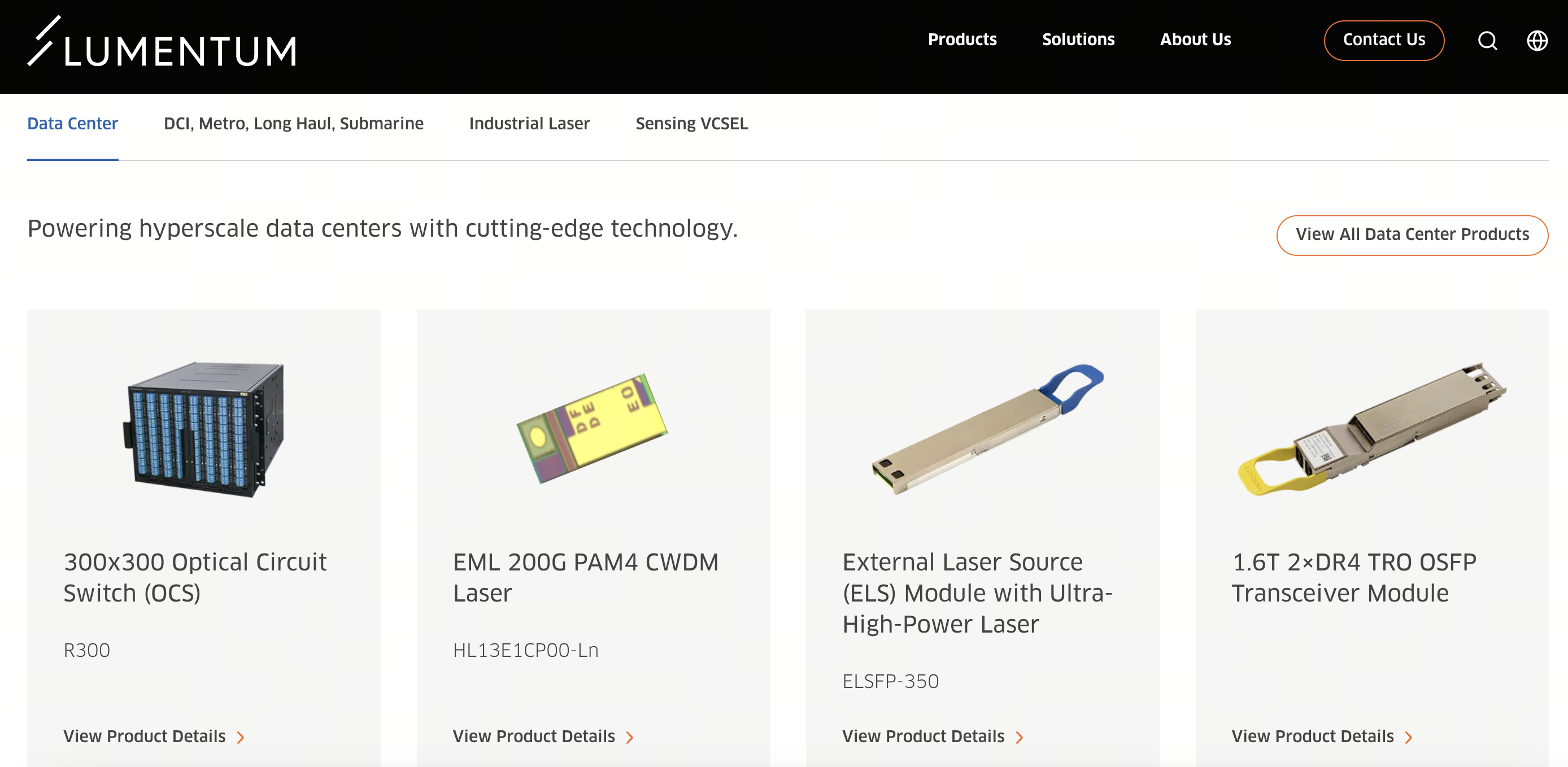
Lumentum (LITE) is a U.S.-based leader in optical communications and laser technology, delivering photonic solutions for data communications, telecom networks, industrial manufacturing, and advanced technology sectors. By developing high-performance lasers, optical components, and communications devices, Lumentum provides foundational technology to global data center operators, network equipment manufacturers, and industrial customers.
The company’s roots trace back to the evolution of optical communications. In 2015, Lumentum was spun off from JDS Uniphase and listed on Nasdaq under the ticker LITE. JDS Uniphase was a long-standing supplier in optical communications and optical components, playing a pivotal role in the global fiber optic industry. Lumentum inherited its expertise in optics, laser manufacturing, and communications devices.
Since its founding, Lumentum has built a business model centered on optical communications, while also expanding into laser applications. In recent years, the company’s business has been influenced by global communications infrastructure investment cycles. However, with rising demand for cloud computing, AI, and high-speed data transmission, the optical communications sector has entered a new era of rapid growth.
With the rise of generative AI, large-scale model training requires extensive GPU clusters working in unison, making GPU interconnect speed a critical factor for computational efficiency. Optical interconnect technology has drawn significant market attention, positioning Lumentum as an essential player in the AI infrastructure supply chain.
Lumentum’s Core Business Focus
Lumentum’s operations center on optical communications products, advanced lasers, and photonic technology, with optical communications representing a major revenue stream.
In optical communications, Lumentum offers optical transceiver modules, laser chips, modulators, amplifiers, and other optical devices. These products are not marketed directly to consumers but serve as fundamental components in data centers, telecom networks, and cloud computing infrastructure.
As data centers evolve to higher speeds, network devices must support larger data throughput. From early 100G and 400G optical modules to current upgrades of 800G and 1.6T optical interconnects driven by AI, the industry is undergoing rapid technological advancement.
Lumentum’s critical advantage lies in its laser technology. High-speed optical modules require stable, high-performance light sources, with lasers directly impacting signal transmission distance, power consumption, and network efficiency. High-quality laser suppliers are protected by significant technical barriers.
Beyond communications, Lumentum is active in industrial and consumer laser applications, such as manufacturing equipment, 3D sensing, and advanced optical systems. While these segments differ in scale, they broaden the company’s technical reach.
Lumentum’s long-term growth strategy is focused on three main areas:
- High-speed optical interconnect demand in AI data centers;
- Continued expansion of network infrastructure by global cloud providers;
- The extension of photonic technology into industrial and next-generation computing applications.
Why Are AI Data Centers Fueling Optical Communications Demand?
AI data centers are transforming traditional network architectures and driving growth in the optical communications sector.
Conventional data centers rely on internal server computing, while AI training tasks require thousands or tens of thousands of GPUs working collaboratively. This dramatically increases the volume of data transferred between nodes, making network speed a decisive factor for AI cluster performance. In large-scale AI model training, GPUs must constantly exchange parameters and data. If bandwidth is lacking, even powerful GPUs may see diminished efficiency due to slow data transfer.
AI infrastructure is evolving from pure computational upgrades to integrated improvements across computing, storage, and networking. Optical interconnects are pivotal in this transition. Compared to copper cables, optical communications offer longer transmission distances, higher bandwidth, lower electromagnetic interference, and reduced power consumption—making them ideal for massive AI clusters.
Major cloud providers—including Microsoft, Google, and Amazon—are investing heavily in AI data centers. These investments drive demand for GPUs, servers, storage, and also high-speed network equipment and optical components.
The rapid adoption of 800G optical modules showcases the pace of AI data center upgrades. As AI clusters scale further, 1.6T optical modules and more advanced interconnect technologies may become the next growth drivers.
For Lumentum, AI data center expansion translates to greater market opportunities for its core products. The company’s lasers and optical components are integral to the high-speed optical module supply chain.
How Do Optical Modules, Lasers, and Optical Devices Establish Core Competitiveness?
The optical communications supply chain includes upstream optical chips, midstream module manufacturing, and downstream network equipment.
Optical chips and lasers are highly technical and represent the highest value segments. Optical modules convert electrical signals to optical signals and back. Server-generated data is converted to optical signals, transmitted via fiber, and then reverted to electrical signals for processing.
Lasers produce high-speed, stable light sources and are the foundation of optical module performance. Lumentum’s competitive strengths include:
- Photonic R&D expertise. The sector requires deep knowledge in semiconductors, materials science, and precision manufacturing. Laser R&D must deliver both high performance and scalable production stability.
- High-end product portfolio. As AI data centers upgrade, demand is shifting to higher-speed modules. 800G and future 1.6T modules require advanced optical components, raising technical barriers.
- Customer and supply chain experience. Clients include major network equipment vendors, telecom operators, and cloud service providers. Long-term partnerships sustain market competitiveness.
The optical communications sector is cyclical. When cloud capital spending slows or telecom operators reduce investment, companies may face inventory adjustments and revenue volatility. Lumentum’s competitiveness depends not only on technology but also on its ability to capture new demand from AI-driven upgrades.
Lumentum’s Applications in AI, Cloud Computing, and Optical Networks
Lumentum’s products support enterprise infrastructure, providing value in foundational technology rather than end-user devices. In AI data centers, Lumentum’s optical communications solutions connect server clusters. As AI training scales, a single data center may need to link tens of thousands of GPU servers, requiring networks with higher bandwidth, lower latency, and reduced power consumption.
Traditional electrical connections face limitations in distance and power, while optical interconnects are becoming the solution for large AI clusters. Optical modules and components facilitate massive data transfers among GPU clusters, switches, and high-speed network equipment. Cloud providers are making long-term capital investments in network upgrades. Microsoft, Google, and Amazon are expanding AI infrastructure, driving demand for servers, chips, and high-speed networking.
Lumentum’s products are applied in:
- AI cluster connectivity: High-speed optical links improve data exchange among GPUs, reducing bottlenecks.
- Cloud data center interconnects: Distributed data centers require high-speed optical networks to connect resources across regions.
- Telecom network upgrades: 5G, future 6G, and edge computing all demand advanced fiber optic networks.
- Industrial laser applications: Lumentum’s laser solutions are used in manufacturing, inspection, automation, precision machining, and advanced manufacturing systems.
As AI expands from training to inference, demand for low-latency, high-efficiency infrastructure is likely to persist. Optical communications are increasingly critical to AI infrastructure.
Lumentum is one of several players in the AI optical communications supply chain. Coherent, Broadcom, and Marvell also target high-speed communications, optical modules, and data center infrastructure. Each has distinct technical and business focuses.
Lumentum: Photonic Devices and Laser Technology
Lumentum’s strengths are in photonics—lasers, optical components, and high-speed communications devices. Unlike broad semiconductor companies, Lumentum specializes in optical communications technology with deep expertise in lasers and optics. Its growth is fueled by AI-driven upgrades and the evolution of high-speed optical standards.
Coherent: Diversified Optical Communications and Laser Applications
Coherent Corp. is a global leader in optics, spanning communications, industrial lasers, and semiconductor manufacturing. Coherent’s broad product portfolio enables participation in the AI infrastructure supply chain. Compared to Lumentum, Coherent’s business is more diversified, with a greater focus on industrial lasers.
Broadcom Inc. is a major semiconductor provider, with AI infrastructure covering network chips, switching chips, ASICs, and connectivity technology. Broadcom’s platform capabilities offer integrated solutions for AI clusters, including optical communications and high-speed network architecture.
Marvell: Data Center Connectivity and Network Chips
Marvell Technology, Inc. focuses on data center semiconductors, network processors, storage connectivity, and high-speed communication chips. Marvell’s role is more chip-centric—high-speed interconnects, data processing, and custom semiconductors. Lumentum, by contrast, is a key supplier of optical communications hardware.
Broadcom and Marvell are closer to AI data center chip infrastructure, while Lumentum and Coherent focus on optical and photonic technology. As AI data centers grow more complex, the industry may pursue multiple technological paths.
Key Risks When Investing in LITE Stock
While AI infrastructure growth offers new opportunities for Lumentum, LITE stock investors should consider several risks:
Cyclical Nature of Optical Communications
The market is driven by capital expenditures. When cloud companies invest in data centers, demand for optical modules surges. But economic downturns or reduced infrastructure budgets can trigger inventory adjustments. Recent telecom investment slowdowns have pressured some optical communications firms, showing that industry demand is not linear.
AI Demand Growth and Market Expectations
AI infrastructure investment is driving high valuations. If AI data center construction lags or cloud spending drops, optical communications firms may face valuation pressures. Investors should focus on real order growth, not just industry trends.
Ongoing Competitive Pressure
The sector is highly competitive and requires sustained R&D. Companies like Coherent, Broadcom, Marvell, and Asian suppliers are all targeting high-speed optical communications. If competitors launch lower-cost or higher-performance solutions, Lumentum’s margins could be affected.
Supply Chain Risks
Optical communications involve semiconductors, precision manufacturing, and specialized materials. Global supply chain shifts, rising costs, or material shortages may impact production and delivery.
Tracking Lumentum (LITE) and Other AI Infrastructure via Gate Stock Trading
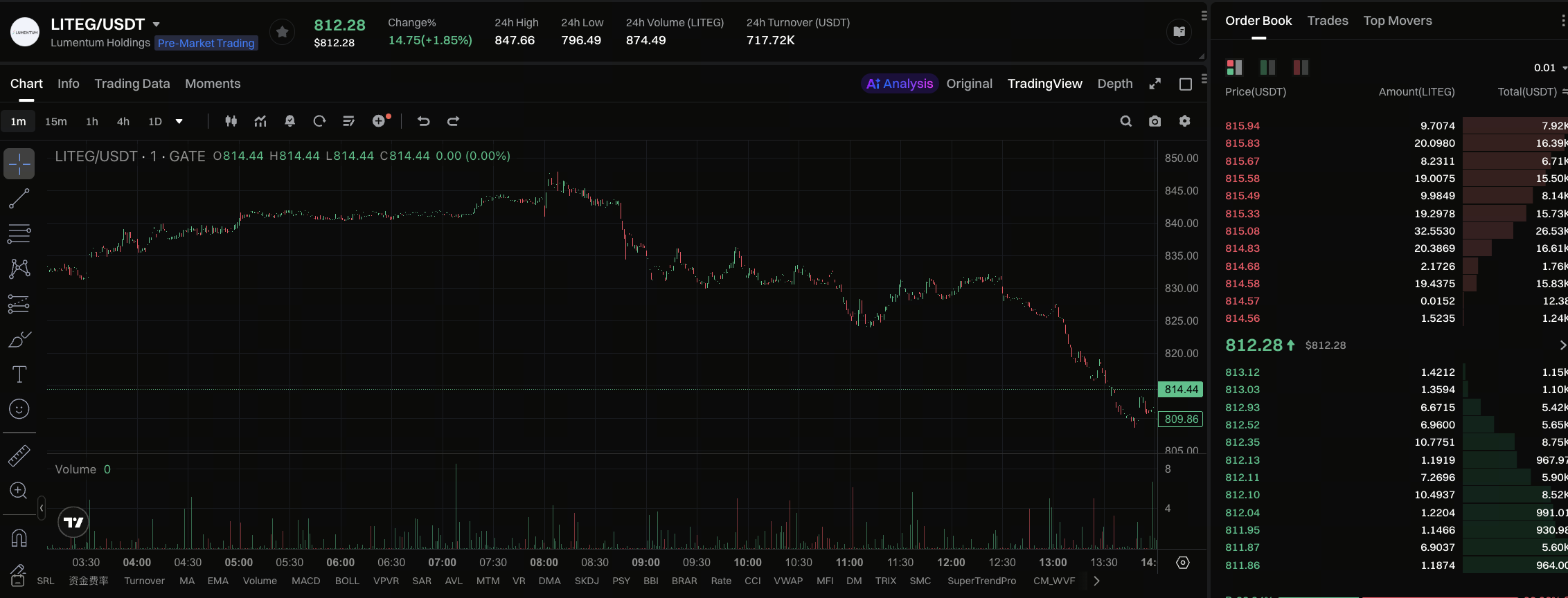
AI, semiconductors, and cloud computing are major investment themes in global markets. More investors are eyeing U.S. tech firms like Lumentum (LITE) for opportunities in the AI infrastructure boom.
Through Gate Stock Trading, users can invest in global equities using USDT, covering U.S. stocks, ETFs, and other asset classes, and manage both digital and traditional assets in a unified account. For investors focused on the AI industry chain, Lumentum’s optical communications segment is closely linked to AI infrastructure leaders like NVIDIA, Broadcom, and Marvell. AI data center expansion boosts demand for GPUs, high-speed networking, optical modules, storage, and power infrastructure. Investing in related companies allows investors to position for AI-era infrastructure upgrades from an industry chain perspective.
Gate Stock Trading supports multi-market asset allocation and flexible trading methods, enabling portfolio adjustments based on market trends. Stock prices are influenced by company performance, industry cycles, macroeconomics, and market sentiment. When tracking tech stocks like LITE, investors should assess fundamentals and their own risk tolerance.
Lumentum’s Future Directions and Long-Term Growth Potential
Long-term, Lumentum’s growth is driven by AI infrastructure, optical interconnect upgrades, and global network digitization.
AI data centers may be the biggest growth driver for optical communications in coming years. As AI model parameters and clusters expand, demand for data transmission will keep rising. Not only training, but also large-scale AI inference deployments will increase communication requirements.
Optical interconnect technology is advancing rapidly. The market is moving from 400G to 800G modules, and exploring 1.6T and faster solutions. Higher speeds require more advanced lasers, optical chips, and components.
If Lumentum maintains technological leadership during these upgrade cycles, it could gain additional market share.
The convergence of AI and photonics may create new applications. Future computing architectures may rely more on optical computing, silicon photonics, and advanced photonic systems. These trends could further enhance the value of optical communications firms.
However, Lumentum’s long-term outlook depends on several factors: its ability to secure AI data center orders, maintain high-speed optical device leadership, improve profitability, and mitigate industry cycles.
If AI infrastructure investment keeps rising, the optical communications supply chain may enter a new phase of expansion, with Lumentum as a key participant.
Summary
Lumentum (LITE) specializes in optical communications and photonic technology, with core products including lasers, optical components, and high-speed communications solutions. As AI data centers, cloud computing, and high-speed networks advance, optical interconnects are becoming essential to digital infrastructure.
The scaling of AI models drives GPU cluster growth, requiring higher-performance data transmission. 800G, 1.6T optical modules, and advanced optical communications technologies are critical for industry upgrades.
While Broadcom and Marvell focus on chips and network systems, Lumentum is dedicated to photonic devices and laser technology, supplying key components to the optical communications chain. Compared to Coherent, Lumentum is more concentrated in communications optics.
Lumentum’s future depends on growth in high-speed optical communications demand, innovation, and competitive dynamics. For investors interested in AI infrastructure, semiconductor supply chains, and next-generation networks, LITE stock represents a strategic investment in the long-term optical interconnect upgrade trend—but industry cycles, competition, and valuation risks must be considered.
What does Lumentum (LITE) do?
Lumentum (LITE) is a technology company specializing in optical communications and laser technology, providing lasers, optical components, and high-speed communications solutions for AI data centers, cloud computing, and telecom networks.
Why does AI development drive Lumentum’s growth?
AI data centers require extensive GPU collaboration, and high-speed data transmission is critical for computational efficiency. Optical interconnects deliver higher bandwidth and lower power consumption than traditional electrical connections, so AI infrastructure upgrades are fueling optical communications demand.
What is Lumentum’s core competitive advantage?
Lumentum’s strengths are rooted in years of photonic technology expertise, including high-speed laser R&D, optical device manufacturing, and supply chain experience in communications.
Broadcom and Marvell focus on AI chips, network chips, and data center systems, while Lumentum concentrates on optical communications devices and laser technology—making it a key player in optical interconnects for AI infrastructure.
What risks should investors consider with LITE stock?
LITE stock faces risks from industry cycles, changes in AI investment pace, competition, and supply chain challenges. Investors should monitor company performance, industry demand, and long-term technology trends.
Is Lumentum an AI concept stock?
Lumentum is not an AI software or chip provider, but is closely tied to AI infrastructure. Its optical communications products are essential for high-speed connections in AI data centers.