Vanguard S&P 500 Growth ETF (VOOG) is a U.S.-listed ETF stock traded in American markets, issued by Vanguard under the ticker VOOG. The product delivers passive exposure to growth-style constituents within the S&P 500, not a single company’s equity and not a crypto token.
Growth-style indexes slice large-cap constituents by growth-related factors so that one ETF stock can cover sectors that often carry higher growth weights, such as information technology and consumer discretionary. On platforms such as Gate Stocks, VOOG appears in stock form, which makes it possible to observe U.S. large-cap growth ETF exposure and stablecoin funding arrangements inside the same account framework.
From a digital-asset user’s perspective, VOOG is a standardized tool for a “U.S. large-cap growth slice”: first clarify the index boundary and replication method, then verify the legal name, ticker, and order fields on the Gate Stocks · VOOG page so that ETF structure research is not confused with order execution.
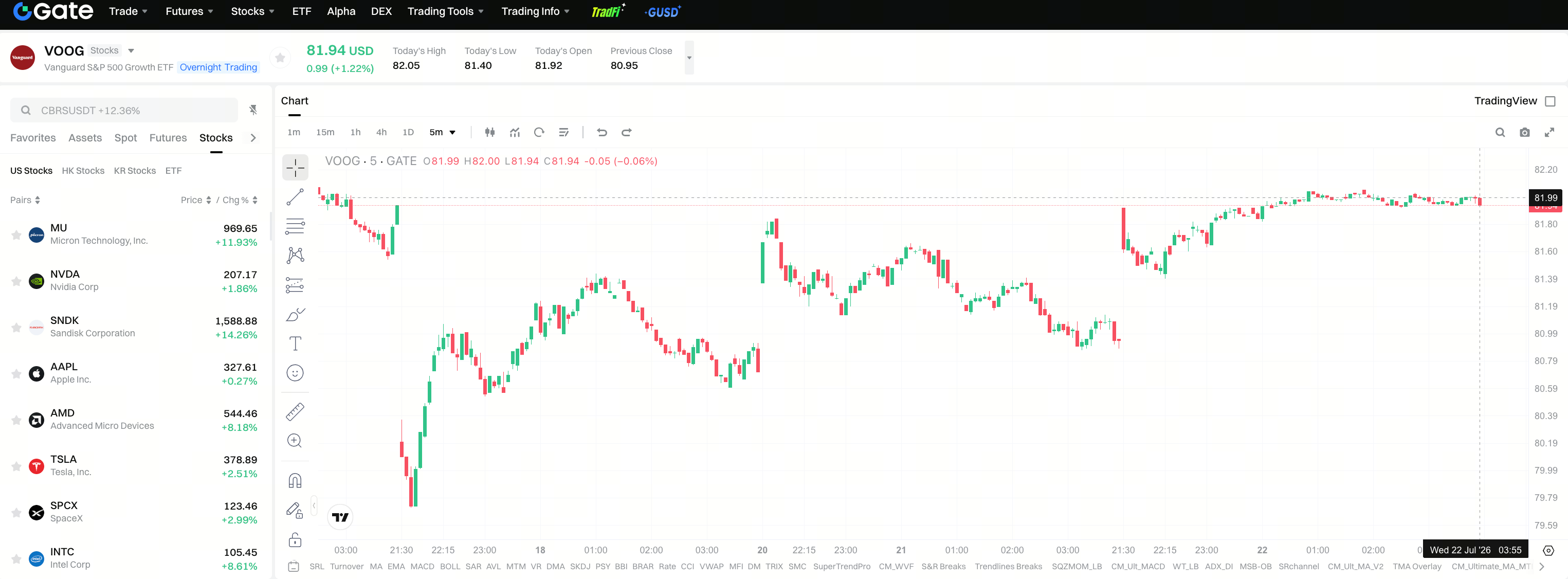
What Is VOOG? How Does It Relate to Vanguard and S&P 500 Growth?
VOOG is an index ETF under the Vanguard family, positioned to track the S&P 500 Growth Index. Its full name is Vanguard S&P 500 Growth ETF, and both public markets and Gate Stocks identify it by the stock ticker VOOG. Holding VOOG is equivalent to holding the basket of large-cap growth-style equity exposure represented by that ETF’s shares, not owning all of the equity of any single listed company.
The three-way relationship can be summarized as issuer–index–product: Vanguard operates the fund and the share trading structure; the S&P 500 Growth Index is constructed by the index provider, which applies style factors to select constituents with stronger growth characteristics from the S&P 500; VOOG passively tracks that index’s performance. Understanding VOOG starts with confirming the tracked index name, then checking that the issuer and trading ticker match. The ticker VOOG points to the ETF product layer; research that remembers only a “growth” label while ignoring that the index boundary is set by S&P 500 Growth—not by the entire universe of growth stocks—misses the product’s defining constraint.
In practice, that means two checks before any deeper comparison: (1) the methodology page or fact sheet names S&P 500 Growth Index as the benchmark, and (2) the listing or Gate Stocks page shows Vanguard S&P 500 Growth ETF under code VOOG. Those two fields anchor every later discussion of holdings, costs, and peer products.
How Does the S&P 500 Growth Index Work? Holdings, Full Replication, and Expense Ratio Explained
The S&P 500 Growth Index starts from S&P 500 constituents and, using style factors related to sales growth, earnings change, and valuation, separates growth and value characteristics, then includes the growth-style side in the index. Constituents remain inside the U.S. large-cap universe, but weights tilt toward companies with stronger growth traits. Sector and single-stock weights change as the index rebalances on its published schedule; a holdings snapshot at one date should not be treated as a permanent roster.
VOOG uses a full-replication strategy: it seeks to hold the index’s constituent securities in line with index weights so that the fund’s portfolio structure stays as close as practical to the index. Full replication emphasizes alignment with index composition; it does not eliminate tracking difference. Cash balances, rebalancing timing, trading costs, and the pace of dividend reinvestment can all leave small gaps between the ETF’s net-asset-value path and the index level.
Expense ratio is one of the core cost parameters for a passive ETF. According to Vanguard’s product-page public disclosure, VOOG’s expense ratio is about 0.07%. That figure describes management and related fees accrued at the fund level against net assets; it is not a return promise and does not replace bid–ask spreads, platform trading fees, or tax effects. Verification should use the latest disclosed field on the product page, and expense ratio should be read separately from tracking difference and style concentration.
Top holdings typically cluster in the largest growth names that dominate index weight, with common sector exposure in areas such as information technology where growth weights are often higher. Names and weights move when the index adjusts, so research should return to fund holdings disclosures and index methodology rather than relying on a memorized static “top few” list.
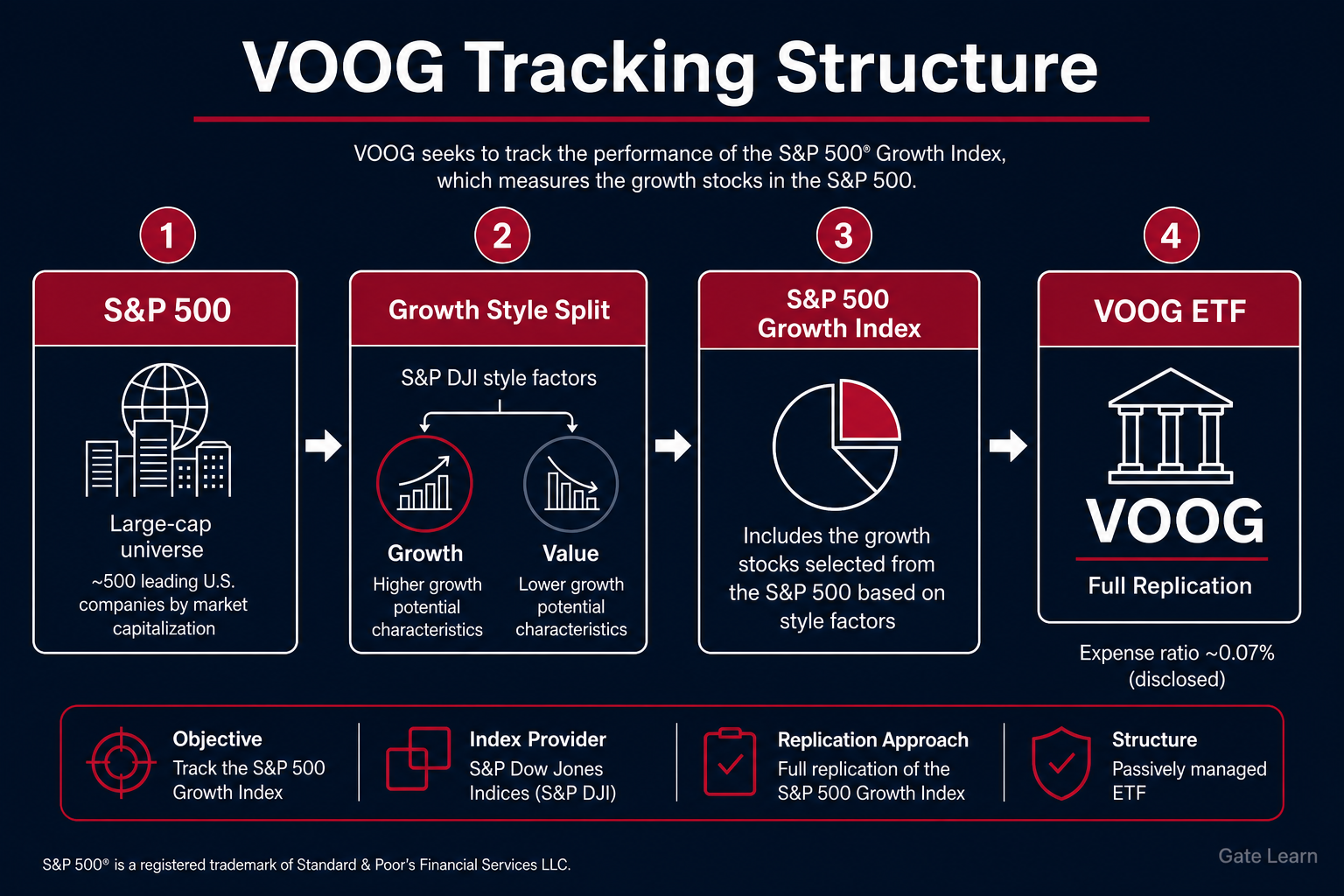 Figure 1. VOOG tracking structure: from the S&P 500 through a growth-style split into the S&P 500 Growth Index, then tracked by VOOG via full replication.
A useful mental model is a pipeline: S&P 500 universe → growth/value style assignment → S&P 500 Growth Index weights → VOOG portfolio that aims to mirror those weights. Each stage adds a constraint; skipping a stage (for example, treating “growth ETF” as synonymous with “all U.S. growth stocks”) produces incorrect peer comparisons later.
How Do You Trade VOOG Stock on Gate Stocks?
On Gate Stocks, the Vanguard S&P 500 Growth ETF can be located by searching ticker VOOG. Gate Stocks · VOOG is the page for verifying the full name, ticker, and displayed product information. When the goal is to complete buy and sell flows with stablecoins, trade VOOG with USDT walks through funding preparation, symbol search, order fields, and fee checks step by step.
Before placing an order, three fixed checks help keep structure and execution separate: whether the page ticker is VOOG, whether the legal name corresponds to Vanguard S&P 500 Growth ETF, and whether order type and available funding match the intended arrangement. Gate Stocks may differ from a traditional brokerage in account structure, settlement display, and funding currency; conclusions from index research do not replace field-level checks on the order ticket.
| Check item |
Focus |
Notes |
| Ticker and legal name |
VOOG / full product name |
Avoid confusion with nearby tickers such as VOO or VUG |
| Funding basis |
Available balance in USDT or other supported units |
Separate account cash from order-available buying power |
| Order rules |
Type, validity, fees |
Reconfirm against fields shown on the page |
The table layers “understanding the ETF” above “completing trade execution”: the first answers what is tracked; the second answers what was clicked on the page. Path descriptions outline a repeatable operating framework only; they are not buy or sell guidance.
Operationally, a typical sequence is account and funding readiness, ticker search, name and fee confirmation, then order submission under the rules displayed for that session. Each step can fail independently—wrong ticker, insufficient available balance, or mismatched order parameters—so treating them as a checklist reduces execution mistakes that have nothing to do with the index itself.
How Does VOOG Differ From VOO and VUG?
VOO is Vanguard S&P 500 ETF and tracks the full S&P 500, covering large-cap growth, value, and other style exposures within that index. VOOG tracks only the growth-style slice. Both are Vanguard products and both sit on a U.S. large-cap equity universe, but their index boundaries differ: VOO is closer to “the large-cap market as a whole,” while VOOG is closer to “the growth side of that large-cap market.”
VUG is Vanguard Growth ETF and provides broader U.S. growth equity exposure; it is not the same as a pure S&P 500 Growth slice. VUG’s benchmark is the CRSP US Large Cap Growth Index, whose constituent screening universe is typically wider than S&P 500 Growth, so VUG should not be described as “only the S&P 500 growth cut, same as VOOG.” When comparing the three, align first on which index or growth universe each product tracks, then compare expense ratio, holdings concentration, and style exposure.
| Ticker |
Product positioning |
Index / exposure boundary (key point) |
| VOOG |
Vanguard S&P 500 Growth ETF |
S&P 500 Growth: large-cap growth slice |
| VOO |
Vanguard S&P 500 ETF |
S&P 500: full large-cap market |
| VUG |
Vanguard Growth ETF |
Broader U.S. growth (CRSP US Large Cap Growth Index), not a pure S&P 500 Growth slice |
The table stresses boundary differences and does not rank products as better or worse. VOOG vs VOO vs VUG develops a finer side-by-side view across index construction, style exposure, and use-case framing.
A common confusion is treating all three tickers as interchangeable “Vanguard growth” labels. VOO is not a growth-only product; VUG is growth-oriented but on a different index family; only VOOG is explicitly anchored to S&P 500 Growth. Keeping those three sentences distinct prevents mistaken substitutions when searching or ordering on Gate Stocks.
What Are the Advantages and Risks of Holding or Trading VOOG?
Structural advantages center on covering S&P 500 growth-style exposure with a single ETF stock; full replication keeps the holdings logic relatively transparent; and an expense ratio of about 0.07% per public disclosure makes the cost parameter easy to place in a long-horizon comparison framework. For users who need to observe crypto assets and U.S. equity ETFs together, Gate Stocks provides a path to search and trade VOOG inside one account.
Risks and limitations should be stated separately. On market risk, growth style can move more when interest rates, valuations, and earnings expectations shift; when index weight concentrates in a few mega-cap growth names, changes in those weights can amplify portfolio volatility. On tracking risk, full replication can still produce differences versus the index because of cash, rebalancing, and fees. On execution risk, ticker mix-ups (for example, ordering VOO or VUG by mistake), session rules, fee definitions, and funding or settlement display differences can all affect realized trade outcomes.
| Type |
Primary sources |
What to watch |
| Style and market risk |
Growth factors, valuation, earnings expectations |
Index weight concentration and sector tilt |
| Tracking difference |
Cash, rebalancing, fee accrual |
Whether NAV path systematically diverges from the index level |
| Execution risk |
Ticker confusion, order and session rules |
Gate page legal name, fees, and holdings confirmation |
Risk notes identify variable sources; they are not trading advice or return promises. Reading structural advantages next to risk mechanisms supports a reusable verification checklist.
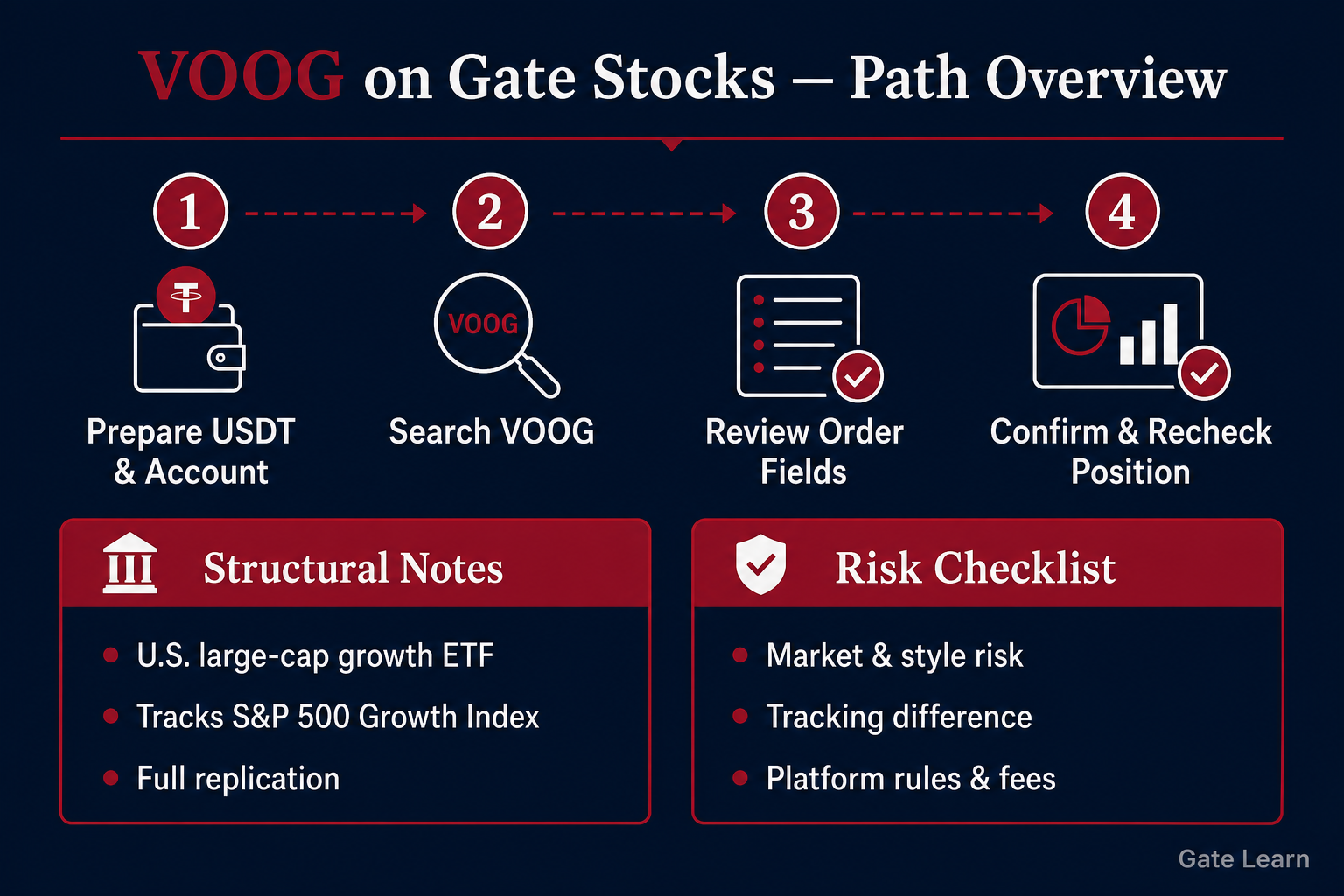 Figure 2. Gate Stocks path overview for VOOG: funding and account preparation, ticker search, order-field checks, plus parallel identification of structure points and a risk checklist.
Separating “product design” from “order mechanics” is especially useful when the same account also holds crypto balances. Style and tracking questions belong to the ETF and index layer; available balance, ticker confirmation, and fee fields belong to the platform layer. Mixing those layers is a frequent source of avoidable mistakes.
Summary
VOOG (Vanguard S&P 500 Growth ETF) is a U.S. ETF stock that tracks the S&P 500 Growth Index, delivers large-cap growth-style exposure through full replication, and carries an expense ratio of about 0.07% according to Vanguard’s product-page disclosure. Understanding the product requires holding three threads at once: how the growth-style index is sliced, how VOOG’s boundary differs from VOO and VUG, and how ticker and order rules are verified on Gate Stocks. Keeping index research and trade execution in separate layers supports a reusable analytical framework.
FAQ
What is VOOG?
VOOG is the trading ticker for Vanguard S&P 500 Growth ETF, a U.S. ETF stock issued by Vanguard. The product tracks the S&P 500 Growth Index and provides passive exposure to the growth-style side of S&P 500 constituents. It is not a single-company stock and not a crypto token.
What index does VOOG track?
VOOG tracks the S&P 500 Growth Index. That index selects and weights growth-style factors from S&P 500 large-cap constituents; constituents and weights change on the index’s regular schedule. VOOG uses full replication to keep portfolio composition as close as practical to the index.
How does VOOG differ from VOO?
VOO is Vanguard S&P 500 ETF and tracks the full S&P 500; VOOG tracks only the growth-style slice (S&P 500 Growth). Both sit in the U.S. large-cap equity universe, but their index boundaries differ: VOO spans growth, value, and other styles within the S&P 500, while VOOG concentrates on the growth side.
How does VOOG differ from VUG?
VUG is Vanguard Growth ETF and offers broader U.S. growth equity exposure via the CRSP US Large Cap Growth Index; it is not identical to a pure S&P 500 Growth slice. VOOG is explicitly anchored to the S&P 500 Growth Index. Comparisons should first verify each product’s benchmark and constituent universe, then compare style exposure and cost parameters.
What is VOOG’s expense ratio?
According to Vanguard’s product-page public disclosure, VOOG’s expense ratio is about 0.07%. That figure is a fund expense-ratio disclosure describing management and related fee levels. It is not a return promise and does not replace bid–ask spreads or platform trading fees.
What risks are involved in trading VOOG?
Main risks include growth-style and market volatility, style tilt from concentrated index weights, tracking difference between the ETF and its index, and execution risks on Gate Stocks such as ticker mix-ups, order rules, and fee definitions. Risk notes identify variables; they are not trading advice.