Will Quantum Computing “Kill” Bitcoin? A Deep Dive into the Possibility of BTC Surging to $1 Million

Last Updated 2026-03-26 22:25:07
Reading Time: 1m
Will quantum computing threaten Bitcoin's security? In this article, we assess whether BTC can achieve the $1,000,000 milestone by reviewing the latest technological developments and price predictions. We analyze the associated risks and potential opportunities, providing crypto investors with exclusive perspectives.

Current Bitcoin Price and Market Outlook
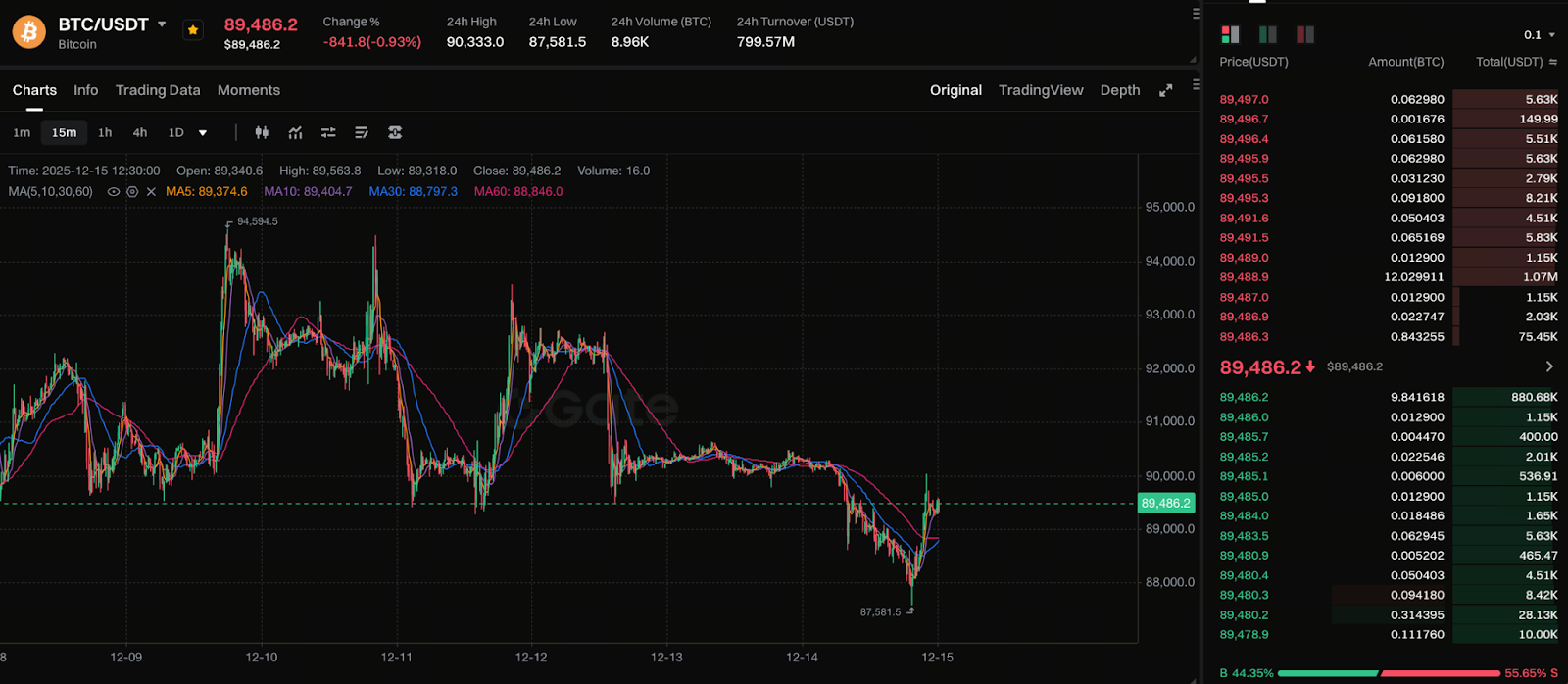

Chart: https://www.gate.com/trade/BTC_USDT

As of December 15, 2025, Bitcoin is trading at approximately $89,500. The price has seen several corrections recently, but some prominent industry figures remain highly optimistic about Bitcoin’s long-term prospects. For example, Coinbase CEO Brian Armstrong has publicly predicted that Bitcoin could hit $1,000,000 before 2030, sparking significant debate across the market.

This eye-popping target isn’t an outlier. Similar bullish forecasts have come from institutional investors, analysts, and leading hedge funds. While the current price is still far from this milestone, investor confidence in Bitcoin’s role as “digital gold” remains strong.

Still, beyond the anticipation of price surges, a deeper risk is quickly gaining attention—the potential threat that quantum computing poses to blockchain cryptographic security.

How Powerful Is Quantum Computing? Bitcoin’s Core Security Mechanisms

Bitcoin’s security is built on two foundational cryptographic technologies:

  • Elliptic Curve Digital Signature Algorithm (ECDSA)
  • SHA-256 Hash Algorithm

These cryptographic schemes are currently considered unbreakable by classical computers, which ensures the safety of users’ private keys and the integrity of transactions.

However, quantum computers use “qubits” instead of traditional “bits.” This allows them to compute in superposition, handling multiple states simultaneously. In theory, this enables exponential processing power and makes it possible for certain algorithms—like Shor’s algorithm—to eventually break today’s cryptographic protocols.

If large-scale quantum computers are realized, they could drastically reduce the effort required to break ECDSA, putting Bitcoin wallets and even the entire transaction system at risk.

Is the Quantum Threat Really Imminent? Expert Predictions and Timelines

Industry views on quantum risk have diverged sharply in recent months:

Solana co-founder Anatoly Yakovenko has warned that Bitcoin needs to prepare for quantum breakthroughs within about five years, or its current cryptographic safeguards could be breached.

Conversely, some technical experts—including the CTO of Ledger—believe quantum computing won’t pose a critical threat to Bitcoin in the near term.

In fact, multiple technical assessments indicate that breaking Bitcoin’s cryptography would require quantum computers with millions of fault-tolerant qubits—a level of technology that remains far out of reach today.

In short, while quantum attacks are a real concern, they’re generally seen as a medium- to long-term risk. This is especially true since Bitcoin’s core code and ecosystem have not yet been fully upgraded to address such threats.

Can Bitcoin Be Upgraded to Resist Quantum Attacks?

The good news is that quantum security is a solvable challenge.

The cryptography community is already developing Post-Quantum Cryptography solutions, such as quantum-resistant signature algorithms based on lattice cryptography or hash-based signatures.

If the Bitcoin community and developers decide to upgrade the protocol and transition to quantum-resistant algorithms, the network can proactively build defenses before quantum threats become a reality.

However, such a sweeping upgrade is a massive undertaking. It would require coordination among miners, node operators, and the global community—a process that can’t happen overnight.

Investor Perspective: Panic or Opportunity?

For investors, quantum risk is both a potential reason to sell and a call to pay attention to technological progress and network upgrades.

Could Bitcoin reach $1,000,000? The market is full of bold predictions—Coinbase’s CEO among the most optimistic—but such targets should be approached with caution.

If Bitcoin continues to operate securely and upgrades its cryptographic safeguards, it could keep attracting long-term investors and remain a store of value in the evolving financial system.

Summary: Quantum Is Not the End, But a New Turning Point

In summary, the question “Will quantum computing kill Bitcoin?” doesn’t have a simple yes or no answer. Quantum computing does present a theoretical risk to current cryptographic systems, but any real threat is still years—if not decades—away.

If the Bitcoin community deploys quantum-resistant upgrades in advance, and momentum from price appreciation and institutional capital continues, BTC won’t just survive—it could thrive, driven by technological innovation and growing market expectations.

Author: Max
Disclaimer
* The information is not intended to be and does not constitute financial advice or any other recommendation of any sort offered or endorsed by Gate.
* This article may not be reproduced, transmitted or copied without referencing Gate. Contravention is an infringement of Copyright Act and may be subject to legal action.

Related Articles

The ve(3,3) Flywheel Explained: How AERO Tokenomics Powers Aerodrome’s DeFi Economy
Beginner

The ve(3,3) Flywheel Explained: How AERO Tokenomics Powers Aerodrome’s DeFi Economy

In the competition for DeFi liquidity, high-inflation mining alone is no longer enough to build lasting advantages. Aerodrome applies the ve(3,3) economic model to redesign token emissions, voting mechanisms, and revenue distribution, creating a liquidity flywheel centered on governance and cash flow. This article examines AERO tokenomics, the veAERO locking mechanism, and protocol revenue models to explain how Aerodrome builds a sustainable DeFi economic system.
2026-03-25 06:41:58
AI-Native Settlement Layers: How United Stables Is Building the Next Financial Rail
Beginner

AI-Native Settlement Layers: How United Stables Is Building the Next Financial Rail

Stablecoins were originally designed as dollar substitutes within exchanges, primarily used for asset pricing and trade settlement. As on-chain financial ecosystems have matured, their role has expanded beyond simple payments to include collateral assets, cross-chain liquidity mediums, and unified settlement units. In particular, as AI systems and automated agents begin to participate directly in economic activity, demand has risen sharply for programmable value units capable of instant settlement. This shift is pushing stablecoins toward the role of foundational financial infrastructure.
2026-03-25 03:16:17
Aerodrome Tokenomics: How ve(3,3) Powers Base's Most Profitable DEX
Beginner

Aerodrome Tokenomics: How ve(3,3) Powers Base's Most Profitable DEX

AERO is the native token of Aerodrome Finance, a core decentralized exchange and liquidity protocol in the Base ecosystem. It is primarily used for liquidity incentives and ecosystem operations. veAERO is a governance NFT that users receive by locking AERO, representing both voting power and the right to share protocol revenue. Through a dual track structure of AERO as a utility token and veAERO as a governance credential, Aerodrome separates liquidity usage value from long term governance power, allowing participants to act as liquidity providers, governance decision makers, and revenue sharers within the same system.
2026-03-25 06:40:31
How is the price of PAXG determined? Pegging mechanism, trading depth, and influencing factors
Beginner

How is the price of PAXG determined? Pegging mechanism, trading depth, and influencing factors

PAXG (Pax Gold) is a tokenized asset backed by physical gold reserves, launched by fintech firm Paxos and issued as an ERC-20 token on the Ethereum blockchain. The core concept is to digitally represent real-world gold assets, allowing investors to hold and trade gold via the blockchain network. Because each PAXG token corresponds to a specific quantity of physical gold, its price is theoretically expected to closely track the global gold market.
2026-03-24 19:11:40
How Does PAXG Work? In-Depth Overview of the Physical Gold Tokenization Mechanism
Beginner

How Does PAXG Work? In-Depth Overview of the Physical Gold Tokenization Mechanism

PAXG (Pax Gold) is a tokenized asset backed by physical gold, issued by the fintech company Paxos and traded on the Ethereum blockchain as an ERC-20 token. The core concept is to tokenize physical gold on-chain, with each PAXG token representing ownership of a certain amount of gold. This structure enables investors to hold and trade gold in the form of a digital asset.
2026-03-24 19:12:51
Aster vs Hyperliquid: Which Perp DEX Will Prevail?
Beginner

Aster vs Hyperliquid: Which Perp DEX Will Prevail?

Aster and Hyperliquid are the two representative protocols of the "purpose-built L1 path" within the current decentralized perpetual exchange (Perp DEX) sector. As a pioneer in the field, Hyperliquid has built a deep liquidity moat through its highly mature order book architecture and strong community consensus. Conversely, Aster, as a rising challenger, seeks to leapfrog the competition in high-performance trading through more aggressive multi-chain aggregation logic, private transaction modules, and an underlying execution environment optimized for 2026 market demands.
2026-03-24 11:58:33





