On public blockchains, traditional tokens offer programmability and transferability, but their addresses, balances, asset categories, and fund flows are often exposed over the long term. This persistent visibility brings ongoing traceability issues for stablecoin settlements, asset management, on-chain trading, corporate collections, and personal payments. The importance of Confidential Assets lies in extending privacy from single-token transfers to the entire asset layer, so that “anonymity” applies not only to native tokens but also to stablecoins, wrapped assets, membership credentials, and even more complex digital asset forms.
Based on the Zano official roadmap and ecosystem progress as of May 2026, Confidential Assets are no longer just a concept. With developments like Hardfork 6, Gateway Addresses, Bridgeless, Zano Trade, fUSD, multi-asset wallet integration, and expanded payment scenarios, Zano is forming a more complete private asset network. The following content breaks down its operational logic, trading methods, cross-chain mechanisms, application boundaries, and future directions.
What Are Confidential Assets
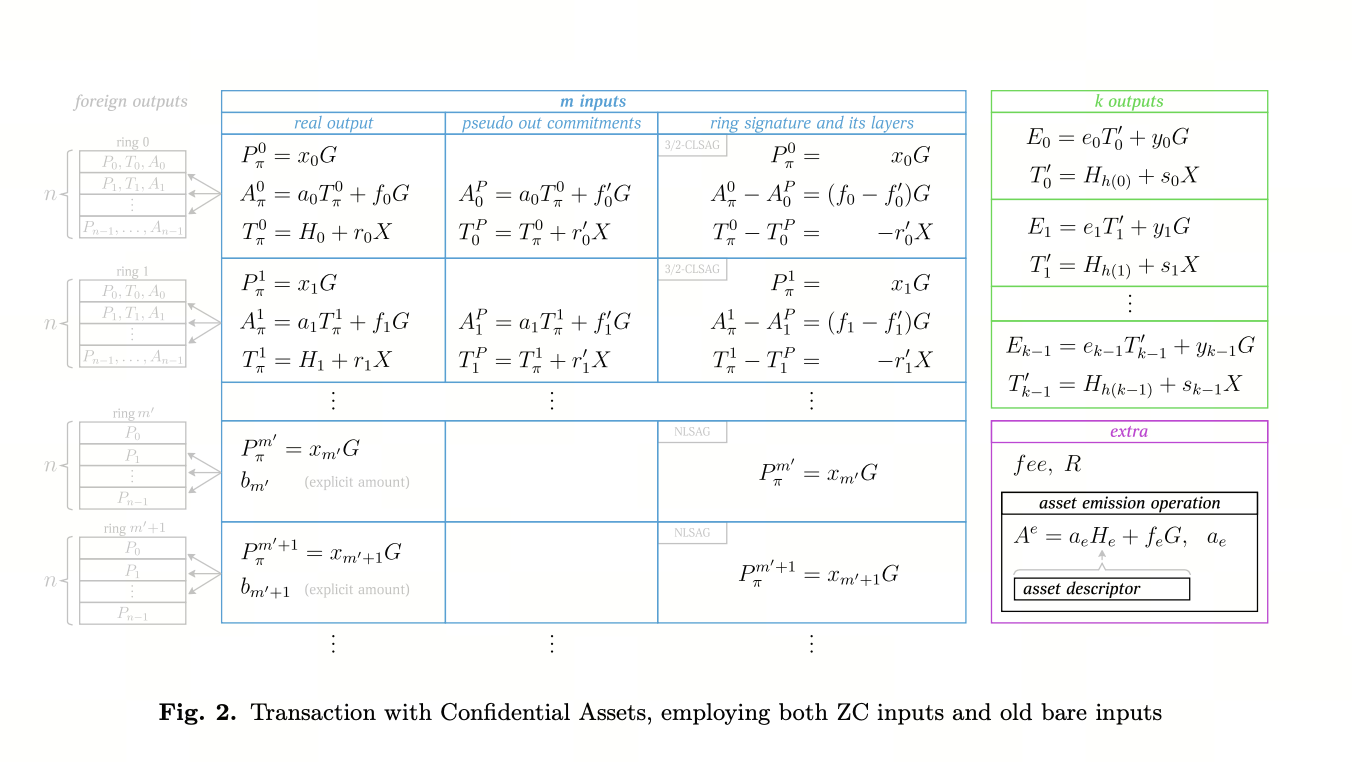
Image source: Zano official documentation
Confidential Assets are best described as the “private asset standard” on the Zano blockchain. Unlike conventional public chain tokens that simply record asset names on-chain and rely on extra tools for privacy, Confidential Assets inherit Zano’s default privacy features at the protocol layer. Per the official documentation, Confidential Assets—like native ZANO—can conceal sender and receiver addresses, transaction amounts, and even obscure the asset type itself.
This means that when analyzing on-chain data, external observers will find it difficult to determine whether a transaction involves ZANO, a stablecoin, wrapped BTC, or another confidential asset. For privacy networks, this is critical: if the asset type is public, even hidden amounts can still allow user behavior patterns to be inferred.
From a product perspective, Zano positions Confidential Assets not as an add-on, but as the foundation for a “private asset economy.” Since its mainnet launch in 2024, this mechanism has steadily expanded to include stablecoins, cross-chain assets, private trading, and payment scenarios, and will remain central to ecosystem growth through 2026.
How Zano Issues Private Assets
Zano enables any user or project to issue their own private asset on-chain, without the need to create a new blockchain. Once issued, the new asset automatically receives the same privacy protections as native ZANO, including hidden addresses, amounts, and asset categories.
Technically, Zano’s asset system is built atop its native privacy model, unlike the transparent token contracts found on most public chains. As a result, Confidential Assets are not just “tokenized”—they are “privately tokenized.” When users hold, transfer, or trade these assets in their wallets, on-chain data does not reveal balance distributions or transaction paths as with ERC-20 or other common token standards.
Recent ecosystem updates show Zano’s asset whitelisting and wallet support are continually improving. In the January and March 2026 updates, confidential assets like BCHx, SOLx, TONx, DAIx, and BNBx have been added to broader wallet displays and community voting, indicating the issuance mechanism is not only technically viable but is also evolving into a manageable, distributable, and governable ecosystem.
How Private Assets Differ from Traditional Tokens
The fundamental distinction between Confidential Assets and traditional tokens lies in their on-chain visibility. Most traditional tokens are issued on transparent ledgers, allowing anyone to see an address’s holdings, outgoing transfers, counterparties, and even infer user strategies, business dealings, and asset allocation habits.
On Zano, private assets are not “token symbols on a public ledger,” but “asset instances in a default-private ledger.” Externally, only the transaction is visible; the holder, amount, and asset type remain hidden. This makes Confidential Assets particularly valuable for private payments, institutional settlements, merchant collections, and personal asset allocation.
Another key difference is the composable privacy pool. With more transparent tokens, there are more on-chain targets for analysis; with Zano’s Confidential Assets, overall anonymity may actually increase. Ideally, different assets share the same privacy infrastructure, and as asset diversity and activity grow, the anonymity set deepens. This “the richer the assets, the deeper the privacy pool” dynamic sets Confidential Assets apart from traditional transparent token systems.
How Zano’s Private DEX Supports Asset Trading
If private assets could only be held but not traded, their ecosystem value would be limited. That’s why Zano Trade and Ionic Swaps are critical for the circulation of Confidential Assets.
According to official sources, Zano Trade is a decentralized trading framework built on Zano’s privacy model, enabling peer-to-peer swaps between ZANO and confidential assets. Unlike transparent DEXs, trades do not expose order details, asset types, trade sizes, or wallet structures to the entire network, greatly reducing risks like MEV, frontrunning, and strategy tracking.
Ionic Swaps are the key mechanism supporting private exchanges. Traditional atomic swaps often expose more information from the party who submits first; Zano’s approach balances the swap structure so both parties complete the exchange within a single transaction, minimizing information asymmetry. For a private asset network, maintaining privacy during trading is just as important as privacy in issuance.
Recent progress shows that as of April 2026, the new Zano Trade is moving forward, and DEX integrations research is a focus in the roadmap. This demonstrates Zano’s commitment to optimizing its private trading experience and integrating with broader liquidity systems.
Cross-Chain Bridges and Private Asset Circulation
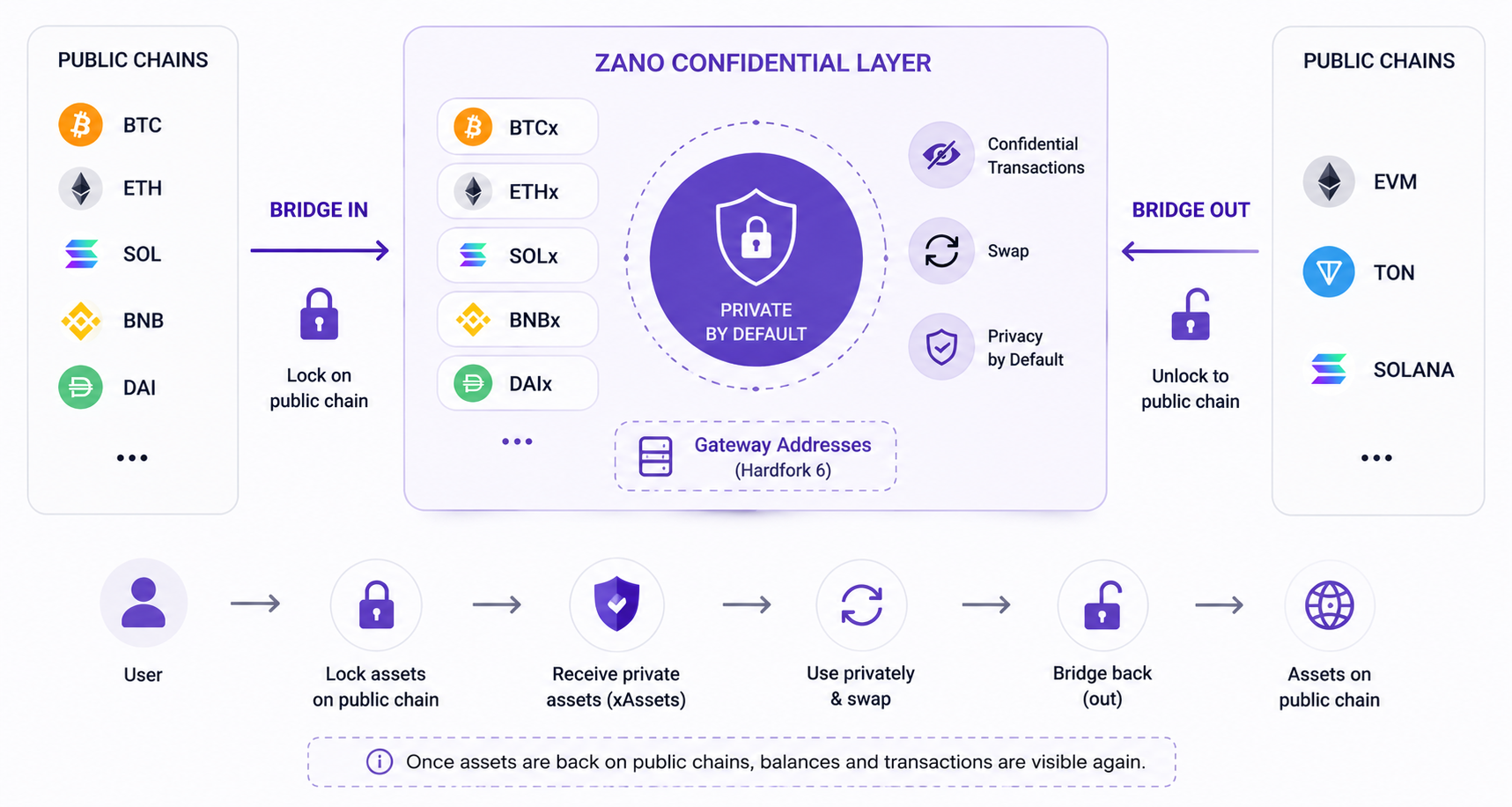
A key value of Confidential Assets is enabling external public chain assets to enter a private environment. Zano’s bridging system, built around Confidential Layer and Bridgeless, is the primary path to achieve this.
The basic process: after users bridge BTC, ETH, DAI, SOL, BNB, and other public chain assets into Zano, they receive private versions like BTCx, ETHx, SOLx, and DAIx. These assets retain the price exposure of their original chains but circulate within Zano with default privacy. For users, this means accessing a more private asset environment without giving up the market properties of their original assets.
Recent 2026 updates reinforce this direction. The official announcement notes that Gateway Addresses are live on the testnet and will be a core part of Hardfork 6, enabling efficient integration for bridges, exchanges, and other infrastructure. Meanwhile, native ZANO and some Confidential Assets are also planned for reverse bridging to EVM, TON, Solana, and other networks. This means Zano is not only “bringing in external assets,” but also connecting its private asset network to external liquidity.
There are clear limits, however: once assets return to a transparent chain, their balances and transaction histories are exposed again. Cross-chain bridging essentially toggles between “privacy environment” and “liquidity environment”—it does not provide permanent privacy across all networks.
Use Cases for Confidential Assets
Confidential Assets have moved beyond theoretical applications. The most notable example is fUSD, a private stablecoin built on Zano. Unlike public chain stablecoins that expose holdings and payment paths, fUSD aims to deliver greater payment privacy and censorship resistance, making it appealing for cross-border payments, merchant settlements, and daily personal transactions.
Another use case is private wrapped assets. Through bridging, users can map mainstream assets like BTC, ETH, and SOL to Zano and hold, transfer, or trade them privately. This model is ideal for users who want to retain original asset price exposure without exposing their transaction paths long-term.
Confidential Assets are also well-suited for membership credentials, private tickets, digital collectibles, and NFT-like assets in sensitive scenarios. Since asset types themselves can be hidden, they are better suited than most public chain credentials for identity-, relationship-, or transaction-sensitive use cases. Since 2026, Zano has steadily promoted wallet, merchant tool, and third-party app integration—demonstrating that the privacy asset ecosystem is evolving from “available” to “consumable.”
Challenges for the Private Asset Ecosystem
While Confidential Assets offer clear differentiation, they also face significant real-world challenges. The first is regulatory compliance. Any system that defaults to hiding asset transfers, balances, and flows increases the compliance burden for exchanges, payment providers, and custodians—impacting listings, fiat on/off ramps, and mainstream integration.
Second is liquidity and network effects. For private assets to be truly useful, they must be issuable, tradable, payable, bridgeable, and widely supported by wallets. Compared with mainstream transparent chains, Zano’s overall ecosystem is still relatively small; while its TVL exceeded $21 million in early 2026, there remains a gap in market depth and developer scale compared to more mature public chains.
Third is the complexity of bridging and infrastructure. When private assets involve cross-chain transfers, wallet compatibility, whitelist management, payment tools, and trading markets, system complexity rises fast. For users, this means higher learning costs and usage barriers; for protocols, it means greater challenges in security and maintenance.
Future Directions for the Zano Ecosystem
Zano’s 2026 roadmap and monthly updates point to a clear expansion strategy. The first priority is optimizing asset infrastructure, including Hardfork 6, Gateway Addresses, greater transaction unification, and ongoing DEX integration research. These upgrades will directly impact whether Confidential Assets can be reliably adopted by bridges, trading platforms, and payment services.
The second priority is expanding asset and wallet access. Unstoppable Wallet launched initial iOS support for ZANO in April 2026 and plans to add more confidential assets, alias features, and DEX integrations; official mobile and light wallets are also advancing. Expanding these access points is especially critical for moving privacy assets from “technical tool” to “widespread use.”
The third priority is growing real-world payment and private finance tools. Recent announcements highlight integrations with AEON Pay, Checkout by Bitcoin.com, CoinDonor, and other payment or donation scenarios—showing Zano’s vision for privacy assets to enter real-world commerce, not just on-chain transfers. If stablecoins, wrapped assets, and merchant tools become more tightly integrated, Confidential Assets could evolve from a unique feature to a foundational layer for private finance.
Summary
Confidential Assets are among the most distinctive infrastructure elements in the Zano ecosystem, extending privacy from native coin transfers to asset issuance, trading, bridging, and payments—bringing “default privacy” to the asset layer. Compared to traditional transparent tokens, this mechanism not only hides balances but also conceals asset types and behavioral patterns, reducing the long-term traceability of public ledgers. As of May 2026, Hardfork 6, Gateway Addresses, Bridgeless, Zano Trade, fUSD, and wallet integrations are all driving the ecosystem’s usability. The opportunity is to become the foundational layer for private asset networks, while challenges remain around regulation, liquidity, and infrastructure maturity. For those interested in private stablecoins, cross-chain private assets, and default anonymous finance, Zano’s Confidential Assets remain a direction worth watching.







