# DailyPolymarketHotspot

389.84K

Daily spotlight on trending Polymarket prediction events, covering crypto, stocks, macro economy, and more. Check real-time volume, leading outcomes, and resolution dates. Make your predictions and trade to win.

📢 Gate Square | Polymarket 5/25 Prediction: What will the HYPE price reach by the end of May?
On May 25, the largest HYPE contract short position, Loracle, was again at a high of $64 this morning, placing a massive $75 million short order. Since switching from a long to a short position in April, this whale has been continuously adding to their position, with holdings soaring from $10 million to over $140 million, and the average price being passively averaged from around $41 to $42.5. What do you think about the whale's influence on HYPE's future price?
🎁 Analysis and Prediction: Select 5 t
View Original
post-image
  • Reward
  • 11
  • Repost
  • Share
Dubai_Prince:
To The Moon 🌕
View More
#Polymarket每日热点
🐋 HYPE Price Prediction — The $140M Whale Short That Has Everyone Talking
This is one of the most fascinating whale stories playing out in crypto right now and I want to give you my honest analysis before dropping my prediction.
Loracle — the largest HYPE contract short position holder — hit $64 this morning and immediately placed a $75 million short order. This is not a new position. Since flipping from long to short back in April this whale has been methodically building — growing from $10 million to over $140 million in short exposure while averaging down from around $41 a
HYPE0.59%
BTC0.08%
post-image
Gate广场_Official
📢 Gate Square | Polymarket 5/25 Prediction: What will the HYPE price reach by the end of May?
On May 25, the largest HYPE contract short position, Loracle, was again at a high of $64 this morning, placing a massive $75 million short order. Since switching from a long to a short position in April, this whale has been continuously adding to their position, with holdings soaring from $10 million to over $140 million, and the average price being passively averaged from around $41 to $42.5. What do you think about the whale's influence on HYPE's future price?
🎁 Analysis and Prediction: Select 5 top users, each rewarded with $5 worth of tokens!
📝 Participation Guide:
Post with #Polymarket每日热点
🔹 Method A: Predict the HYPE price and attach an event card
🔹 Method B: Share your trading screenshot, along with your trading ideas and opinions
Join now: https://gate.onelink.me/Hls0/prediction?page=detail&event_ticker=442407&source=cex
repost-content-media
  • Reward
  • 13
  • Repost
  • Share
ShainingMoon:
To The Moon 🌕
View More
#DailyPolymarketHotspot
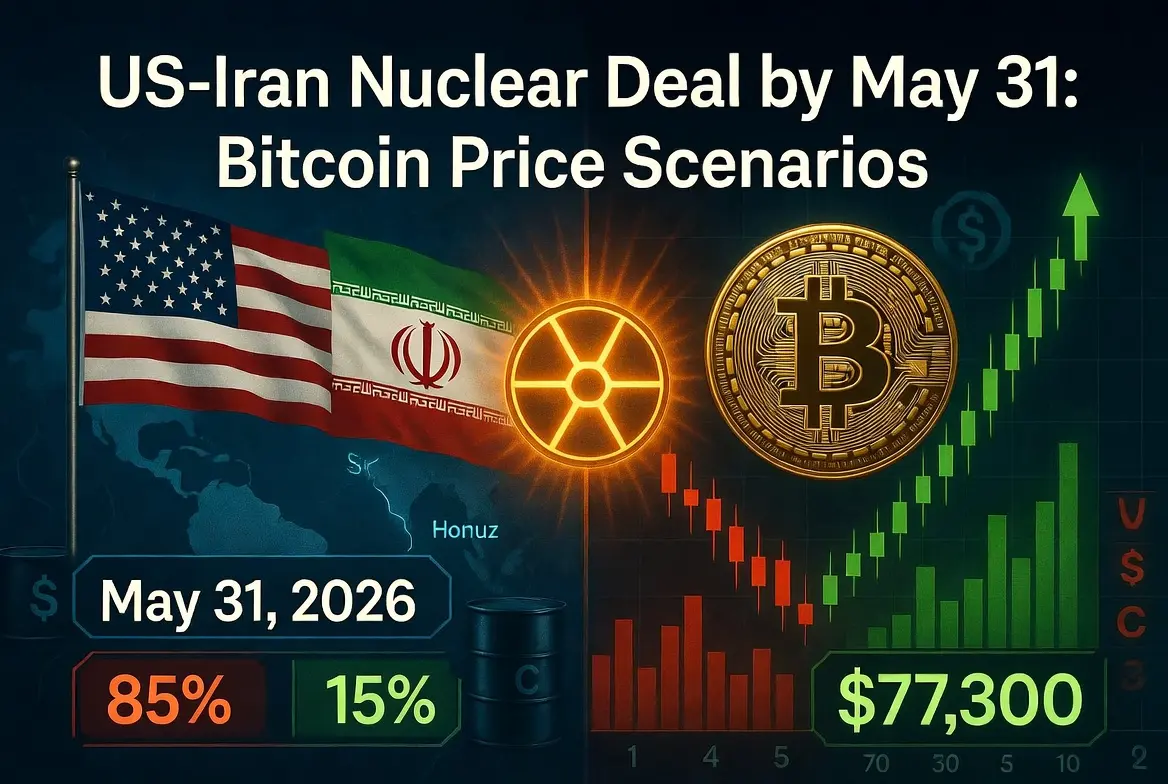
The US-Iran nuclear negotiations ahead of the May 31, 2026 deadline have become a major geopolitical risk catalyst for global financial markets. According to prediction markets such as Polymarket, the probability of a nuclear deal stands near 15%, while 85% of participants expect no agreement.
Bitcoin is currently trading around $77,300, after fluctuating between $74,000 and $80,000 in recent sessions. This positioning reflects uncertainty across risk markets as traders price in two very different macro outcomes: geopolitical escalation versus diplomatic de-escalation.
BTC0.08%
HighAmbition
#DailyPolymarketHotspot
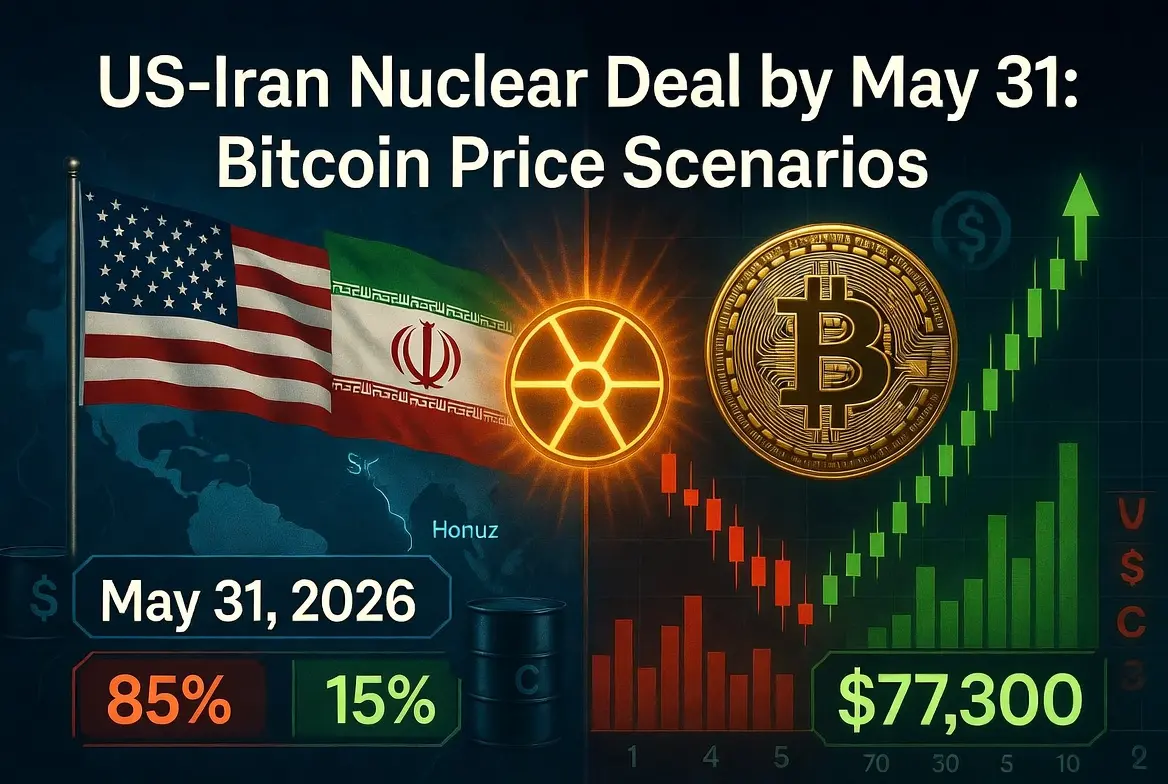
The US-Iran nuclear negotiations ahead of the May 31, 2026 deadline have become a major geopolitical risk catalyst for global financial markets. According to prediction markets such as Polymarket, the probability of a nuclear deal stands near 15%, while 85% of participants expect no agreement.
Bitcoin is currently trading around $77,300, after fluctuating between $74,000 and $80,000 in recent sessions. This positioning reflects uncertainty across risk markets as traders price in two very different macro outcomes: geopolitical escalation versus diplomatic de-escalation.
Part I: US-Iran Nuclear Negotiations — Current Status
The current round of negotiations is part of a long-standing geopolitical dispute between the United States and Iran over nuclear enrichment capabilities and sanctions relief. Since the US withdrawal from the JCPOA framework in 2018, tensions have remained elevated, with intermittent diplomatic efforts failing to produce a lasting agreement.
In 2025–2026, renewed negotiations have taken place in multiple locations, including indirect mediation channels. The key pressure point is the May 31 deadline, which markets now treat as a binary risk event.
Core Disputes
Uranium Enrichment Limits: US demands strict caps or dismantlement, while Iran insists on sovereign enrichment rights
Stockpile Reduction: Approximately 440 kg of enriched uranium remains a key negotiation point
Sanctions Relief: Iran seeks removal of oil export restrictions and frozen asset releases
Verification Systems: Disagreement over inspection intensity and access protocols
The negotiation structure remains fragile, with limited time for convergence on core issues.
Part II: Market Probability and Sentiment Structure
Prediction markets currently price the outcome as heavily skewed toward failure:
No Deal: ~85% probability
Deal Reached: ~15% probability
Earlier in May, expectations briefly reached as high as 70% probability of a deal, but sentiment reversed as negotiations slowed and unresolved structural issues became more visible.
This shift indicates that markets now expect either:
Continued stalemate
Or delayed agreement beyond the deadline
Part III: Bitcoin Market Position and Current Structure
Bitcoin is currently trading near $77,300, consolidating after recent volatility. The price structure reflects a balance between geopolitical uncertainty and sustained institutional demand.
Key Price Levels
Immediate Support: $76,000 – $76,500
Strong Support: $74,000 – $75,000
Critical Support: $72,000 – $73,000
Immediate Resistance: $78,000 – $78,500
Major Resistance: $80,000 – $82,000
Extended Resistance: $85,000 – $90,000
Bitcoin remains in a compression phase where breakout direction will likely depend on macro catalysts, especially geopolitical developments.
Part IV: Scenario Analysis — No Nuclear Deal (85%)
A failure to reach agreement by May 31 would likely increase geopolitical tension in the Middle East, particularly around the Strait of Hormuz, through which nearly 20% of global oil supply passes.
Short-Term Market Reaction
Bitcoin could initially react with volatility:
Possible drop toward $72,000 – $75,000
Increased liquidations in leveraged derivatives markets
Temporary risk-off sentiment across equities and crypto
However, Bitcoin may also attract defensive capital flows as a non-sovereign asset.
Medium-Term Outlook
If tensions escalate:
Oil prices may rise above $90 – $110 per barrel
Inflation expectations could increase globally
Central banks may delay rate cuts
Bitcoin range in this scenario:
$68,000 – $82,000
Long-Term Impact
Despite short-term volatility, structural demand remains supported by:
Spot ETF inflows
Institutional accumulation
Post-2024 halving supply reduction
Long-term projection remains:
$120,000+ potential in 2025 cycle continuation
Part V: Scenario Analysis — Nuclear Deal Reached (15%)
A successful agreement would represent a major geopolitical de-escalation event, significantly reducing global risk premiums.
Immediate Market Reaction
Bitcoin breakout above $80,000 – $82,000
Potential rally toward $85,000 – $90,000
Strong risk-on sentiment across global markets
Medium-Term Effects
A deal would likely:
Ease oil supply constraints
Reduce inflation pressure
Increase probability of Fed rate cuts
Improve global liquidity conditions
Bitcoin price range:
$85,000 – $110,000
Extended Bullish Case
If macro liquidity expands:
$120,000 – $150,000 (late 2025 potential range)
Institutional inflows accelerate via ETFs
Corporate adoption increases
Part VI: Technical Market Structure
Bitcoin remains in a strong macro uptrend despite short-term consolidation.
Support Zones
$76,000–$76,500: short-term defense
$74,000–$75,000: accumulation zone
$72,000–$73,000: breakdown threshold
Resistance Zones
$78,000–$78,500: immediate ceiling
$80,000–$82,000: breakout trigger
$85,000–$90,000: major expansion zone
A sustained break above $82,000 could trigger accelerated momentum toward psychological levels above $90,000.
Part VII: Macro Drivers Beyond Geopolitics
Bitcoin pricing is also influenced by broader macroeconomic conditions:
Federal Reserve Policy: Rate cuts would support risk assets
ETF Demand: Continuous inflows create structural buying pressure
Liquidity Cycles: Global M2 expansion supports crypto valuations
Post-Halving Supply Shock: Reduced issuance increases scarcity pressure
Institutional forecasts remain highly optimistic:
Some models project $120,000–$150,000 in 2025
Long-term projections extend beyond $200,000 under bullish liquidity cycles
Part VIII: Risk Factors
Downside Risks
Military escalation in Middle East
Oil shock above $110 per barrel
Global liquidity tightening
Regulatory pressure on crypto markets
Breakdown below $72,000 support zone
In extreme scenarios, Bitcoin could temporarily retrace toward $65,000–$68,000.
Volatility Conditions
Implied volatility remains elevated due to:
Options market uncertainty
Geopolitical binary event risk
Leveraged derivatives exposure
Part IX: Market Psychology and Positioning
Market participants are currently positioned cautiously:
Neutral funding rates in derivatives
Balanced long/short exposure
Increased hedging activity
Elevated demand for downside protection
This suggests that traders are not aggressively directional, but rather waiting for the May 31 resolution before committing to larger positions.
The US-Iran nuclear negotiations represent a high-impact geopolitical catalyst that could significantly influence Bitcoin’s short-term trajectory while reinforcing its longer-term macro narrative.
No Deal (85%) scenario: Bitcoin likely trades between $68,000 and $82,000 with volatility spikes
Deal (15%) scenario: Bitcoin could rally toward $85,000–$110,000 with potential extension toward $120,000+
At approximately $77,300, Bitcoin is positioned at a critical equilibrium point, where macro clarity will determine the next directional expansion phase.
Regardless of outcome, structural drivers such as ETF adoption, halving supply reduction, and institutional accumulation continue to support a long-term bullish framework.@Gate_Square @Gate广场_Official #TradfiTradingChallenge #
repost-content-media
  • Reward
  • Comment
  • Repost
  • Share
#DailyPolymarketHotspot
The US-Iran nuclear negotiations ahead of the May 31, 2026 deadline have become a major geopolitical risk catalyst for global financial markets. According to prediction markets such as Polymarket, the probability of a nuclear deal stands near 15%, while 85% of participants expect no agreement.
Bitcoin is currently trading around $77,300, after fluctuating between $74,000 and $80,000 in recent sessions. This positioning reflects uncertainty across risk markets as traders price in two very different macro outcomes: geopolitical escalation versus diplomatic de-escalation.
BTC0.08%
post-image
US-Iran nuclear deal by May 31?
Yes 20%
No 80%
$260.56K Vol
  • Reward
  • 17
  • Repost
  • Share
Crypto_Buzz_with_Alex:
This is really amazing explainations in this post very clear and easy to understand.
View More
#DailyPolymarketHotspot 🔮 THE CROWD IS NO LONGER GUESSING — IT’S FRONT-RUNNING THE FUTURE
Traditional markets wait for headlines.
Polymarket traders try to predict them before they happen.
And right now, the prediction market battlefield is becoming one of the most powerful sentiment engines across crypto, macroeconomics, politics, AI, and global finance.
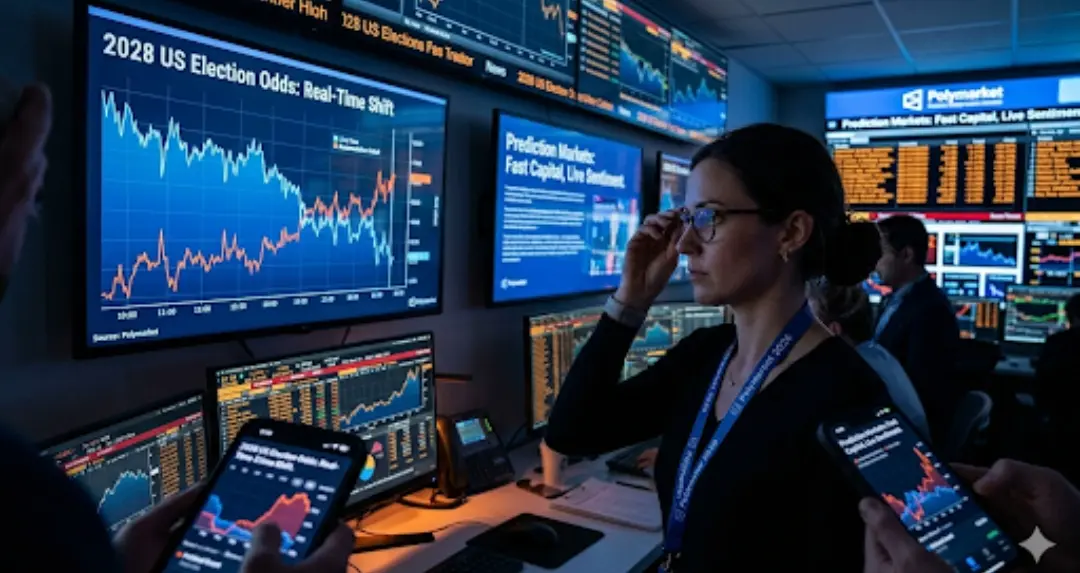
What started as a niche betting platform has transformed into a real-time liquidity radar where traders price probability faster than traditional analysts react.
Today’s hotspot activity reveals something important:
The crowd is becoming sm
BTC0.08%
post-image
  • Reward
  • 9
  • Repost
  • Share
ShainingMoon:
To The Moon 🌕
View More
#USIranDraftDeal
The United States and Iran are currently negotiating a landmark draft peace agreement that could fundamentally reshape global financial markets. This agreement, mediated by Pakistan with involvement from Oman and other regional stakeholders, represents one of the most significant geopolitical developments of 2026.
The draft deal emerged after months of intense negotiations following a prolonged period of military escalation that began in early 2026. That conflict disrupted global supply chains, increased energy volatility, and triggered large-scale institutional risk realloca
HighAmbition
#USIranDraftDeal
The United States and Iran are currently negotiating a landmark draft peace agreement that could fundamentally reshape global financial markets. This agreement, mediated by Pakistan with involvement from Oman and other regional stakeholders, represents one of the most significant geopolitical developments of 2026.
The draft deal emerged after months of intense negotiations following a prolonged period of military escalation that began in early 2026. That conflict disrupted global supply chains, increased energy volatility, and triggered large-scale institutional risk reallocation across commodities and digital assets.
This transition from conflict to potential stabilization is now acting as a global macro inflection point, shifting markets from geopolitically driven pricing models back toward liquidity-driven and interest-rate-driven structures.
Expanded Geopolitical Context
The strategic importance of this agreement is centered on three pillars:
Strait of Hormuz reopening
Controls nearly 20% of global oil flow and remains the most critical energy chokepoint in the world. Any disruption here immediately impacts global inflation expectations, shipping insurance premiums, and energy security strategies of major economies including the US, EU, and China.
A reopening would:
Normalize global oil shipping routes
Reduce freight and insurance costs significantly
Restore predictable supply chains for Asia and Europe
Remove a major tail-risk from energy markets
Sanctions restructuring on Iran
Iran’s gradual reintegration into global oil markets would represent a structural supply-side shift.
Increased Iranian crude exports
Gradual compliance-based sanctions easing
Redistribution of OPEC+ influence
Potential competitive pressure on other oil producers
This could reshape medium-term global energy pricing dynamics.
Nuclear program constraints
The nuclear component remains the most sensitive geopolitical pillar.
Long-term verification mechanism
Restrictions on enrichment levels
International monitoring expansion
Reduction in escalation probability between major powers
This reduces the probability of future military escalation cycles, which historically act as volatility triggers across all asset classes.
Overall, this creates a transition from an “energy shock regime” to a controlled geopolitical equilibrium phase.”
Impact on Cryptocurrency Markets
Bitcoin Market Structure
Bitcoin continues to function as the global macro risk indicator for liquidity, sentiment, and institutional positioning.
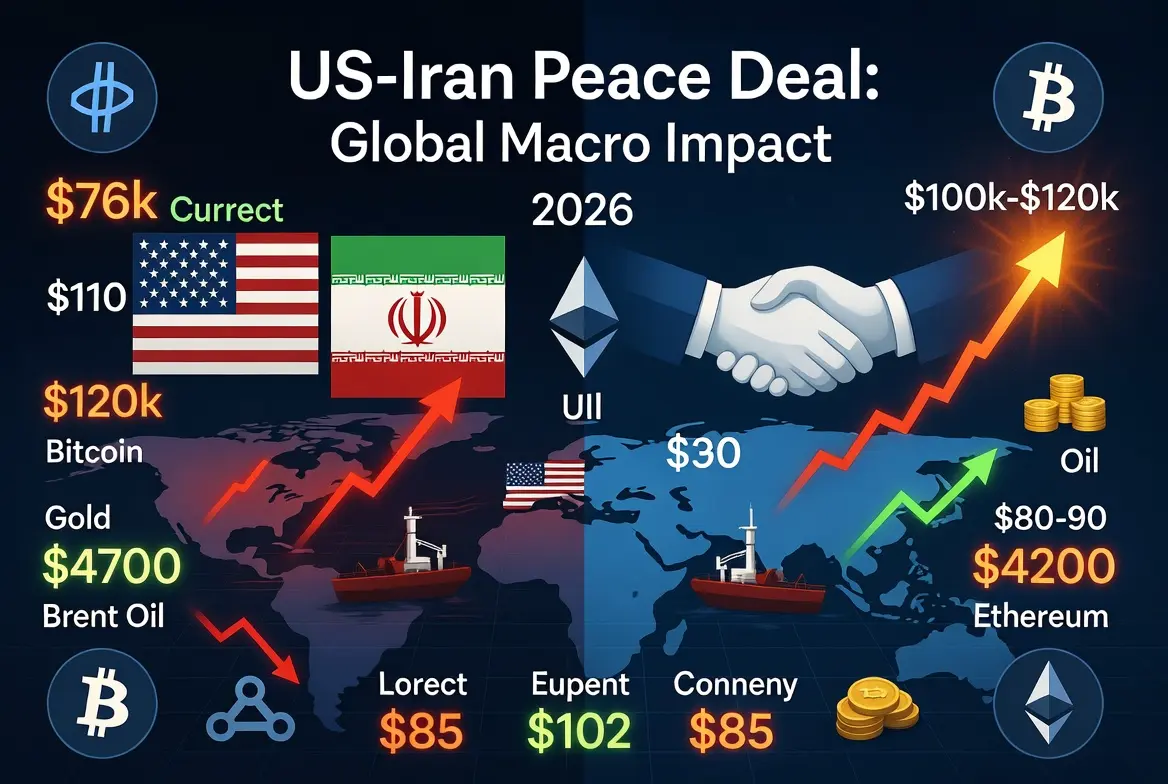
Peak cycle highs: $110,000+
Conflict-driven low: ~$75,000
Current consolidation: $78,000 – $80,000
Bitcoin’s behavior in this cycle shows a hybrid identity:
Part risk-on asset (like tech equities)
Part geopolitical hedge asset (like gold during crisis periods)
Key Drivers of Crypto Reaction
Bullish structural drivers:
Reduction in geopolitical uncertainty improves institutional risk appetite
Lower oil prices reduce global inflation pressure
Increased probability of central bank rate cuts
Continued ETF inflows and custody adoption
Strengthening institutional infrastructure (pensions, funds, sovereign exposure)
Bearish structural drivers:
Reduced sanctions-related demand for Bitcoin as alternative settlement rail
Short-term capital rotation into equities after risk normalization
Profit-taking after conflict-driven volatility expansion
Liquidity redistribution across traditional markets
Ethereum & Altcoins
Ethereum remains strongly correlated to Bitcoin but shows higher sensitivity to liquidity cycles.
Ethereum range: $2,300 – $2,600
Layer-1 ecosystems remain dependent on liquidity expansion
DeFi activity stabilizes but does not yet expand aggressively
Stablecoins continue growing as global settlement infrastructure
Stablecoins are increasingly functioning as:
Cross-border liquidity tools
Inflation hedges in emerging markets
On-chain dollar exposure instruments
Updated Crypto Scenario Matrix
Bull case: $120K – $150K
Driven by liquidity expansion, ETF inflows, and macro easing cycle
Base case: $90K – $110K
Consolidation phase with moderate institutional accumulation
Bear case: $70K – $75K
Risk-off scenario if geopolitical deal collapses or Fed tightens unexpectedly
Gold Market Deep Analysis
Gold is transitioning from a pure crisis hedge into a structural monetary asset supported by long-term macro forces.
Price Structure
Peak: $4,850/oz
Current range: $4,650 – $4,800/oz
Futures: ~$4,713/oz
Gold remains historically elevated due to:
Persistent central bank accumulation
Global debt expansion
De-dollarization trends
Long-term inflation anchoring
Key Structural Forces
Downward pressures:
Declining geopolitical risk premium
Stronger US dollar in normalization phase
Reduced emergency hedge demand from institutions
Capital rotation into risk assets
Upward structural support:
Central banks increasing reserve diversification
Emerging market demand growth (Asia, Middle East)
Persistent fiscal deficits in major economies
Long-term distrust in fiat currency stability
Institutional Forecast Band
JPMorgan: $5,243/oz revised average
ANZ: $5,600/oz long-term target
Barclays: $5,000 – $5,400/oz range
Gold is therefore not expected to collapse even in peace scenarios, but rather to reprice into a higher structural equilibrium zone.
Oil Market Structural Reset
Oil remains the most geopolitically sensitive commodity and acts as the immediate transmission channel for global inflation shocks.
Current Market Structure
Brent peak: $105 – $110/bbl
Post-deal adjustment: ~$98 – $102/bbl
Current equilibrium: ~$98.80/bbl
Key Mechanism Shift
The peace agreement trig
gers:
Removal of war-risk premium (~$5–$10 per barrel)
Stabilization of shipping through Strait of Hormuz
Reduction in insurance and freight volatility
Expectations of increased Iranian supply output
This results in a rapid repricing of short-term crude futures.
Energy Market Transition Phase
Even after peace is confirmed, oil markets adjust slowly due to:
Global tanker routing delays (30–90 days)
Strategic inventory rebalancing
Refinery throughput adjustment cycles
OPEC+ policy reassessment lag
Thus, oil stability is delayed even after geopolitical resolution.
Oil Scenarios
Bull case: $110 – $115
(OPEC cuts + global demand surge + supply lag)
Base case: $95 – $105
(gradual normalization and supply recovery)
Bear case: $85 – $90
(oversupply risk if Iranian exports ramp quickly)
Macro Liquidity & Fed Policy Impact
The US–Iran agreement has indirect but powerful monetary implications.
Transmission Chain:
Oil price decline → lower inflation (CPI)
Lower inflation → higher probability of Fed easing
Rate cuts → liquidity expansion
Liquidity expansion → risk asset rally
This creates a second-order macro effect that often outweighs the geopolitical headline itself.
Historically, such transitions mark the beginning of:
Multi-month equity expansions
Crypto bull cycles
Weak-dollar phases
60-Day Market Timeline Projection
Phase 1 (0–15 days)
High volatility across crypto and oil
Liquidity shock reactions
Forced liquidation events in leveraged markets
News-driven price instability
Phase 2 (15–40 days)
Stabilization of macro expectations
Gradual trend formation in Bitcoin
Gold consolidation at elevated levels
Oil repricing continues with lower volatility
Phase 3 (40–60 days)
Institutional positioning becomes dominant
Macro data (inflation, Fed signals) drives direction
Market structure shifts from reaction → trend trading
Investor Positioning Strategy
Accumulation Phase
Bitcoin: DCA accumulation $75K – $82K zone
Gold: strategic accumulation near $4,600 dips
Oil: avoid directional leverage due to geopolitical sensitivity
Breakout Strategy
Bitcoin above $85K → momentum acceleration phase
Oil above $105 → renewed geopolitical pricing risk
Gold below $4,600 → liquidity rotation confirmation
Avoid high leverage during geopolitical transitions
Use staggered accumulation instead of lump-sum entries
Track Fed policy expectations and inflation data closely
Monitor Strait of Hormuz operational normalization
Conclusion
The US–Iran draft peace deal represents a global macro regime shift, not just a geopolitical event.
It marks the transition from:
Conflict-driven pricing → liquidity-driven pricing
Risk shock → macro stabilization
Energy volatility → structured supply equilibrium
Final Market Snapshot
Bitcoin: $78K–$80K consolidation with long-term upside toward $150K+
Gold: structurally elevated near $4,700/oz with long-term upside stability
Oil: stabilizing near $98–$100 after geopolitical spike above $110
The next 60 days will determine whether global markets enter:
A sustained expansion cycle
or
A renewed volatility regime driven by policy or geopolitical failure@Gate_Square @Gate广场_Official #DailyPolymarketHotspot #GateSquarePizzaDay
repost-content-media
  • Reward
  • 4
  • Repost
  • Share
Vortex_King:
To The Moon 🌕
View More
#DailyPolymarketHotspot
Prediction markets are rapidly becoming one of the most influential sectors in both crypto and global finance. What started as a niche experiment for political forecasting has now evolved into a massive ecosystem where traders speculate on elections, macroeconomics, sports, AI companies, central bank decisions, and even geopolitical conflicts in real time. In 2026, the growth of platforms like Polymarket has completely changed how people interpret public sentiment and future expectations.
The biggest reason behind this rise is speed. Traditional financial analysis ofte
post-image
  • Reward
  • 6
  • Repost
  • Share
MasterChuTheOldDemonMasterChu:
Get in quickly!🚗
View More
🚨 MASSIVE FOR CRYPTO 🚨
Senator Cynthia Lummis just made it clear 👀
🇺🇸 “The next step is simple: get the crypto bill through Congress and onto the President’s desk.”
Washington is moving closer to major crypto regulation clarity — and the market is paying attention 🔥
If this bill moves forward successfully, it could open the door for: ✅ More institutional adoption
✅ Stronger crypto infrastructure
✅ Regulatory clarity
✅ Long-term bullish momentum for $BTC & altcoins
The U.S. is slowly shifting from fighting crypto… to embracing it 🚀
IT’S COMING.
#TradfiTradingChallenge #PlatinumCardCreat
BTC0.08%
  • Reward
  • Comment
  • Repost
  • Share
#DailyPolymarketHotspot
🔥Daily Polymarket Hotspot 🔥 Real-Time Prediction Markets, Macro Signals & Crowd Probability Trading

Polymarket Daily Polymarket Hotspot is a continuously evolving snapshot of global prediction markets where users trade probabilities on real-world outcomes across crypto, macroeconomics, politics, sports, and geopolitical events. Unlike traditional financial dashboards that track prices of assets, prediction markets track *belief itself*—turning expectations into tradable instruments.
At its core, Polymarket operates as a decentralized forecasting layer where each ma
BTC0.08%
  • Reward
  • 11
  • Repost
  • Share
PrinceMagsi786:
To The Moon 🌕
View More
#DailyPolymarketHotspot
Polymarket traders have moved past binary "open vs. closed" thinking. The new pricing structure is controlled de-escalation – partial traffic recovery by late June at 61% probability, versus 39% for continued disruption.
But here’s the catch: sentiment is running far ahead of physical flow.
📉 Strait of Hormuz – Reality Check
Current throughput is only ~10% of normal (12–13 vessels/day vs. 55–65). Prediction markets are forward-looking, but logistics confirm normalization is still in early phase. Even in the bullish scenario, full flow efficiency lags sentiment by week
BTC0.08%
post-image
  • Reward
  • 7
  • Repost
  • Share
Miss_1903:
2026 GOGOGO 👊
View More
Load More