tongrun

vip
Active for: 4.9y
Crypto Market Researcher
Diamond Hands
Life is cycling: balance in motion. Joining the Movement & Ecosystem Building.
Pin
Filecoin’s latest progress in the AI data center space has evolved from a simple “decentralized cloud storage” model into AI-native infrastructure with programmable storage, compute near the data, fast finality proofs, AI Agent self-governance, and other capabilities.
With the launch of Onchain Cloud and the continued influx of high-value data, Filecoin is becoming the underlying AI data infrastructure that Wall Street and traditional financial institutions are paying attention to.
FIL0.46%
View Original
tongrun
Filecoin’s Latest Research and Progress in AI Data Centers (as of July 2026)
In 2026, Filecoin is undergoing a strategic shift from a “general-purpose decentralized storage network” toward “AI-native verifiable storage infrastructure.” Below are the key directions of its latest research and progress:
I. Filecoin Onchain Cloud: a Programmable Storage Layer for AI Agents
On March 26, 2026, Filecoin launched Onchain Cloud on the mainnet, positioning it as a programmable storage and payment layer for developers (especially AI Agents).
In the early stage of the launch, 49.41 TiB of data had already been stored through 478 active datasets, with 81 payment wallets connected to on-chain payment channels.
This service enables AI Agents to autonomously complete data storage, retrieval, and payment without a credit card and without centralized accounts, achieving an ecosystem closed loop for AI pipelines.
II. Compute-over-Data: a New Paradigm Where Computation Moves Closer to Data
Filecoin’s 2026 “Onchain Cloud” plan officially supports Compute-over-Data. AI models can be trained directly on storage nodes without moving massive datasets between centralized servers.
This architecture pushes compute tasks to the location of the data, fundamentally changing the economic model of AI data pipelines and effectively alleviating the bandwidth bottleneck caused by migrating large AI datasets.
III. Fast Finality (F3) Protocol: a 100x Performance Leap
On April 29, 2025, the Fast Finality (F3) protocol went live on the mainnet, increasing transaction settlement speed by 100x and significantly narrowing the most prominent performance gap between Filecoin and centralized cloud services.
This enables Filecoin to better support the high-frequency read/write needs required for AI training.
IV. Rising Storage Utilization: from Capacity Hoarding to Demand-Driven
In 2026, Filecoin is experiencing a strategic shift from “storage capacity hoarding” to “paid demand-driven”:
Storage utilization has risen from single digits two years ago to 36%, with the share of high-value data continuing to increase.
There are 925 customers storing more than 1,000 TB of datasets on Filecoin, covering institutions such as the Smithsonian Institution, the MIT Open Learning Project, the Internet Archive, and the Flickr Foundation.
The FIL+ program has attracted high-value data including medical genomics and satellite imagery.
V. Ecosystem Integration and Deeper AI Vertical Use Cases
5.1 Bagel: a Decentralized Machine Learning Ecosystem
Bagel partnered with the Filecoin Foundation so that AI developers can use Filecoin’s storage capabilities and Bagel’s decentralized compute network for model training, storage, and machine learning workloads. Its innovative GPU re-architecture technology allows storage providers (SPs) to contribute to both the storage and compute networks simultaneously, enhancing Filecoin’s practicality for AI applications and creating new revenue opportunities for SPs.
5.2 Swan Chain: an AI Training and Deployment Layer
Swan Chain uses secure storage on Filecoin and IPFS for AI models and output results, supporting various AI workloads, including model training, inference, and rendering—such as large language models and image/music generation.
5.3 Lilypad: a Distributed Compute Network
Lilypad integrates Filecoin and uses IPFS for hot storage to ensure secure, transparent, and verifiable data processing across the entire artificial intelligence workflow, supporting open and responsible AI development environments.
5.4 Akave Cloud: Filecoin L2 Storage
Akave Cloud provides S3-compatible hot/warm storage plus a Filecoin archival layer, designed specifically for AI, IoT, ML, and compliance workloads. It supports integrations such as Snowflake to enable verifiable backups, offering AI teams a storage solution that balances performance and long-term retention.
5.5 Aethir: Distributed GPU Computing
Aethir integrates with Filecoin to store model outputs and user data. Filecoin storage providers can rent Aethir’s GPUs to perform operations such as sealing, effectively addressing the GPU scarcity issue.
VI. High-Value Data Storage and Public-Interest Projects
Filecoin has become a data foundation for many research and cultural institutions:
Internet Archive
Uses Filecoin to store more than 1 PB of data, supporting long-term archiving such as the Wayback Machine
Science and Cultural Data
OpenAQ (air quality data), Shoah Foundation (video archives), and institutions including Smithsonian and MIT collaborate to enable decentralized preservation
Medical Genomics and Satellite Imagery
Other high-value datasets are onboarded through the FIL+ program
VII. A New Paradigm for Autonomous Data Management by AI Agents
Filecoin’s ecosystem funding direction has clearly listed the following AI products as priorities:
Long-term memory for AI Agents
Tamper-proof audit logs
Provenance for AI training data
Data compliance products for AI teams
Developers can build data DAOs, allowing the community to jointly plan and monetize specialized training datasets, while the network’s existing exabyte-scale capacity can absorb sudden demand spikes.
VIII. Technical Roadmap and Future Directions
Filecoin’s 2026 strategy focuses on high-value vertical domains such as AI pipelines and AI Agents. These scenarios require persistent storage with end-to-end integrity to support critical datasets.
Early data shows that AI Agents can already use autonomous transactions to acquire and update training data without human intervention.
Summary:
Filecoin’s latest progress in the AI data center space has evolved from a simple “decentralized storage drive” into AI-native infrastructure with capabilities such as programmable storage, compute near data, fast finality proofs, and autonomous management by AI Agents.
With the launch of Onchain Cloud and the continuous influx of high-value data, Filecoin is becoming an AI underlying data infrastructure that is attracting attention from Wall Street and traditional financial institutions.
$NVDA #FIL, $FIL
Source of materials: official media/online news. Content is for reference, learning, and交流 only. Please strictly comply with local laws and regulations. It does not represent any investment advice.
repost-content-media
  • Reward
  • Comment
  • Repost
  • Share
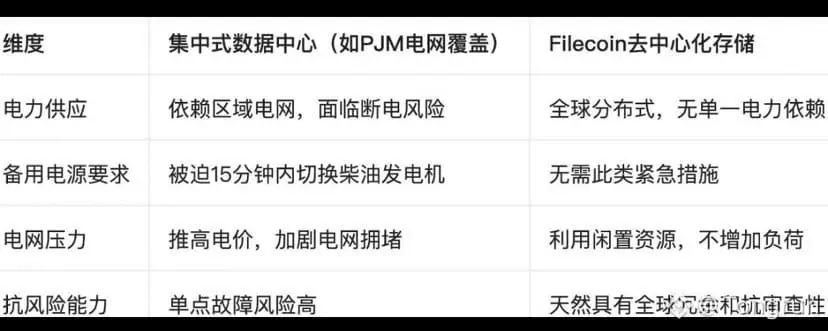
When the largest power grid in the United States was on the verge of collapse due to a surge in #AI数据中心 power demand, and was forced to switch to backup power, Filecoin’s global #分布式存储网络 avoided this fundamental vulnerability of centralized infrastructure from the very beginning. $FIL
FIL0.46%
View Original
tongrun
The US power grid is facing a crisis—distributed storage can directly prevent this kind of fragility
The Department of Energy can force any data center larger than 50 megawatts to switch to backup power within 15 minutes; otherwise, PJM will begin implementing rolling blackouts across 13 states covering a population of 67 million.
The real predicament facing the US power grid:
In the summer of 2026, #美国最大电网运营商PJM is facing a historic electricity supply crisis. The PJM grid, covering 13 states and serving 67 million people, has already broken a record set 20 years ago for peak electricity demand under the dual shocks of extreme heatwaves and AI data center demand.
Key data: Grid load has surpassed 162.7 gigawatts; if demand-response reductions are factored in, actual demand reaches as high as 168.7 gigawatts. Spot wholesale power prices in Virginia’s “data center corridor” have surged to over $600 per megawatt-hour (about 4.07 yuan RMB per kWh).
Background on forced backup power switching:
The US Department of Energy has invoked emergency powers to require any data center larger than 50 megawatts to switch to backup power (diesel generators) within 15 minutes; otherwise, PJM will be forced to implement rolling blackouts across 13 states. The backdrop to this measure is that the shutdown pace of aging power plants is faster than the pace of building new ones, while AI data center electricity demand is growing exponentially.
Filecoin’s decentralized advantage:
In stark contrast, Filecoin, as the world’s largest decentralized storage network, has already achieved global distributed deployment of its storage providers. The filecoin network does not rely on centralized data centers or a single grid node; instead, it distributes data across thousands of independent nodes worldwide, with cryptographic proofs and economic incentives ensuring its operation.
Filecoin’s key advantages are:
No need to rely on #public cloud or a centralized power grid: #存储提供商 has been deployed globally from the start, with no single electricity-supply bottleneck.
Resistant to single points of failure: Power loss at any single node or regional power grid will not affect the network’s normal operation.
No risk of being forced to switch to backup power: The network design naturally avoids the electricity-crisis predicament faced by centralized data centers.
In one sentence: When the United States’ largest power grid is on the verge of collapse due to #AI数据中心 ’s surge in power demand and is forced to mandate a switch to backup power, #Filecoin ’s global #分布式存储网络 has avoided the fundamental fragility of this kind of centralized infrastructure from the start. $FIL ‌Source of material: official media / online news. For reference, learning, and exchange only. Readers should strictly comply with local laws and regulations. This does not represent any investment advice.
repost-content-media
  • Reward
  • Comment
  • Repost
  • Share
The US power grid is facing a crisis—distributed storage can directly prevent this kind of fragility
The Department of Energy can force any data center larger than 50 megawatts to switch to backup power within 15 minutes; otherwise, PJM will begin implementing rolling blackouts across 13 states covering a population of 67 million.
The real predicament facing the US power grid:
In the summer of 2026, #美国最大电网运营商PJM is facing a historic electricity supply crisis. The PJM grid, covering 13 states and serving 67 million people, has already broken a record set 20 years ago for peak electricity dema
FIL0.46%
View Original
post-image
  • Reward
  • Comment
  • 1
  • Share
GEICO case shows a trend for enterprises to migrate from public cloud back to self-built infrastructure—reducing costs through open hardware and independent control;
while Filecoin is an alternative that does not rely on public cloud at all—achieving data storage through globally distributed nodes and cryptographic proofs.
Different technology paths: GEICO moves toward self-built private cloud, while Filecoin moves toward a decentralized public network. $FIL
FIL0.46%
View Original
Original content no longer visible
  • Reward
  • Comment
  • Repost
  • Share
Filecoin’s core value lies in replacing trust with mathematics, providing a storage method that does not rely on any centralized entities.
Against the backdrop of surging AI storage demand and continuously rising traditional cloud costs, this feature is becoming increasingly valuable.
$FIL
FIL0.46%
View Original
tongrun
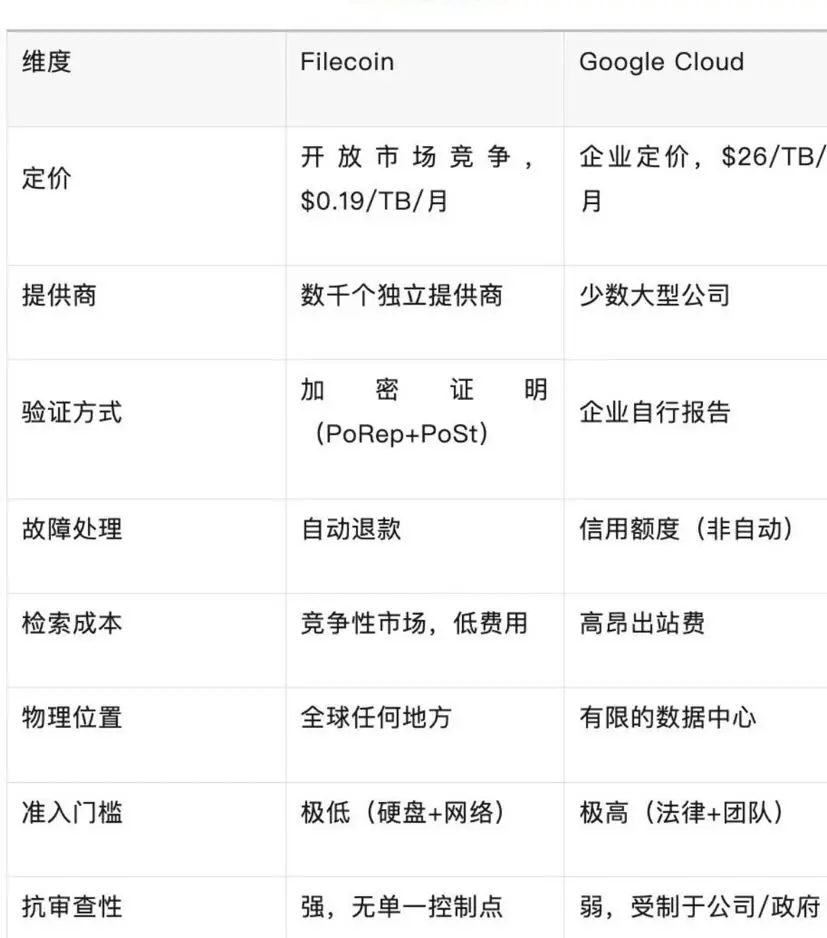
The fundamental differences between Filecoin and Google Cloud across multiple dimensions
I. Pricing mechanism: open market vs enterprise pricing
Filecoin storage prices are determined by competition in the open market. Storage providers bid globally, and users can get highly competitive prices—cold storage costs as low as $0.19 per month per TB, which is 99% lower than AWS.
Google Cloud prices are set uniformly by the enterprise pricing department. Users have no room to negotiate. Standard storage is about $26 per month per TB, which is more than 100 times higher than Filecoin.
II. Degree of decentralization: many independent providers vs a few giants
The Filecoin network consists of thousands of independent, small storage providers around the world. Anyone can join with a low barrier (just a computer, hard drive, and an internet connection).
Google Cloud is controlled by a handful of large companies, with extremely high entry thresholds for storage providers (requiring legal agreements, marketing teams, support staff, etc.).
III. Reliability verification: cryptographic proofs vs self-reported enterprise claims
Filecoin uses two cryptographic mechanisms—Proof of Replication (PoRep) and Proof of Spacetime (PoSt)—to have the network independently and publicly verify whether data is stored correctly, without needing to trust any third party.
Google Cloud’s reliability data is reported by the company itself. Users can only trust its SLA commitments and cannot verify independently.
IV. Data security and fault handling
Filecoin uses an automatic refund mechanism: if a file is lost or unavailable, the network will automatically refund the user—no manual intervention required.
In Google Cloud, when data is lost, only the company decides whether to provide the user with a credit limit as compensation. Users do not have automatic protection.
V. Retrieval costs and flexibility
Filecoin has a highly competitive retrieval market. Retrieval costs are typically lower than storage costs and it supports a zero outbound fee option.
Google Cloud’s retrieval fees are usually higher than storage fees. Egress is expensive, reaching up to 6 times the storage cost, creating a de facto “data lock-in.”
VI. Physical location distribution
Filecoin storage providers are located anywhere in the world. Data can be distributed across different geographic nodes, naturally mitigating single points of failure and the risk of government censorship.
Google Cloud data centers are only distributed in specific regions. Once a data center in an area suffers a fire, flood, or policy change, data in that region may all be lost.
VII. Entry barriers to become a storage provider
Filecoin has extremely low entry barriers: you only need a computer, hard drive, and an internet connection to become a storage provider.
Google Cloud requires complex legal agreements, marketing teams, and support personnel—individuals can hardly participate.
VIII. Censorship resistance and autonomy
Filecoin’s decentralized architecture has no single entity that can censor or delete data. Users have absolute control over their own data.
Google Cloud’s centralized service provider may delete or restrict data access due to government requests or company policies.
The core value of Filecoin lies in replacing trust with mathematics, providing a storage method that does not rely on any centralized entity. Against the backdrop of surging AI storage demand and steadily rising costs of traditional cloud services, this feature is becoming increasingly valuable.
Source material: official media / online news. For reference, learning, and communication only. Readers should strictly comply with the local laws and regulations where they are located. This does not represent any investment advice.
repost-content-media
  • Reward
  • Comment
  • Repost
  • Share
The fundamental differences between Filecoin and Google Cloud across multiple dimensions
I. Pricing mechanism: open market vs enterprise pricing
Filecoin storage prices are determined by competition in the open market. Storage providers bid globally, and users can get highly competitive prices—cold storage costs as low as $0.19 per month per TB, which is 99% lower than AWS.
Google Cloud prices are set uniformly by the enterprise pricing department. Users have no room to negotiate. Standard storage is about $26 per month per TB, which is more than 100 times higher than Filecoin.
II. Degree of d
FIL0.46%
View Original
post-image
  • Reward
  • Comment
  • 1
  • Share
Conflux’s latest progress in its #PayFi transformation mainly comes down to three areas: payment channel integrations (Alchemy Pay, BitUnion, BitStore), the establishment of multi-currency settlement capabilities (GANA integration), and ecosystem funding injection (a 500 million CFX fund). The PayFi infrastructure is basically in place, and it is now awaiting validation and momentum from market demand.
$CFX
CFX-0.49%
View Original
tongrun
As of July 26, 2026, what are the latest developments of Conflux’s PayFi transformation?
I. Full integration of payment infrastructure
1. Strategic cooperation with Alchemy Pay (May 29, 2026)
#Conflux and #Alchemy Pay reached a core partnership, achieving three key breakthroughs:
Native support for Conflux-chain USDT 0 stablecoin; users can buy and sell Conflux-chain assets directly with fiat through #ACH ’s global channels.
Opening 300+ global local payment channels, covering bank cards, e-wallets, bank transfers, and offline cashier systems.
On-chain payments for merchants are implemented: offline physical stores and online e-commerce can integrate the ACH cashier system, enabling users to consume directly with stablecoins.
2. Synergistic closed-loop formed with BitUnion prepaid cards
With ACH online inflows/outflows combined with BitUnion UnionPay prepaid cards for offline spending in 183 countries, a complete payment closed loop is achieved: “use fiat to buy stablecoins → store on-chain → make global offline card purchases.”
3. BitStore Card supports CFX top-ups and spending
BitStore and Conflux have entered into a partnership; users can use BitStore Card to top up and spend CFX. In various scenarios such as shopping and dining, it enhances the practical use of digital currencies.
II. Multi-currency settlement and withdrawal features launched
1. GANA deeply integrates BitUnion’s payment solution
GANA has completed deep integration of the Conflux BitUnion payment solution, introducing multi-fiat settlement capabilities (USD, GBP, etc.), significantly improving cross-border payment efficiency.
2. GANA launches Conflux PayFi withdrawal feature (May 11, 2026)
GANA officially launched the Conflux PayFi withdrawal function, allowing users to directly convert Web3 assets to bank accounts, supporting real-time deposits in major currencies such as USD, RMB, KRW, JPY, and HKD.
III. Ecosystem funds and incentive programs
1. A 500 million CFX ecosystem fund dedicated for support
The Conflux Foundation allocates 500 million CFX from the ecosystem fund specifically to promote the development of PayFi stack components.
2. GANA and Conflux establish a strategic partnership
The two sides will collaborate around three directions: Web3 payment and stablecoin application scenarios; combining on-chain assets with real-world consumption scenarios; and integrating public-chain infrastructure with the payment network.
IV. Clear strategic positioning
Conflux is in a critical stage of transitioning from #DeFi to PayFi and RWA, and its core narrative has shifted to real-world financial infrastructure. Although the market is still in a phase of “narrative leading but demand lagging,” the payment closed loop has already taken shape, and infrastructure buildout is accelerating.
In summary: Conflux’s latest progress in its #PayFi transformation is mainly reflected in three areas—payment channel integration (Alchemy Pay, BitUnion, BitStore), establishing multi-currency settlement capabilities (GANA integration), and ecosystem fund injection (a 500 million CFX fund). The PayFi infrastructure is basically ready, and it is now awaiting validation and a demand-driven surge from the market side.
Source: official media and online news materials, for reference, learning, and exchange only. Please strictly comply with local laws and regulations; this does not represent any investment advice.
repost-content-media
  • Reward
  • Comment
  • Repost
  • Share
As of July 26, 2026, what are the latest developments of Conflux’s PayFi transformation?
I. Full integration of payment infrastructure
1. Strategic cooperation with Alchemy Pay (May 29, 2026)
#Conflux and #Alchemy Pay reached a core partnership, achieving three key breakthroughs:
Native support for Conflux-chain USDT 0 stablecoin; users can buy and sell Conflux-chain assets directly with fiat through #ACH ’s global channels.
Opening 300+ global local payment channels, covering bank cards, e-wallets, bank transfers, and offline cashier systems.
On-chain payments for merchants are implemented:
CFX-0.49%
ACH0.65%
View Original
post-image
  • Reward
  • Comment
  • 1
  • Share
Cost has become the primary concern, reflecting that public cloud economic models are being reexamined amid the backdrop of AI scaling deployments. And decentralized storage solutions such as Filecoin, due to their features of open market competition and the lack of unilateral pricing power, have a natural advantage in “cost predictability,” potentially making them an attractive additional choice for enterprise hybrid multi-cloud strategies. $FIL
FIL0.46%
View Original
post-image
tongrun
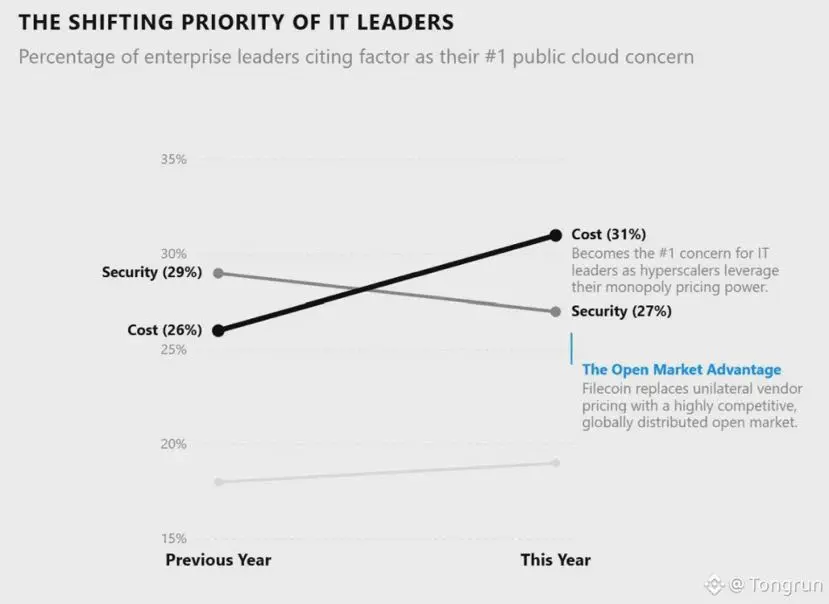
In 2026, cost first surpassed security to become the top concern for enterprises about public cloud! Filecoin has a natural advantage in “cost predictability”
This year, cost first surpassed security to become the top concern about public cloud, rising among IT leaders surveyed by Broadcom from 26% to 31%.
Filecoin storage pricing comes from an open, competitive market. No single vendor can unilaterally raise prices.
According to Broadcom’s report 《Private Cloud Outlook 2026》, in 2026, cost first surpassed security to become the top concern about public cloud, with the share of interviewed IT leaders citing this increasing from 26% in 2025 to 31%.
This change marks an important turning point in enterprise cloud strategy.
1. The backdrop for the rise in cost concerns
The impact of AI workloads
As generative AI and agent workloads move from the experimental stage to production, infrastructure costs have surged. 62% of IT leaders say they are very or extremely concerned about AI infrastructure costs.
Widespread waste in spending
97% of respondents believe their public cloud spending has waste, and 52% think the waste exceeds one quarter of the total budget.
2. Security is still important, but cost has taken priority
While cost has risen to the top issue, security and compliance remain the top reasons for enterprises to migrate workloads (from public cloud back to private cloud) (51%).
Cost predictability comes next, becoming the second-largest driver (39%), which is also one of the most notable year-over-year changes highlighted in the report.
3. Comparison with Filecoin’s pricing mechanism
The fact that Filecoin storage pricing is based on an open, competitive market is precisely in sharp contrast to the root causes of public cloud cost problems:
Public cloud cost issues stem from single-vendor closed pricing, data egress fees, a pay-as-used GPU model, and hard-to-predict bandwidth costs.
Meanwhile, Filecoin’s decentralized market model—because no single entity can unilaterally raise prices—can theoretically provide higher cost predictability, directly addressing enterprises’ current top concern: “cost predictability.”
4. Real-world impact: enterprises accelerate migration back to private cloud
83% of enterprises are considering moving workloads from public cloud back to private cloud, and 50% have already completed part of the migration.
Among them, 43% of organizations currently migrating are specifically moving AI training, large language model, and inference workloads back.
The growth rate of investment in private cloud is double that of public cloud (21 percentage points vs 10 percentage points).
In conclusion
Cost becoming the top concern reflects that, amid the scaling up of AI deployments, the economic model of public cloud is being reexamined. And decentralized storage solutions such as Filecoin, due to their open market competition and lack of unilateral pricing power, have natural advantages in “cost predictability,” potentially making them an attractive complementary option for enterprises’ hybrid multi-cloud strategy.
Source: official media / online news materials. For reference, learning, and交流 only. Please readers strictly comply with the laws and regulations in their jurisdictions. This does not represent any investment advice.
  • Reward
  • 8
  • Repost
  • Share
whxing777:
How much more shame do you still have?
View More
In 2026, cost first surpassed security to become the top concern for enterprises about public cloud! Filecoin has a natural advantage in “cost predictability”
This year, cost first surpassed security to become the top concern about public cloud, rising among IT leaders surveyed by Broadcom from 26% to 31%.
Filecoin storage pricing comes from an open, competitive market. No single vendor can unilaterally raise prices.
According to Broadcom’s report 《Private Cloud Outlook 2026》, in 2026, cost first surpassed security to become the top concern about public cloud, with the share of interviewed IT
FIL0.46%
AVGO-2.79%
View Original
  • Reward
  • Comment
  • 1
  • Share
When U.S. AI data centers are widely delayed due to transformer shortages, grid bottlenecks, and community opposition, Filecoin’s global distributed storage network is already running and is not constrained by these centralized infrastructure issues. $FIL
FIL0.46%
View Original
post-image
tongrun
U.S. Data Center Construction Bottleneck | A Comparison with Filecoin
Real-world bottlenecks facing U.S. data centers:
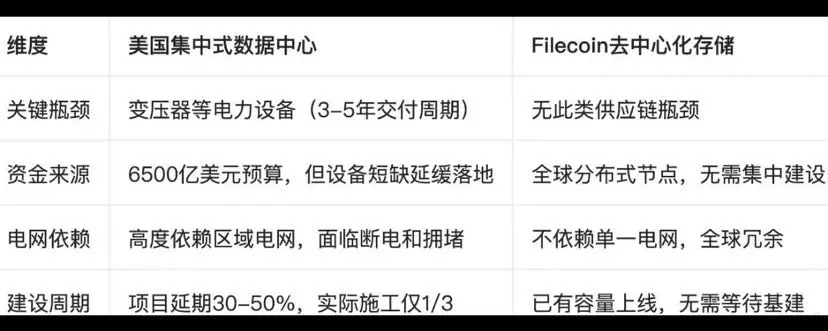
According to a report from Bloomberg in April 2026, U.S. AI data center construction is encountering a severe “power choke point” problem. The transformer delivery cycle has stretched from 24–30 months before 2020 to 3–5 years today, and some companies are even forced to refurbish old transformers from decommissioned power plants as emergency backups.
In 2026, the U.S. plans to add about 16 GW of data center capacity, but 30%–50% of projects face the risk of delay or cancellation; currently, only about 5 GW has truly entered the construction stage.
This is not because of a lack of chips or funding—just #Alphabet、# four tech giants, Amazon, #Meta, and Microsoft. In 2026, AI infrastructure budgets from these companies alone exceed $650B.
What really gets stuck in the “throat” is power equipment that accounts for less than 10% of the total cost of data centers: transformers, switchgear, and batteries.
Layered multiple crises:
Tight power supply: #Texas’s grid (ERCOT) projects that by 2032, #数据中心 power demand in the state will force the addition of 111 GW of electricity.
Community opposition escalates: the share of people opposing building new data centers near their communities surged from 48% at the end of 2025 to 70% in May 2026.
Policy tightening: across the U.S., 69 local governments have issued construction moratorium orders, and Seattle has implemented a one-year ban.
Labor shortages: there is a severe shortage of skilled professionals such as electricians and plumbers; in remote areas, labor costs have risen by as much as 30%.
Filecoin’s differentiated positioning:
In sharp contrast to the above predicaments is that #Filecoin capacity has already been initiated and is live.
As a decentralized storage network, Filecoin’s storage providers do not need to rely on public cloud or centralized power grids from the start; instead, they use idle disk space around the world to build a distributed storage network.
This architecture inherently avoids the risks faced by centralized U.S. data centers, including power equipment shortages, grid congestion, and single points of failure.
One-sentence summary:
When #AI数据中心 in the U.S. is widely delayed due to transformer shortages, grid bottlenecks, and community opposition, Filecoin’s global distributed storage network is already operating and is not constrained by these centralized infrastructure limitations.
Source: official media / online news. For reference, learning, and交流 only. Readers should strictly follow local laws and regulations, and this does not represent any investment advice.
  • Reward
  • Comment
  • Repost
  • Share
U.S. Data Center Construction Bottleneck | A Comparison with Filecoin
Real-world bottlenecks facing U.S. data centers:
According to a report from Bloomberg in April 2026, U.S. AI data center construction is encountering a severe “power choke point” problem. The transformer delivery cycle has stretched from 24–30 months before 2020 to 3–5 years today, and some companies are even forced to refurbish old transformers from decommissioned power plants as emergency backups.
In 2026, the U.S. plans to add about 16 GW of data center capacity, but 30%–50% of projects face the risk of delay or cancellat
FIL0.46%
AMZN-0.64%
META-1.78%
MSFT0.06%
View Original
  • Reward
  • Comment
  • 1
  • Share
When traditional technology giants face rising compliance costs, longer construction timelines, and strong community opposition while deploying physical data centers, Filecoin’s pre-deployed, globally distributed, permissionless decentralized network offers businesses a built-in storage solution that naturally hedges the above geographic and political risks.
FIL0.46%
View Original
tongrun
According to a report released by Data Center Watch, in the United States alone in 2025, at least 48 data center projects will have faced at least one of the following outcomes: being forced to stall or be delayed due to opposition from local communities. The total investment involved is as high as $156B. Local backlash and environmental concerns have evolved from isolated incidents into a nationwide political force, posing significant geopolitical and site-selection risks to large-scale capital deployments.
Specific manifestations of the local opposition wave
Projects stalled at massive scale
In just three short months from March to June 2025, projects worth about $98B were severely affected, exceeding the $64B total previously tracked over nearly a year (from May 2024 to March 2025).
Opposition groups become networked
By the end of 2025, active local opposition groups had spread across 42 states, numbering in the hundreds. Only #弗吉尼亚州 has 57 active opposition groups, confirming the region’s intense tensions as the #全球数据中心 -highest density area.
Energy and bills become catalysts
Residents are worried that #数据中心建设 will drive up electricity bills, increase resource consumption, and undermine the fairness of tax incentives. This concern has fueled cross-party opposition movements, even affecting local elections in Georgia and Virginia.
Filecoin’s response plan
Filecoin’s decentralized storage network fully bypasses this kind of political and community risk that is highly tied to geographic siting.
No geographic dependency
Filecoin’s storage capacity is provided by thousands of independent storage providers worldwide. These nodes are distributed around the globe; enterprises do not need to wait for facilities on a specific plot of land to be approved before they can directly use the network capacity that is already deployed and online.
Capacity already in place
Filecoin’s storage capacity was built and launched before the current AI and #数据中心 construction boom caused supply-chain tightness (such as hard drive preorders extending to 2028). This offers an “on-demand” #存储 supply that is not constrained by approval delays for new data center construction.
Mitigate geopolitical risk
Under the traditional model, data center developers must deal with complex processes ranging from local zoning regulations to environmental lawsuits and public hearings—making projects highly likely to be stalled due to shifts in political sentiment.
Filecoin’s decentralized market mechanism frees the supply of storage resources from “physical building approval,” fundamentally avoiding this risk.
Cost predictability
Compared with the current spike in storage hardware prices driven by supply-demand imbalance (such as a near 50% increase in enterprise hard drive prices) and the uncertainty of future construction costs, Filecoin’s pricing model in an open competitive market provides greater cost stability.
Conclusion
When traditional tech giants face rising compliance costs, longer construction timelines, and strong community opposition to deploy physical data centers, Filecoin—with already deployed capacity, global distribution, and a permissionless decentralized network—offers enterprises a storage solution that naturally hedges the above geographic and political risks.
It enables enterprises to bypass the unavoidable “NIMBY (not in my backyard)” game phase of building data centers and directly obtain storage resources.
Source material: official media / online news. For reference, learning, and交流 only—strictly comply with local laws and regulations. It does not represent any investment advice.
  • Reward
  • Comment
  • Repost
  • Share
According to a report released by Data Center Watch, in the United States alone in 2025, at least 48 data center projects will have faced at least one of the following outcomes: being forced to stall or be delayed due to opposition from local communities. The total investment involved is as high as $156B. Local backlash and environmental concerns have evolved from isolated incidents into a nationwide political force, posing significant geopolitical and site-selection risks to large-scale capital deployments.
Specific manifestations of the local opposition wave
Projects stalled at massive scale
FIL0.46%
View Original
  • Reward
  • Comment
  • 1
  • Share
Filecoin’s Latest Research and Progress in AI Data Centers (as of July 2026)
In 2026, Filecoin is undergoing a strategic shift from a “general-purpose decentralized storage network” toward “AI-native verifiable storage infrastructure.” Below are the key directions of its latest research and progress:
I. Filecoin Onchain Cloud: a Programmable Storage Layer for AI Agents
On March 26, 2026, Filecoin launched Onchain Cloud on the mainnet, positioning it as a programmable storage and payment layer for developers (especially AI Agents).
In the early stage of the launch, 49.41 TiB of data had already
NVDA-0.99%
FIL0.46%
View Original
post-image
post-image
post-image
post-image
post-image
post-image
post-image
  • Reward
  • Comment
  • 1
  • Share
LayerEdge recursive proof aggregation technology can reduce on-chain verification costs in the Conflux ecosystem.
Conflux’s global user base complements LayerEdge’s verification network,
and Conflux has taken a new step toward expanding its infrastructure ecosystem.
EDGEN0.00%
CFX-0.49%
View Original
  • Reward
  • 1
  • Repost
  • Share
HostGg:
Just go for it 👊
  • Pinned