Ethereum Name Service (ENS) co-founder Alex Van de Sande proposed a new plan on July 7: delegate 5 million idle ENS tokens from the ENS DAO treasury to community participants, thereby diluting the voting dominance of a single large holder and driving DAO governance reform. Van de Sande emphasized that the delegated tokens still belong to the DAO, and participants only receive voting rights.
ENS DAO Voting Structure Problem: One Delegate Exceeds the Combined Voting Power of the Next 50 Delegates
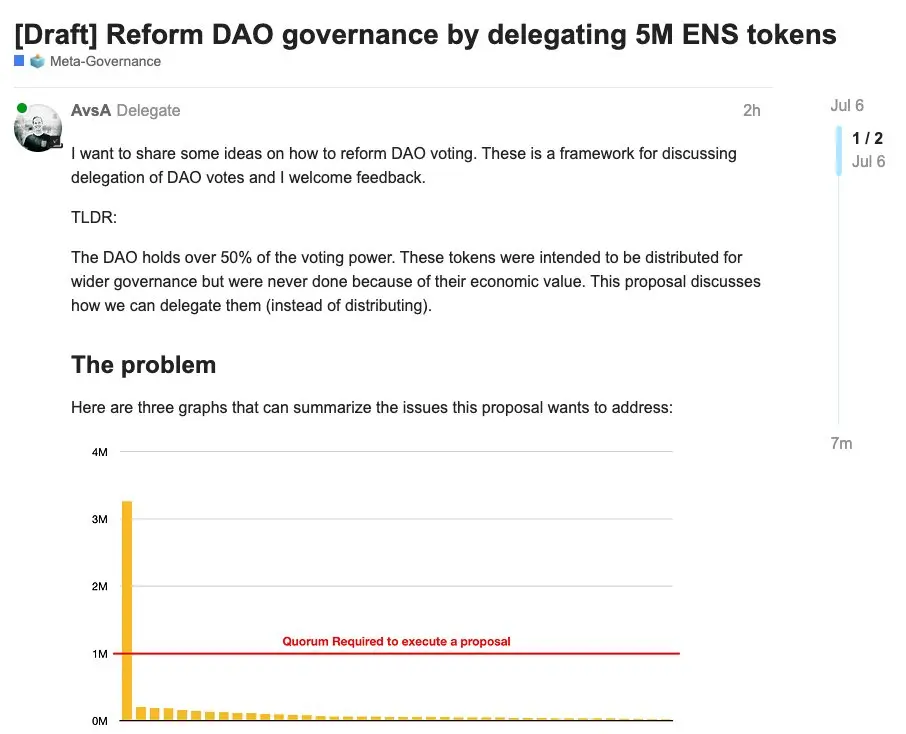 (Source: Van de Sande)
According to Van de Sande's proposal description, the current voting structure of ENS DAO exhibits a high degree of concentration:
One person equals quorum: The voting power of a single delegate alone can reach quorum, sufficient to execute any governance proposal.
Severe weight imbalance: This delegate's voting weight exceeds the combined voting power of the next 50 delegates.
Total voting power scale: ENS DAO's total voting power is approximately 40 million tokens.
Impact of the delegation scale: 5 million tokens represent about 12.5% of the total voting weight, enough to offset the concentrated voting of 1 to 2 large holders in specific proposals.
Design features of Van de Sande's proposal: The delegated tokens remain in the DAO treasury; participants only receive temporary voting rights and cannot sell or transfer them. This effectively temporarily delegates the voting rights of the DAO's own assets to active community members.
ENS Labs Five-Member Board Controversy: Context of Treasury Capture Accusations and Governance Disputes
Van de Sande's proposal did not emerge in a calm environment. Previously, ENS Labs proposed transferring control of the DAO's operational wallet, ENS token holdings, and fund allocation to a five-member board, triggering strong community accusations of "treasury capture by insiders." This is the direct backdrop for the escalating governance controversy within ENS.
Over the past year, ENS has also implemented multiple infrastructure upgrades, including migrating from the Ethereum mainnet to an L2 network, integrating TLD top-level domains, and a hierarchical registration system. These technical upgrades have increased community expectations for governance efficiency and made the decision-making bottleneck caused by voting concentration more apparent.
Frequently Asked Questions
How does Alex Van de Sande's 5 million token delegation proposal work specifically?
According to the proposal description, 5 million idle ENS tokens from the ENS DAO treasury will be delegated to community participants. Delegates only receive voting rights; token ownership remains with the DAO treasury and cannot be sold or transferred. The 5 million tokens account for approximately 12.5% of ENS's total voting power (about 40 million). The proposal aims to disperse the current highly concentrated voting structure. Specific delegation mechanisms and eligibility are subject to the official ENS DAO proposal text.
How serious is the "one person equals quorum" problem in ENS DAO?
According to Van de Sande's explanation, in current ENS DAO governance, a single delegate's voting power alone can reach quorum and execute any proposal. Moreover, this delegate's voting weight exceeds the combined voting power of the next 50 delegates, indicating that governance decisions are effectively dominated by a very small number of people.
What is the connection between ENS Labs' five-member board proposal and this delegation proposal?
ENS Labs previously proposed transferring control of the DAO's operational wallet and fund allocation to a five-member board, triggering community accusations of "treasury capture by insiders." Van de Sande's delegation proposal is interpreted as a countermeasure against the centralization trend of ENS governance, aiming to rebuild governance balance within ENS DAO by expanding the voting weight of active community participants. The final outcomes of both proposals will be determined by the official ENS DAO voting results.


