Arthur Hayes’s family office Maelstrom published a deep research report on X on June 24 about Solana ecosystem physical card trading platform Collector Crypt (CC), setting a target price for the CARDS token at $4 before the end of summer. CC offers instant settlement and on-chain liquidity with only a 2% fee (compared with eBay’s 16-20%).
Collector Crypt business data disclosed in the Maelstrom research report
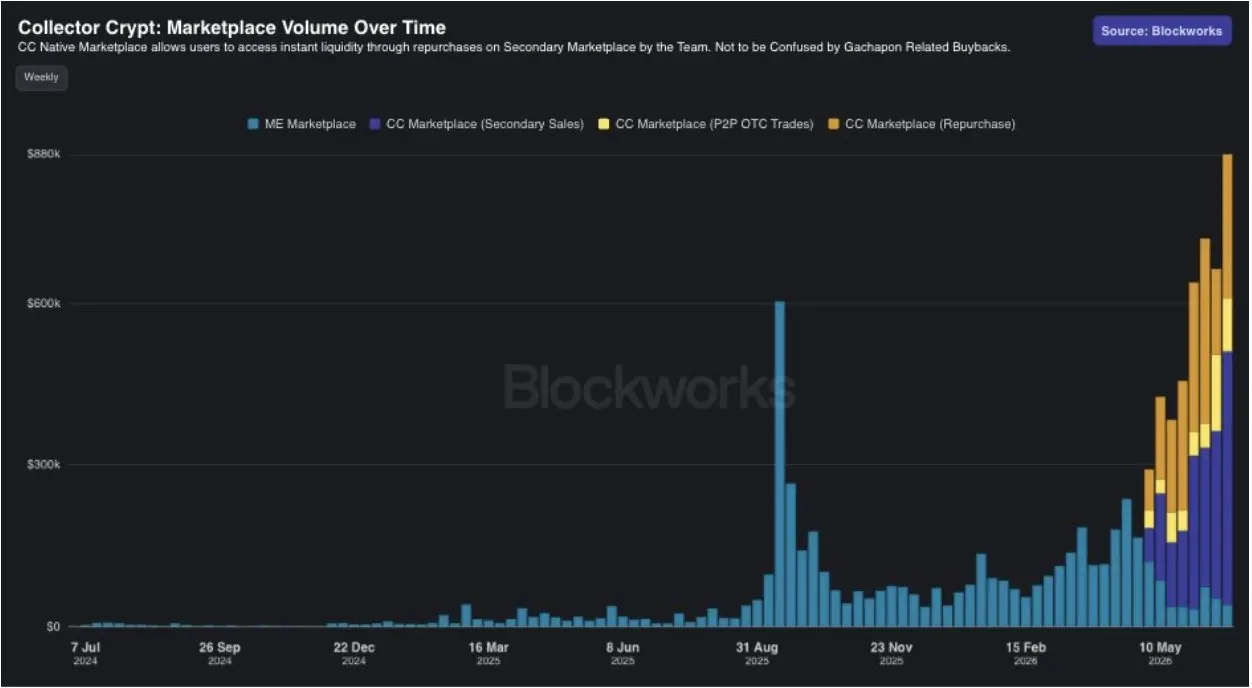 (Source: Maelstrom research report screenshot)
Based on Maelstrom’s deep research report (research author: @lukasruppert), the main business data for Collector Crypt is as follows:
· May annualized total revenue of about $1.2 billion, with annualized gacha business profit of about $54 million;
· In June, projected annualized total revenue of $2.4 billion, annualized profit of about $109 million, and about 800 daily active users;
· Weekly peak secondary-market trading volume of up to $650,000;
· Cumulatively about $23 million in transaction card inventory and about $10 million in cash have been deployed; buybacks have been initiated (purchases in the market since June 11;
· On May 12, it acquired a seed-round pre-investor’s shares for $500,000).
Gacha machine business model: 4.5% profit margin, 2% fee, and comparison with eBay’s 16-20%
The report explains that CC’s core profit model is a gacha machine (opening digital card packs): it buys trading cards in bulk at a 5-15% discount. After users open packs, they can choose to keep cards or sell immediately at a price 7-15% below market. When users resell back, the platform earns an approximately 4.5% profit margin; users’ overall expected收益 is about 2%, while the platform keeps about 4.5%.
On fees, the report points out that eBay’s total cost for selling Pokémon cards accounts for 16% to 20% of the selling price (including 13.25% transaction fee, fixed order fee, promotion fee, packaging, and shipping). CC charges only 2%, and provides instant settlement, insured custody, and one-click trading. Maelstrom compares CC to a stablecoin-like disruption of cross-border payments, arguing that this is a “tenfold upgrade” for collectible card trading.
Token supply analysis: FDV based on a $2 billion foundation, and valuation recalculation based on actual circulating supply of only $1.3 billion
The report states that CARDS’s FDV is calculated based on a total token supply of $2 billion, but the report believes this overestimates the final supply. Over 50% of the total supply is allocated to the foundation and the community, and most of it may never enter circulating supply.
The report’s conservative estimate is: by September 2027 (after all tokens are unlocked), only about 1.3 billion tokens may actually enter circulation. Based on this, assuming a $500 million FDV purchase and holding until all unlocks are completed, the actual paid valuation is roughly equivalent to $325 million.
The report also notes that CC chooses to list first on the DEX rather than paying high centralized exchange listing fees (similar to Hyperliquid’s strategy), leading to “liquidity not yet in place,” so even fundamental investors remain largely on the sidelines.
FAQ
Does Maelstrom’s $4 target have a clear time window?
According to Maelstrom’s post on X, the target is “$4 before Summer’s End” (the specific date is not defined), and it clearly marks “Non-investment advice. Do your own research.” This is Maelstrom’s investment viewpoint in its research report, not a market commitment or guarantee.
Why is Collector Crypt so profitable now but has only 800 users?
Based on Maelstrom’s research report, CC’s high profit comes from bulk purchase discounts (5-15%), the 4.5% profit margin generated when users resell at a high rate after opening, and steadily growing secondary-market trading fee income. The report says that although daily active users are only about 800, the platform’s profitability has already exceeded many crypto top companies, and it is in a phase of rapid growth.
Why is the circulating supply of CARDS tokens so different from what FDV shows?
According to the report, FDV is calculated based on a theoretical total supply of $2 billion. But among the tokens allocated to the foundation and the community—over 50%—most may never enter circulation (the foundation portion may not be used at all due to strong profitability; the community incentives portion will slow its distribution as token prices rise). The report conservatively estimates that by September 2027, the actual circulating token count will be about 1.3 billion, making the real paid valuation lower than the number indicated by FDV.


