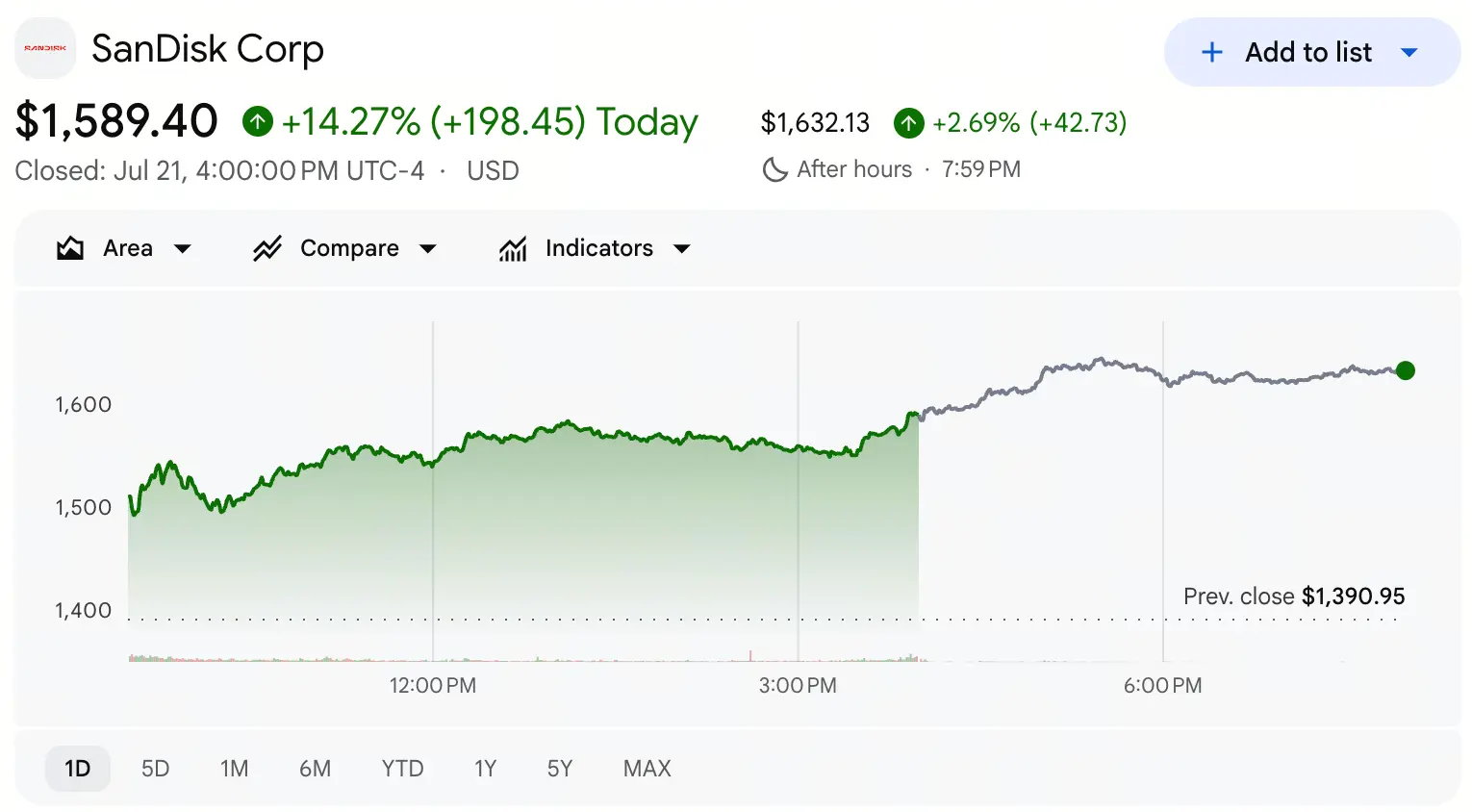
On July 22, 2026, a landmark move by a storage-chip sector bellwether drew widespread market attention. SanDisk surged more than 14% in a single day, with its share price reclaiming the $1,500 level; it was temporarily trading at $1,588.88. This rebound began around last week’s low near $1,325 and, within just a few trading days, the cumulative gain has already reached about 20%. Earlier, at the end of June, SanDisk briefly set a record high of $2,353. After a drawdown of roughly 32% from its historical peak, it rebounded by more than 20% in short order—this price action trajectory has sparked market discussion: is the storage sector going through a systemic inflow of capital?
What’s the industry backdrop behind SanDisk’s surge?
SanDisk’s rise this time is not an isolated event. Since the second quarter of 2026, the global storage-chip market has continued to send recovery signals. After the deep downturn from 2023 to 2024, contract prices for NAND Flash and DRAM began stabilizing gradually in the second half of 2025, and the first half of 2026 has shown a clear upward price trend. As a leading provider of flash storage solutions worldwide, SanDisk’s stock performance is often viewed as a leading indicator of industry conditions in the storage space.
From an industry-cycle perspective, the storage-chip industry is highly cyclical, and supply-demand imbalances are the main drivers of price volatility. From 2023 to 2024, major global storage manufacturers proactively cut production to respond to weak demand, and the supply-side contraction began to show effects in 2025. Entering 2026, continued expansion of AI compute infrastructure, growth in enterprise SSD demand, and the completion of inventory digestion at consumer-electronics endpoints together provided support on the demand side. SanDisk’s sharp rebound from last week’s low of $1,325 to $1,588.88 reflects the market’s concentrated response to this recovery narrative.
What drives the capital inflow into the storage sector?
To understand capital inflows into the storage sector, first you need to see what money is withdrawing from—and what it is flowing into. In the first half of 2026, global capital markets had already priced AI compute-related industry chains quite thoroughly; valuations for sub-segments such as GPUs and optical modules were at historical highs. By contrast, after a two-year-cycle bottom, the storage-chip segment had more room for valuation repair.
From the perspective of capital behavior, the storage sector’s appeal shows up in three areas. First, storage chips are one of the most resilient sub-segments in the semiconductor industry; when the cycle turns, the slope of performance improvement tends to be steepest. Second, the large-scale deployment of AI compute is creating entirely new storage demand—large-model training and inference rely far more on high-speed, high-capacity storage than traditional computing scenarios. Third, the competitive landscape in the storage industry is relatively clear: major players’ capacity plans and pricing strategies are more predictable, reducing investment uncertainty.
After SanDisk touched a historical high of $2,353 at the end of June, it experienced about a 32% pullback. That degree of adjustment is relatively sharp within the semiconductor sector. However, after initiating a rebound from the mid-July low of $1,325, it climbed back to $1,588 within just a few days, and the rebound strength was similarly strong. This kind of price pattern—rapid reversal after a deep drop—usually indicates the market is repricing a particular asset, rather than being driven purely by short-term sentiment.
How does AI compute expansion reshape the storage demand structure?
Reshaping storage demand through AI is a key clue to understanding the valuation repair in this storage-sector rally. Traditionally, storage-chip demand comes mainly from three endpoint categories: PCs, smartphones, and servers. But AI large models have parameter sizes moving from the hundreds of billions to the trillion scale, imposing entirely different requirements for storage bandwidth, capacity, and latency.
HBM (high-bandwidth memory) is a typical representative of this AI-driven storage demand boom. HBM uses 3D stacking technology to achieve data-transfer rates far beyond traditional DRAM, and it has become standard equipment for AI training chips. From 2025 to 2026, global HBM capacity has remained tight; major storage vendors have shifted capacity toward HBM, which in turn exacerbates supply contraction in the traditional DRAM market and indirectly lifts overall storage prices.
Meanwhile, demand for enterprise SSDs is also growing rapidly in AI inference scenarios. Large-model inference deployment requires massive parameter storage and fast reads; enterprise SSDs’ advantages in read/write speed and capacity density make them a key component of AI infrastructure. SanDisk’s positioning in the enterprise SSD space makes it one of the core beneficiaries of this demand-structure shift.
Is the supply-demand landscape for storage chips undergoing fundamental change?
Supply-side constraints are supporting continued recovery in storage prices. In 2026, major global storage manufacturers’ capital expenditures remain relatively restrained. After the industry trough of 2023 to 2024, manufacturers have become more cautious about expansion decisions and are more inclined to improve output efficiency through technology upgrades rather than simply adding capacity.
On process technology, NAND Flash is evolving toward 3D NAND with 200 layers and above, while DRAM is moving toward 1α and 1β nanometer-class nodes. Unit cost declines resulting from technology upgrades help offset, to some extent, pressure from rising prices; however, ramping capacity takes time, so supply elasticity in the short term is limited.
Uncertainty on the demand side mainly comes from the pace of macroeconomic recovery and endpoint consumption. Although global economic growth in 2026 remains positive overall, differences across regions and industries are still evident. Replacement demand in consumer electronics has not fully recovered to pre-pandemic levels, which to a certain extent limits upside potential for storage demand.
Taken together, supply- and demand-side factors suggest the storage-chip market is moving gradually toward balance, with prices rising moderately—not a surge cycle driven by severe supply-demand imbalance. This implies the valuation repair for this storage sector could be relatively durable.
How long can the storage sector’s valuation repair last?
The durability of valuation repair depends on two core variables: the upward slope of storage prices and the quality of demand growth.
From the price side, storage-chip price increases in the first half of 2026 are more the result of supply-side contraction than explosive demand growth. If terminal demand in the second half fails to follow through effectively, the momentum behind price gains may gradually weaken. But from another angle, moderate price increases actually help extend the cycle duration, avoiding demand suppression caused by prices rising too quickly.
From the demand side, growth in AI-related storage demand has strong structural characteristics. The growth rates of high-end products such as HBM and enterprise SSDs are significantly higher than those of traditional storage products, providing a differentiated growth path for firms with technological advantages and product footprints. SanDisk’s positioning across enterprise and high-end consumer storage markets places it favorably within this structural shift in demand.
Market pricing for the storage sector is shifting from the logic of “bouncing off the cycle bottom” to the logic of “structural demand growth.” This transition itself leads to rebuilding valuation frameworks, and rebuilding often brings volatility. SanDisk’s pullback after reaching the $2,353 historical high at the end of June—followed by a rapid rebound—reflects the price-discovery function during this kind of valuation reshaping.
What risks does the investment logic for the storage sector face?
Any repricing of assets comes with risks, and the storage sector is no exception. The risks that need to be watched mainly include the following.
First is the timing of the inventory cycle. In the first half of 2026, inventories of storage chips in some channels have already started to rise. If terminal demand growth falls short of expectations, inventory pressure could once again become a factor that suppresses prices.
Second are potential supply-chain shocks from geopolitical factors. The storage-chip industry chain is highly globalized; any regional supply disruption could cause nonlinear effects on the global supply-demand balance.
Third is the shortening of product lifecycles caused by technology iteration. Storage chips update extremely fast; each generation has a limited lifecycle, so manufacturers need ongoing R&D investment to maintain competitiveness, which creates continuous capital pressure for smaller and mid-sized firms.
Fourth is the macroeconomic outlook. As a cyclical industry, storage chips are highly correlated with global economic growth. If global economic conditions decline unexpectedly in the second half of 2026, the recovery pace of storage demand could be interrupted.
These risks do not negate the storage sector’s current valuation-repair logic, but they do remind market participants to pay attention to timing and rhythm.
What broader signals can be seen from SanDisk’s surge?
SanDisk rebounded from last week’s low of $1,325 to $1,588.88, with a single-day rise of more than 14%. From a more macro perspective, it may be reflecting several signals worth noting.
First, global technology industry investment priorities are structurally extending from the compute layer to the storage layer. Over the past two years, market attention on AI has been highly concentrated on compute chips, but storage—also a critical component—is now being reevaluated for its strategic value.
Second, assets near cycle bottoms often have asymmetric risk-reward characteristics. After the storage-chip industry endured a decline for roughly two years, downside risks have largely been released, while upside elasticity has been gradually building alongside industrial recovery. SanDisk’s rapid rebound initiated from $1,325 is an expression of that market asymmetry.
Third, rotation of capital within the technology sector is accelerating. Money seeking better value is moving away from high-valuation segments toward sub-sectors with more attractive cost-effectiveness. Due to its clear position in the cycle and a more certain industry trend, the storage sector is one of the candidate directions for capital inflows.
FAQ
Q1: What are the core drivers behind SanDisk’s surge this time?
SanDisk’s surge reflects a convergence of multiple factors: improved supply-demand conditions in the storage-chip industry, AI compute expansion driving growth in storage demand, and valuations in the sector sitting near the cycle bottom. In the first half of 2026, NAND Flash and DRAM prices continued to climb, while AI-related storage demand such as enterprise SSDs and HBM grew strongly.
Q2: Is the capital inflow into the storage sector sustainable?
Whether valuation repair in the storage sector is sustainable depends on the slope of storage price increases and how quickly terminal demand follows through. With supply and demand moving toward balance and prices rebounding moderately—combined with structural demand growth driven by AI—there is fundamental support for valuation repair. But inventory cycle dynamics and macroeconomic uncertainty still need to be watched.
Q3: How do the storage-chip industry’s cyclical characteristics affect the investment pace?
The storage-chip industry has highly cyclical traits, and supply-demand mismatches are the primary drivers of price fluctuations. Industry troughs are often the window for positioning, while the phase of rapidly rising prices requires vigilance about the risk of a cycle top. The industry is currently transitioning from the cycle bottom into a recovery phase.
Q4: How is the storage sector in the crypto ecosystem related to the traditional storage market?
Both benefit from storage demand expansion driven by the exponential growth of global data. Decentralized storage projects may show some correlation with traditional storage market sentiment in terms of token prices and network activity. The integration of AI and blockchain also creates new application scenarios for storage-like crypto assets.
Q5: What risk indicators should be monitored when investing in the storage sector?
Key risk indicators to watch include: channel inventory levels of storage chips, capital expenditure plans of major storage manufacturers, global macroeconomic data, and marginal changes in AI-related storage demand. Shifts in these indicators may signal a turn in the industry cycle.


