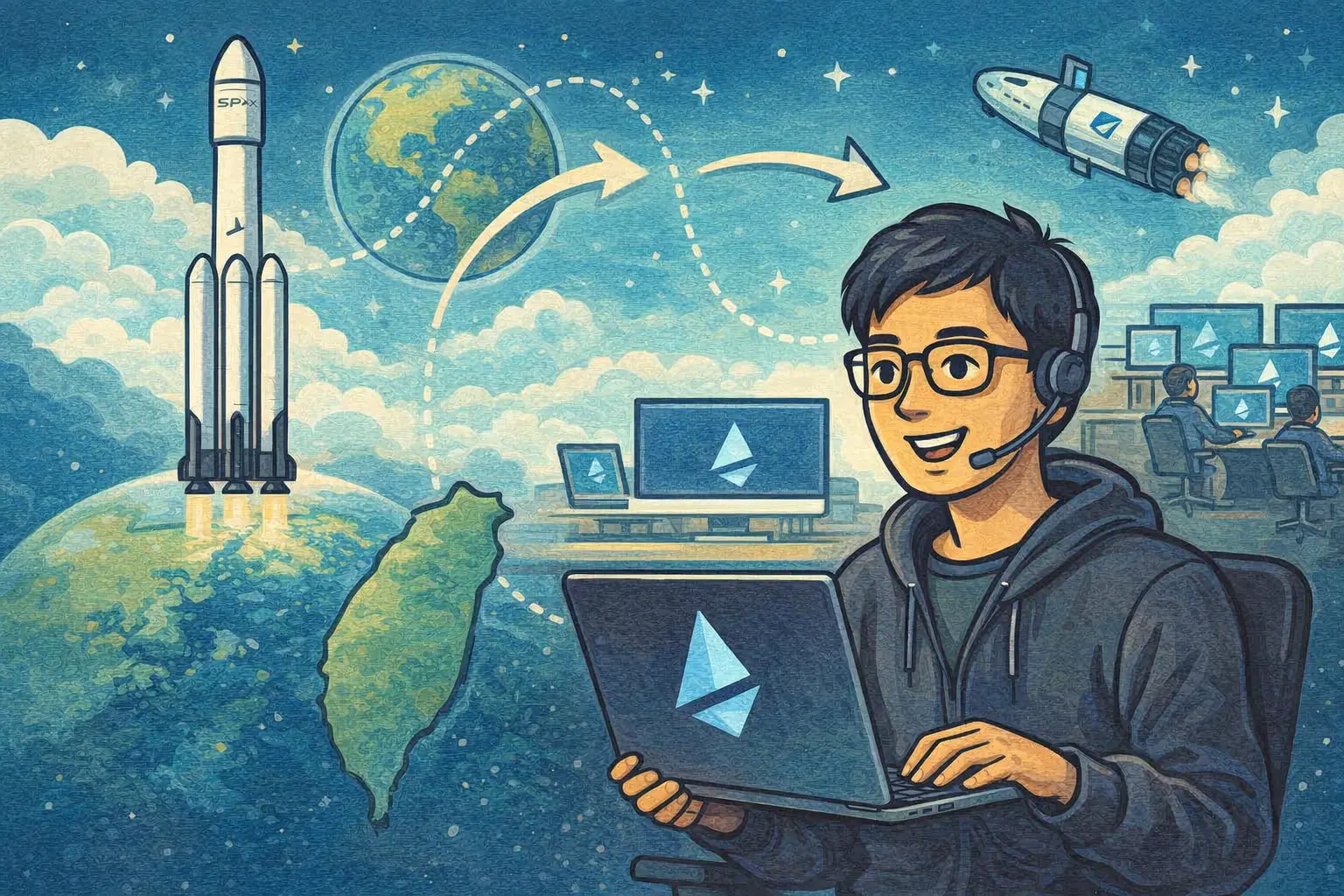
SpaceX, through its subsidiary X67, and Cursor’s parent company Anysphere have signed a merger agreement, acquiring Cursor via an all-stock deal. Among Cursor’s founding team, there are faces from Taiwan—early engineer Huang Shaoru (Ian Huang), who attended the Taipei American School and the University of Illinois Urbana-Champaign. He joined Cursor by passing a trial while he was still in college, when the company had only about 7 people.
SpaceX signs a merger agreement with Anysphere via its X67 subsidiary, worth $60 billion
According to SpaceX’s 8-K filing submitted on the day, SpaceX has signed a merger agreement with Anysphere through its subsidiary X67, acquiring Cursor through an all-stock transaction implied to be worth $60 billion in equity value. Even before the parties formally signed, the S-1 filing submitted by SpaceX already disclosed the structure of the acquisition options: if either party does not continue, SpaceX will pay Cursor a $1.5 billion breakup fee, and provide a $8.5 billion deferred services fee (effectively compute).
On April 21, Cursor CEO Michael Truell announced on X that he would collaborate with the SpaceX team to expand Composer, thereby obtaining compute power from the Colossus supercomputer (driven by tens of thousands of Nvidia top-tier AI chips).
Cursor ARR reaches $4 billion, serving 60% of Fortune 500 companies
According to a report by Forbes, Cursor’s recent annualized ARR has doubled to $4 billion, and it currently serves 60% of Fortune 500 companies, with 700 employees. Cursor launched in March 2023, and in 2024 disclosed over 40,000 customers. By the end of 2025, revenue grew 10x year over year, surpassing $1 billion. Cursor CEO Michael Truell is a MIT alumnus (graduated in 2022). He co-founded Anysphere with his classmates; within 12 months, he brought annualized ARR to $1 million, starting out by building a version that is more useful than Microsoft’s open-source VS Code.
Huang Shaoru’s joining story: MineJS on GitHub has 2,700 stars, and he got an offer after one-week trials
Huang Shaoru attended the Taipei American School, then went to the University of Illinois Urbana-Champaign (UIUC) to study electrical and computer engineering. His father is Professor Huang Zhongyang of NTU’s Department of Electrical Engineering. The Minecraft project MineJS, rewritten with JavaScript during high school, has accumulated more than 2,700 stars on GitHub and once ranked first on that week’s trending list (later taken down by Microsoft due to copyright issues).
According to those familiar, as an early heavy user of Cursor, Huang’s impressive GitHub performance prompted Truell to personally write to him and reach out. After two rounds of online interviews, Huang flew to San Francisco to complete a one-week work trial. Immediately after the trial ended, he received an offer, then took a leave of absence to join full-time. At the time, Cursor had only about 7 people in total. Today, his LinkedIn title is Founding Engineer. The Cursor official blog’s early team introduction also lists his name, with his notable work being the voxel engine Voxelize.
Frequently Asked Questions
Why did SpaceX acquire Cursor?
Based on reported analysis, this is a deal where both sides get what they want: Cursor needs compute power to support building its own top AI models, while the Grok model from SpaceX and Musk still has weaknesses in programming capabilities that can be strengthened using Cursor’s data and product. Musk on X said Grok has clearly improved after being trained on “a lot” of Cursor data. SpaceX’s 8-K filing is the main legal document source for this merger.
Why do employees describe the relationship between Cursor and Anthropic as “weird”?
According to reports quoting employee accounts, Cursor tools have long been driven by Anthropic models, and in Cursor’s early days it once contributed around 40-50% of Anthropic’s revenue. But according to a report from Bloomberg, by February 2026, Anthropic’s own Claude Code annualized revenue has reached $2.5 billion, surpassing Cursor by about $500 million. Developers began openly unsubscribing from Cursor to switch to Claude Code, breaking the previous interdependence balance.
What clarification did Professor Huang Zhongyang make about the Business Insider report?
According to the report, Professor Huang Zhongyang posted on Facebook clarifying two points: first, the Business Insider report said Cursor’s work trials were unpaid, but Huang clarified that they were actually paid. Second, Cursor’s self-built models did not start in 2026; its own model suite Composer had already been available earlier (Cursor 2.0 launched its first in-house programming model Composer on October 29, 2025).


