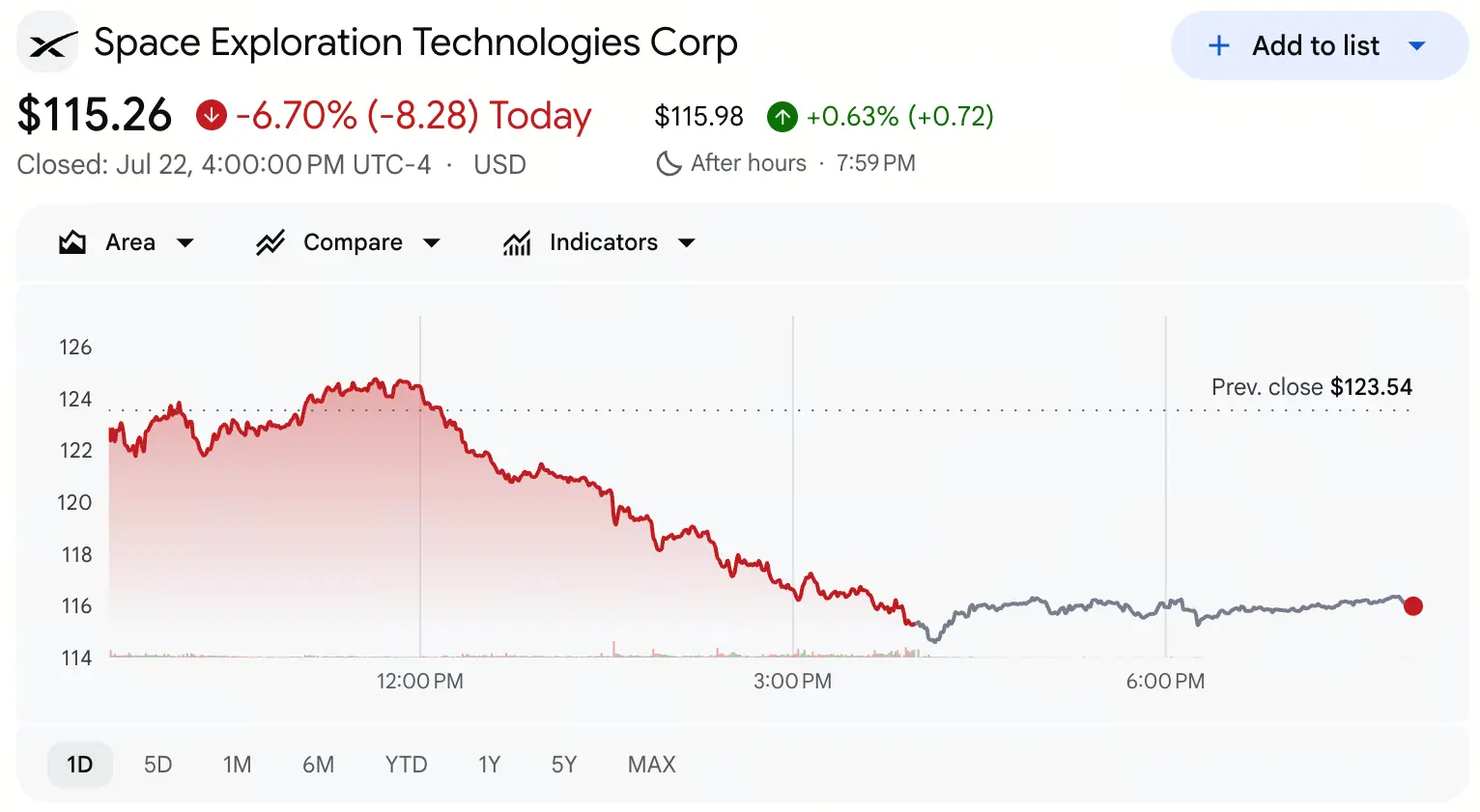
On July 23, 2026, SpaceX (SPCX) closed at $115.26, down 6.70% on the day, again setting a new lowest closing price since it began trading.
Looking at a longer time horizon, SpaceX went public on June 12 at an issue price of $135, surged to a historical high of $225.64 by the third trading day after listing. Since then, the stock has entered a one-way downtrend channel. As of the close on July 23, the price is down 14.6% from the IPO issue price and has retraced as much as 48.9% from the historical high—nearly a 50% drop.
This round of selloff was not triggered by a single event, but the result of multiple pressures converging.
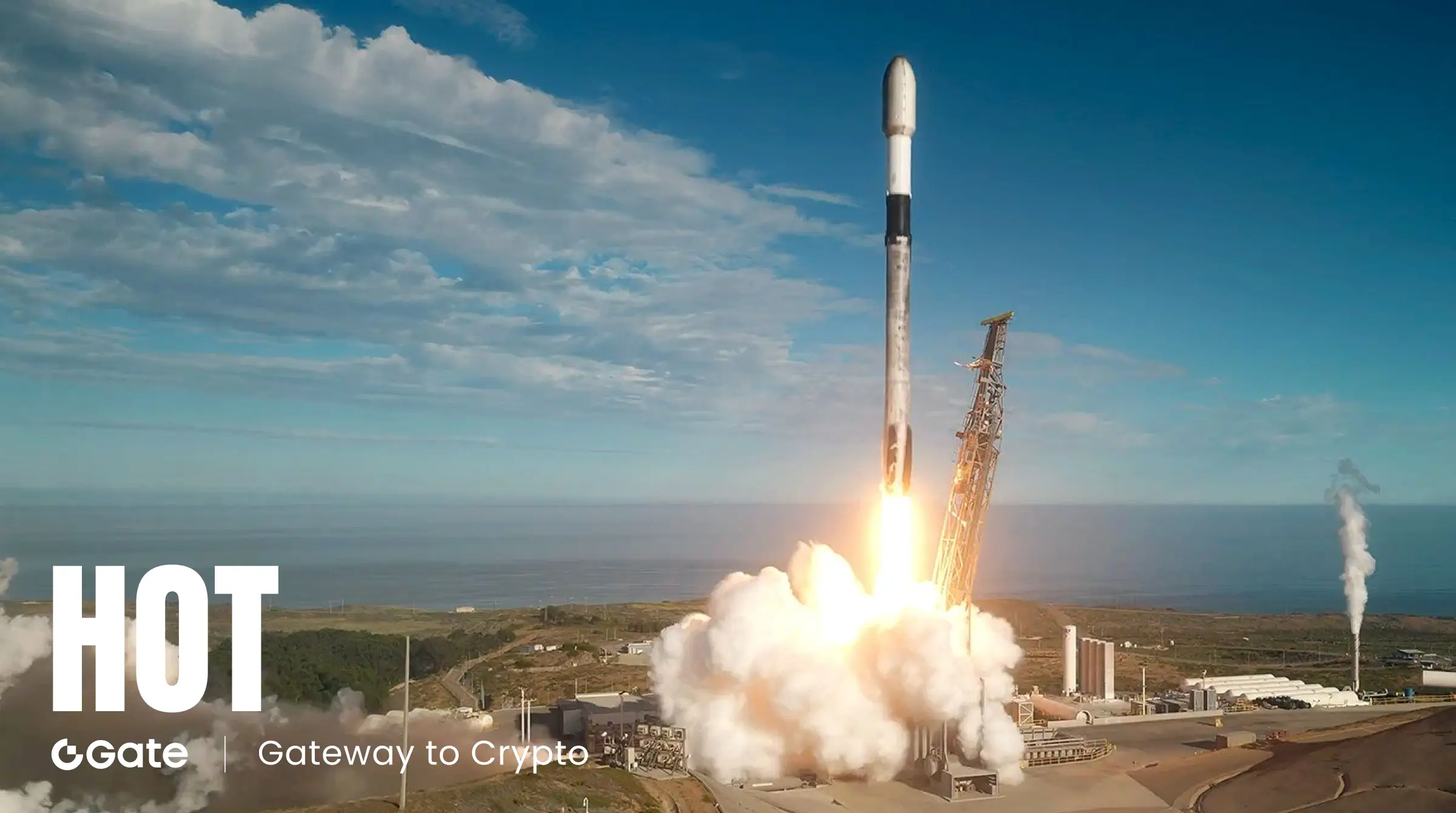
The Starship test-flight shutdown is the direct spark. On July 16, the 13th planned Starship flight test was automatically aborted during the ignition phase because multiple engines failed to start. This was originally the company’s first Starship launch mission after going public, and the technical setback delivered a direct blow to market sentiment. SpaceX later adjusted the launch window to July 23, but the change failed to ease investors’ concerns.
The macro environment is also a drag. In the past week, global equity markets faced a compounded shock: intensifying Middle East geopolitical conflict, a return of energy-driven inflation, and deleveraging momentum in AI hashrate. Data from Goldman’s main brokerage business shows that over the past eight weeks, the pace at which hedge funds exited US tech stocks hit a record high. As a representative high-multiple tech stock, SpaceX was hit first in this round of capital rotation. In addition, Secretary of State Rubio’s hardline remarks on Iran prompted the market to reprice geopolitical risk, and SpaceX’s close ties between Musk and Trump make it a particularly sensitive target for geopolitical sentiment.
Why are bears massively betting against SpaceX?
One of the most striking features of this selloff is the rapid ballooning of short positions. According to S3 Partners data, as of July 23, about 206 million shares of SpaceX were being shorted, accounting for roughly 32% of publicly traded float, with a nominal short position size of about $25 billion.
The speed of this increase is remarkable. About a month ago, short holdings were only around 40 million shares, less than 7% of float. In just a few weeks, short positions expanded by more than 400%.
The core logic behind the large-scale short bet points to a valuation bubble. Based on Morningstar calculations, SpaceX’s fair value is about $62 to $63, while the IPO issue price was $135. Even after a sharp pullback, SpaceX’s price-to-sales ratio remains as high as about 83x—by comparison, Apple’s price-to-sales ratio is about 8x, and NVIDIA is under 30x.
Bears are also targeting the upcoming unlock wave. Matthew Unterman, head of research at S3, noted that short sellers are adding positions ahead of multiple key catalysts coming up, including the company’s first disclosure of results as a listed company and the expiration of subsequent lock-up periods. The shorts are betting that when a massive amount of new supply hits the market, the current price will be difficult to sustain.
Musk responded sharply, saying companies that “maintain a large short position against SpaceX for the long term have a very low chance of survival.” However, under the current fundamentals and valuation landscape, that warning has not been able to curb the bears’ offensive.
Is there a fundamental mismatch between valuation and fundamentals?
To understand why SpaceX shares fell from $225 to $115, it’s necessary to go back to a core question: on what exactly is this company’s valuation built?
SpaceX’s valuation story has been questioned from the very beginning. At IPO pricing, the price-to-sales ratio was already above 90x, and in the early days after listing it even climbed to around 140x. Full-year 2025 revenue was $18.67B, with net losses as high as $4.94B. In 2026’s first quarter, an operating loss of $2.47B from the AI segment dragged the company’s overall net loss to $4.28B.
On revenue composition, Starlink is the only profitable business segment. In 2025, Starlink generated about $11.4 billion in revenue and $4.4 billion in operating profit, but even this profit is still not enough to cover the massive losses from space launches and AI infrastructure. In the first quarter of 2026, the company achieved $4.7 billion in revenue, yet capital expenditures reached $10.1 billion—spending 2.15 times revenue.
SpaceX’s valuation premium relies on a key assumption: that its three core businesses—space launches, Starlink, and AI computing—can all grow into trillion-dollar markets. The company positions itself as a “rockets, satellites and artificial intelligence company,” claiming a potential market size of $28.5 trillion, with more than 90% driven by AI.
However, the market is repricing this narrative. Analysts believe the stock decline reflects the market’s cautious stance on AI costs and returns, and investors have started to question the sustainability of its AI growth story. When an unprofitable company trades at a price-to-sales multiple of over 80x, any operational imperfection can trigger a sharp valuation contraction.
How will the trillion-dollar unlock reshape supply and demand?
August will bring the most testing moment since SpaceX listed.
The company has announced it will release its 2026 second-quarter earnings after the close of US markets on Tuesday, August 4. This will be the first official window for the market to fully review SpaceX’s real financial fundamentals. However, the earnings release itself is not the end—the real test comes two days later.
Under SpaceX’s phased lock-up agreement, the first group of insiders and employees eligible for an unlock—20% of shares held by the full employee group (up to a combined maximum of 911.5 million shares)—will be released from restrictions on the second trading day after the earnings release (August 6). Based on the July 23 closing price of $115.26, the market value of these unlocked shares is about $105.1 billion—equivalent to 1.45 times all publicly tradable float shares issued at IPO.
More worth watching is the continuity of the unlocks. By the end of 2026, the total shares available for trading across the market will jump from the current ~639 million shares to 5.33 billion shares, an increase of more than sevenfold. Musk holds about 7.8 billion shares—around 60% of total shares outstanding—and his lock-up period extends beyond one year after listing, so it will not be a source of unlock pressure in the short term. But even so, the massive increase in supply will still pose an unprecedented challenge to the market’s supply-demand balance.
The prospectus also discloses a trigger clause: if the closing price on at least five of the ten trading days before earnings disclosure is at least 30% above the IPO issue price (i.e., $175.50), an additional 10% of shares will be unlocked (about 455.8 million shares). At the current share price level, the market generally believes the likelihood of meeting the condition is low.
Can the earnings report become a turning point for the stock price?
SpaceX’s earnings on August 4 could be the most weighty catalyst at present.
Wall Street analysts expect SpaceX’s total revenue in the second quarter to be about $6.87 billion, significantly higher than $4.7 billion in the first quarter. Of that, connection business (primarily Starlink) revenue is expected to be $3.26 billion in Q2, while the space launch business contributes $620 million. The AI infrastructure segment is most likely to show the fastest growth, with Q2 revenue of $820 million.
Since the start of this year, SpaceX has signed multiple major contracts in the AI hashrate rental space: in May, an AI hashrate rental agreement with Anthropic for $1.25 billion per month; and in June, a hashrate contract with Alphabet for $920 million per month starting in October. Most revenue from these contracts will be recognized gradually over time, but the market generally expects AI business revenue in Q2 to rise sharply compared with Q1.
However, even if the company delivers an impressive quarterly report, there is still significant uncertainty over whether the stock can reverse immediately. The first pressure comes from the supply-side shock caused by the unlocks; the second pressure comes from valuation itself—despite the plunge, SpaceX’s forward price-to-sales ratio is still as high as 23.3x (based on 2027 revenue estimates), remaining very expensive compared with large-cap tech peers.
In the earnings report, investors should focus on three dimensions: Starlink user growth and ARPU trends; the capital expenditure pacing and commercialization progress of AI infrastructure; and management’s guidance on full-year performance. If the earnings report demonstrates that Starlink’s operating cash flow is sufficient to cover the huge spending on Starship R&D and AI infrastructure, it could provide fundamental support for the valuation logic.
What possible scenario paths exist for the outlook?
Based on the current market structure, SpaceX’s outlook could follow several scenarios.
- Earnings beat expectations with unlock digestion staying smooth. If the August 4 earnings show strong revenue growth, Starlink gross margins continue to improve, and management provides a clear path for cash-flow delivery, market buy orders may be enough to absorb the increased tradable supply. In this scenario, the stock price could stabilize near current levels and gradually recover. Of the 32 analysts tracking the stock on Wall Street, 27 still rate it as “Buy,” implying about 86% upside versus current levels in terms of average target price. Morgan Stanley set a target price of $300, while the most optimistic Raymond James even set a target of $800.
- Earnings miss expectations with unlock selling pressure. If the earnings fail to meet market expectations—for example, if Starlink user growth slows, AI hashrate rental revenue recognition falls short, or capital expenditure guidance is further raised—weakening fundamentals combined with the dual pressure of more than $1 trillion in newly tradable shares could continue to weigh on the stock. The bearish side’s target prices range as low as $30 to $115.
- A successful Starship launch brings sentiment repair. The July 23 Starship launch attempt is the most important technical catalyst in recent times. If the launch is successful and the satellite deployment mission is completed, it would likely trigger positive sentiment repair in the market. But a single launch success may not fundamentally change the valuation and fundamentals mismatch framework—the market needs sustained technical breakthroughs and commercial delivery.
No matter which scenario becomes reality, over the next few months SpaceX will remain in a tug-of-war around two themes: “valuation digestion” and “supply release.” Historical data shows that among the top ten largest super IPO fundraisings globally, most see a surge and subsequent pullback in the early period after listing. After Meta’s IPO in 2012, the stock price once plummeted by nearly 50%, taking 14 months to return above the issue price. Whether SpaceX can follow a similar repair path depends on whether its fundamentals can continuously deliver on the market’s long-term expectations.
FAQ
Q: How much has SpaceX’s current share price fallen versus the IPO issue price?
A: As of the close on July 23, 2026, SpaceX was at $115.26, down about 14.6% from the $135 IPO issue price.
Q: How much has SpaceX’s stock price retraced from its peak?
A: From the intraday high of $225.64 on June 16, the cumulative retracement is about 48.9%, nearly a 50% drop.
Q: How large is SpaceX’s short position?
A: According to S3 Partners data, currently about 206 million shares of SpaceX are being shorted, roughly 32% of publicly tradable float, with a nominal short position size of about $25 billion.
Q: When does SpaceX’s shares unlock, and how big is it?
A: The first batch, up to 911.5 million shares held by insiders, will be released from restrictions on August 6 (the second trading day after the earnings release). Based on current share prices, the market value is estimated at about $105.1 billion.
Q: When will SpaceX release its first earnings report?
A: SpaceX will release its 2026 second-quarter earnings after the close of US markets on August 4, 2026.
Q: Is SpaceX’s valuation reasonable?
A: Even after a large pullback, SpaceX’s price-to-sales ratio is still as high as about 83x. The bearish view puts fair value around $62 to $63; the bullish view bets on the long-term growth potential of the space economy and AI, with target prices ranging from $190 to $800.
Q: How has the Starship test flight affected the stock price?
A: On July 16, the 13th Starship test flight was aborted due to engine failure, becoming one of the direct catalysts behind the stock decline. SpaceX attempted another launch on July 23, and the result will affect near-term market sentiment.


