The first semifinal of the 2026 World Cup between the US, Canada, and Mexico will kick off on July 14 local time at Dallas Stadium. France and Spain, the top two teams in the FIFA rankings, will settle for the first spot in this edition’s final in a direct showdown. This is not only a clash between two distinctly different football philosophies—France’s efficient counterattacks versus Spain’s absolute possession play—but also a fated matchup that has appeared in major tournament semifinals for the third consecutive year. Based on prediction market data, the current wagers give France a 41% chance of winning in regular time, a 30% chance of a draw, and Spain at 30%. The market gives France a slight edge, but overall opinions are highly divided.
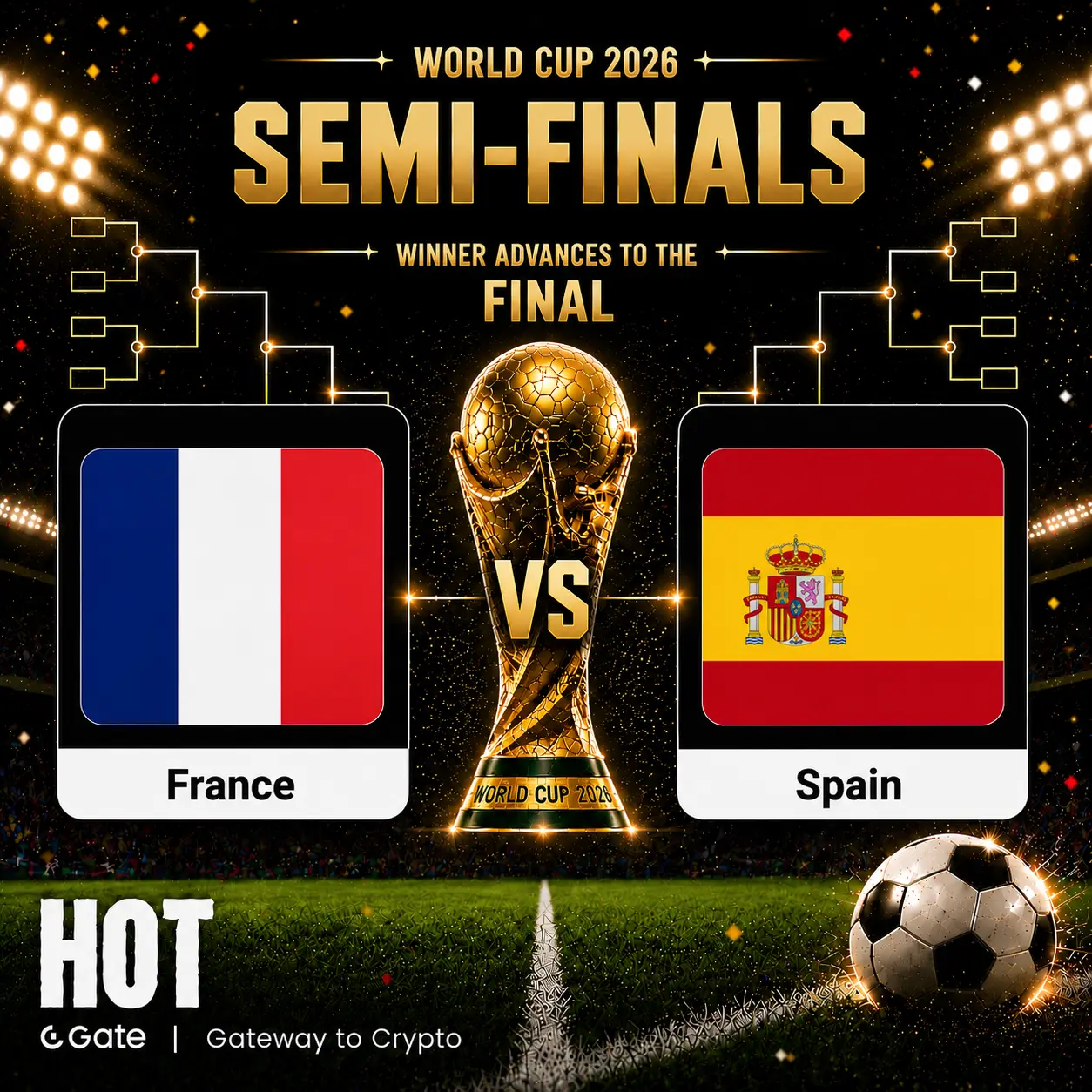
How two unbeaten European powerhouses made it to the semifinals
France is the only team in this World Cup so far with a perfect record. Across six matches, they scored 16 goals and conceded 2. In the knockout stage, they kept Sweden, Paraguay, and Morocco all scoreless in succession. Mbappé leads the top scorer chart with 8 goals, Dembélé has contributed 5 goals, and Olise has recorded 5 assists. France averages 7.8 shots on target per game, setting the highest figure for any event since statistics began in 1966. If France wins the title, they will become the first team in World Cup history to win the trophy with eight straight victories.
Spain is also unbeaten, with a record of 5 wins and 1 draw. In six matches, they scored 11 goals and conceded just 1. This is the best defensive record in this World Cup. Spain has gone 36 consecutive matches unbeaten in regular time, only one match short of Italy’s 37-match historical record. Head coach De la Fuente remains unbeaten in major tournaments, leading the team through the first 13 matches of both the European Championship and the World Cup without a loss.
The two teams reached the semifinals in radically different ways: France relies on overwhelming attacking firepower, while Spain leans on an airtight defensive system and extreme ball control. As a result, many view this matchup as an “early replay of the final.”
Three years, three semifinal meetings—what the head-to-head history signals
France and Spain have met 38 times in history, with Spain winning 18, drawing 7, and losing 13, holding an overall advantage. But on the World Cup stage, the two teams have only met once—at the 2006 Germany World Cup Round of 16, when France beat Spain 3-1.
What makes this semifinal particularly rich in story is that the two teams have faced each other in consecutive major tournament semifinals over the past two years. In the 2024 European Championship semifinal, Spain beat France 2-1 and went on to win the tournament; at the time, Yamal, then only 16, scored a spectacular goal. In the 2025 UEFA Nations League semifinal, the two teams played out a 5-4 thriller, with Spain emerging victorious. In their last 10 meetings, Spain has won 7.
However, historical data cannot simply be extrapolated. Before the match, France’s coach Deschamps emphasized that two past defeats do not predict the outcome of this semifinal—“Now the players are a different group, and their form may not be the same as back then.” De la Fuente, Spain’s coach, believes this France side is stronger than it was two years ago. Head-to-head records provide a psychological backdrop, not a definitive verdict on who will win.
How two football philosophies collide head-on in this match
At its core, this semifinal is a systematic contest between efficiency football and possession football.
France employs a 4-2-3-1 formation. They are not fixated on meaningless possession; their key strategy is to contract the shape appropriately, focus on midfield strangulation, and use the speed of Mbappé, Dembélé, and Olise in the front line to attack the space behind the opponent’s defensive line. France’s change began after their defeat at the 2024 European Championship, when Deschamps switched from 4-3-3 to 4-2-3-1 and promoted Olise and Dembélé from the U23 national team to form a new attacking line with Dembélé. This system has already proven highly effective in this World Cup.
Spain will most likely still try to control the match and suppress France’s counterattacking space. Rodri acts as the single holding midfielder to manage the team’s build-up tempo. Through continuous horizontal and vertical ball circulation, they drain the opponent’s physical energy and squeeze the space for France’s forward bursts. Spain’s attacking structure centers on width from Yamal and Nico Williams on the flanks, while in the middle, Oyarzabal and Merino form a large-and-small attacking partnership.
The key variables in the tactical battle are: France’s defensive involvement in their four-man front line is insufficient, which could leave gaps exposed in the middle of the midfield; and when Spain’s two fullbacks push up significantly, the space behind them could be exploited by Mbappé’s pace. It’s a match where whoever makes the first mistake may pay dearly.
Mbappé vs Yamal: a direct duel between two generations of attacking leaders
The biggest individual matchup in this game is undoubtedly the head-to-head between Mbappé and Yamal.
Mbappé represents the very top tier of speed and impact in world football. In this World Cup, he has scored 8 goals and is tied for the top of the scoring chart with Messi. In the quarterfinal, he picked up an ankle injury, but Deschamps confirmed he participated in pre-match training and is fine.
Yamal, meanwhile, embodies the creativity and quickness of Spain’s attack. Although he has scored only 1 goal so far in this tournament and has not yet returned to peak form, he has netted in both of his previous matches against France. At the pre-match press conference, Yamal said with confidence: “If France have a feared opponent, it’s us—because we’ve knocked them out.”
The two have faced each other 10 times so far, with Yamal holding an 8-2 advantage. But individual matchup statistics have limited explanatory power in an 11-a-side game; what truly determines the outcome is the execution efficiency of the two players within their respective tactical systems.
Midfield control and squad completeness: how they shape the outcome
Control of the midfield will very likely decide the final outcome of this game.
France faces uncertainty in midfield personnel. Tchouaméni is absent from the previous two knockout matches due to a minor groin strain, and although his recovery is progressing well, it still needs to be confirmed before kickoff whether he will start. His ability to sweep across the midfield and assist with ball progression from the holding/defensive midfield role is an important safeguard for France to limit Spain’s possession and passing system. Quadio Koné is also in a pending status due to muscle fatigue.
By contrast, Spain currently has no injury concerns and can come at full strength. Rodri is set to start, and the midfield pairing is still uncertain between Pedri and Fabián Ruiz. Spain has a slight edge in midfield configuration completeness and mutual understanding.
However, France’s squad depth should not be overlooked. Attackers such as Barcola, Cherki, Mateta, and Thuram are still waiting on the bench with momentum to contribute. Deschamps also has tactical options that have not been fully revealed. In high-intensity matches where the game could potentially go into extra time, squad depth could be a decisive factor.
What the prediction market data and key statistical indicators reveal
According to prediction market data, the current wagers give France a 41% chance of winning in regular time, 30% for a draw, and 30% for Spain. The market gives France a narrow advantage, but more than half the money does not expect France to settle the contest in regular time—draw probability is as high as 30%, indicating that the possibility of extra time is not dismissed.
From macro statistical data, France’s attacking firepower contrasts sharply with Spain’s defensive solidity. In six matches, Spain have faced only 7 shots on target—an average of 1.17 per game, the lowest record for any World Cup since statistics began in 1966. That means France’s attacking group will face the tightest defense in this tournament.
On the other hand, France has kept opponents scoreless in three consecutive knockout matches, so their defensive stability should not be underestimated either. Both teams have demonstrated extremely high defensive standards, further reinforcing market expectations that the match could reach extra time and possibly a penalty shootout.
A noteworthy contextual factor is that the match day coincides with France’s National Day. This timing could provide France with additional psychological motivation, or it could add extra pressure—but such non-competitive factors do not have quantifiable predictive value within a strict analytical framework.
FAQ
Q: What are France’s and Spain’s records in this World Cup, respectively?
France is 6 for 6: 16 goals scored and 2 conceded. Spain is 5 wins and 1 draw: 11 goals scored and 1 conceded.
Q: What do the teams’ past head-to-head records in major tournament semifinals look like?
In the 2024 European Championship semifinal, Spain beat France 2-1. In the 2025 UEFA Nations League semifinal, Spain beat France 5-4. Spain has eliminated France in two consecutive semifinals.
Q: Who is in better form—Mbappé or Yamal?
Mbappé has scored 8 goals in this World Cup and is in excellent form. Yamal has scored only 1 goal and has not yet returned to peak form. However, Yamal scored in both of his previous matches against France.
Q: What is the biggest tactical point of discussion in this match?
A head-on clash between France’s efficient counterattacking style and Spain’s absolute possession play. The side that executes better within its tactical system will be closer to victory.
Q: When and where is the match?
July 14 at Dallas Stadium in the US (local time). July 15 at 3:00 a.m. Beijing time.
Q: What happens if the match is tied in regular time?
There will be 30 minutes of extra time; if still tied, it will proceed to a penalty shootout.