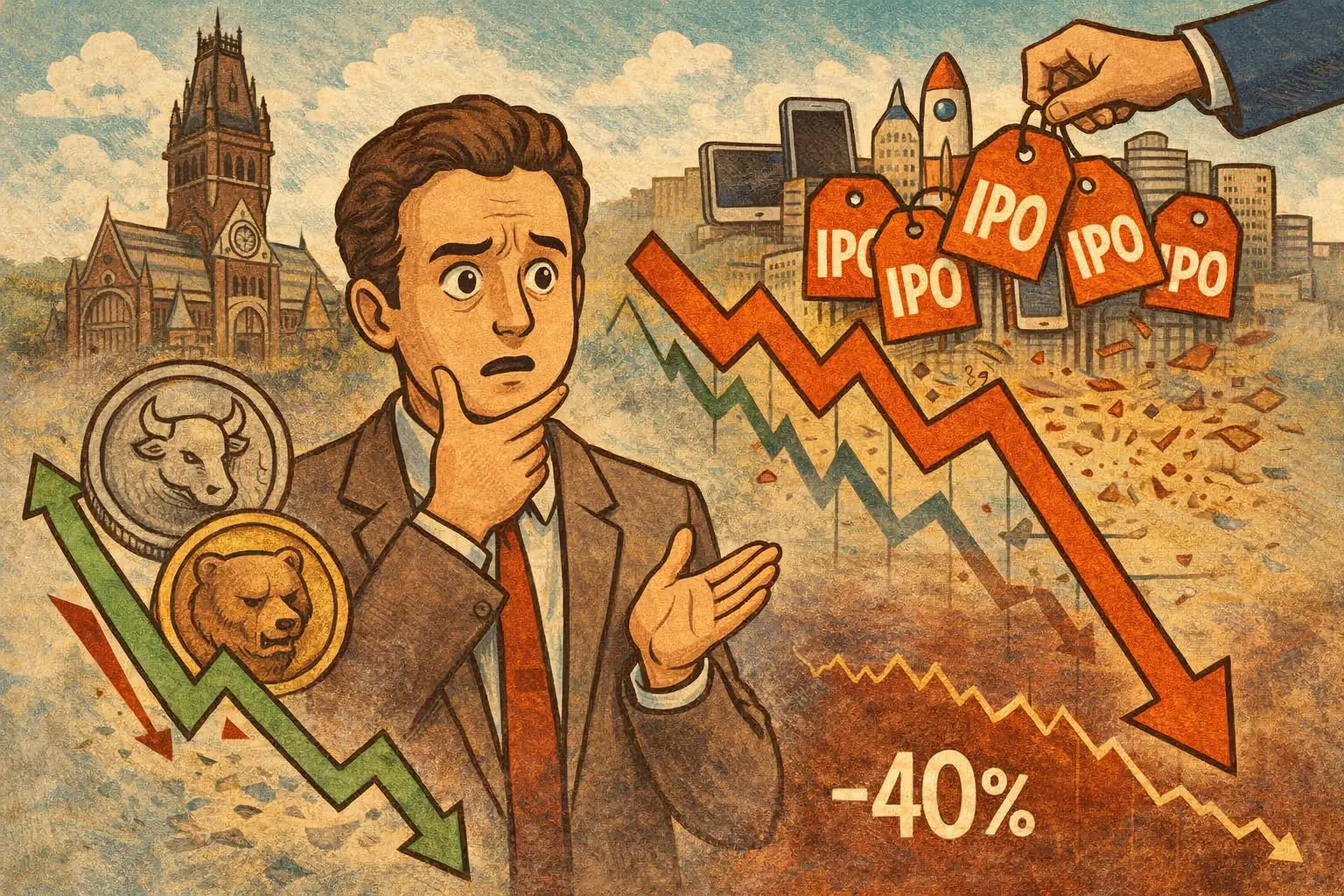
Harvard University economist Xavier Gabaix warned on June 22 that large-scale IPOs siphon liquidity from existing stock markets. Research from investment firm GMO shows that for every additional 1 percentage point that IPO financing makes up of the total market capitalization of the stock market, the stock market’s average return over the next 12 months will decline by about 7.5 percentage points; GMO’s model estimates that U.S. stocks could face nearly a 40% drop over the next 12 months.
Research by Gabaix and Koijen: For every $1 outflow from the U.S. stock market, total market capitalization could fall by about $5
According to research jointly conducted by Harvard University economist Xavier Gabaix and University of Chicago professor Ralph Koijen, there is a “capital multiplier effect” in the U.S. stock market: for every $1 of capital that flows out of the stock market, the total market capitalization of the entire market could decrease by about $5.
Gabaix said, “An IPO, by nature, pulls capital out of the existing stock market.” He noted that the impact on the stock market may remain neutral only if the IPO funding is entirely sourced from the bond market, overseas investors, or other new capital coming from outside the market.
GMO research: If IPO size rises by 1% of the stock market, the average return over the next 12 months falls by 7.5%
GMO’s research analyzed changes in the share of total market capitalization represented by IPO financing. It found that for every additional 1 percentage point, the stock market’s average return over the next 12 months will decline by about 7.5 percentage points.
The estimates cited in the report认为 that the combined fundraising size of SpaceX, OpenAI, and Anthropic is about 5% of the total market capitalization of the U.S. stock market. Based on the GMO model, this corresponds to nearly a 40% downside risk for the U.S. stock market over the next 12 months (7.5% × 5 = about 37.5%). The report also noted that this does not mean the market must experience a crash similar to those in 2000 or 2008.
Baker’s historical reference: The highest records for large-scale equity financing occurred in 1929 and 2000, respectively
Malcolm Baker, a professor at Harvard Business School, said that large-scale IPO issuance is often an important signal of Wall Street’s “irrational boom.” Historical data show that periods when U.S. equity financing reached record highs typically coincided with the most exuberant stages of market sentiment. The first two famous instances in history occurred just before the Great Depression in 1929 and at the peak of the 2000 internet bubble, respectively. Baker said, “We all know what happened later.”
FAQ
What is the basis for the claim that U.S. stocks face nearly a 40% downside risk?
This is the result of GMO’s historical statistical model based on the ratio of IPO financing size to the stock market’s total market capitalization. GMO’s research shows that for every additional 1 percentage point, the stock market’s average return over the next 12 months declines by about 7.5 percentage points. The estimate cited in the report assumes the combined financing size of three companies (SpaceX, OpenAI, and Anthropic) is about 5% of the stock market’s total market capitalization, and multiplying by 7.5 yields about 37.5%. This is a statistical estimate from the research model, not a deterministic conclusion that the market will surely fall.
Is there specific data supporting the Harvard Gabaix study’s “$1 corresponds to $5 in market-capitalization contraction”?
According to the report, this “capital multiplier effect” comes from research jointly conducted by Xavier Gabaix and Ralph Koijen. This ratio represents the overall liquidity elasticity of the stock market, reflecting the amplifying effect of passive rebalancing behavior by institutional investors on the market’s overall valuation. The report does not provide more methodological details; interested readers can consult the original academic papers by Gabaix and Koijen.
How is this AI IPO wave fundamentally different from the 2000 internet bubble?
According to the report, analysts point out that the AI industry today indeed has real technological breakthroughs and business value, which is fundamentally different from internet companies in 2000 that lacked viable profit models in large numbers. But the report also cites Baker’s view, saying that even a great technological revolution cannot prevent phase-based valuation bubbles from appearing in capital markets. This is the analysts’ viewpoint cited in the report, not an official institutional assessment of the market’s outlook.


