In July 2026, traffic through the Strait of Hormuz fell to the lowest point in two and a half months. The strategic waterway carries about a quarter of global seaborne oil trade and roughly a fifth of liquefied natural gas shipments, and it is currently in its most severe shipping crisis since the Iran-Iraq War.
Gate prediction market data show that, as of July 28, 2026, the probability that the Strait of Hormuz will return to normal operations by Aug. 15 is only 3%, and the probability by Aug. 31 is13%. These figures are not random swings in sentiment; they are “collective wisdom” paid for with real money by tens of thousands of participants—a comprehensive re-pricing of complex geopolitical developments, military brinkmanship, and the energy supply chain.

What are the Strait of Hormuz’s actual shipping conditions right now?
Based on shipping data, the worsening trend is clear. The Strait of Hormuz has been effectively closed since March 2, 2026, and the current transit volume is only 4% of pre-war levels. In early July, the Strait’s weekly average number of voyages was still 76, but by the week of July 21 it had plummeted to just 8. On July 23, it hit the lowest level since May 7—only one tanker departed, with zero arrivals.
The Islamic Revolutionary Guard Corps of Iran has clearly stated that as long as U.S. forces continue their aggression in the region, the Strait of Hormuz will be “closed indefinitely.” Citing sources, Iran’s Fars News Agency reported on July 19 that traffic through the strait has fallen to zero and that Iran will not grant passage permits to any vessel. On July 27, the spokesperson for Iran’s Ministry of Foreign Affairs, Baghaei, again confirmed that the Strait of Hormuz is still closed.
What happened to drag the probability from 91% down to 13% on the prediction market
In mid-June 2026, the U.S. and Iran reached a memorandum of understanding through third-party mediation, and the Strait of Hormuz briefly saw partial easing. At that time, Gate prediction market data showed the probability of a return to normal by Dec. 31 had climbed to 91%—the market generally believed it was a high-probability event that the Strait’s shipping problem would be resolved within the year.
But this judgment was quickly overturned by reality. The memorandum lasted for less than three weeks before becoming essentially meaningless. Since mid-July, the U.S. military has carried out multiple rounds of strikes on military targets inside Iran; by July 24, it had conducted airstrikes for 13 consecutive nights. The U.S. strikes are highly targeted: all are aimed at Iran’s military strongpoints along the Strait of Hormuz. This is no longer a punitive air campaign; it is a systematic effort to strip Iran of the ability to control the strait militarily.
Iran’s counterattacks are also focused on reshaping military deterrence around the Strait. Relevant Iranian proposals have elevated control over the strait from military emergency operations to the level of a national legal framework. This means that even if negotiations resume in the future, Iran’s bottom line on sovereignty over the strait will be further locked in by legislation, potentially narrowing the space for talks even more.
From “reopening seemed within reach” to “shipping back to zero,” this reversal took less than a month. Gate prediction market data show that the probability of resuming operations by Aug. 31 has fallen to 13%, by Sept. 30 is22%, and by Dec. 31 is52%. The sharp drop in the probability curve is, in essence, the market re-pricing the risk that the stalemate may be far more persistent than expected.
What obstacles stand in the way of normal operations by late August?
Zero-sum games at the military level are the primary obstacle. Li Zixin, an assistant researcher at the China Institute of International Studies, said that the struggle between the U.S. and Iran over management of the Strait of Hormuz is becoming a turning point, and that this turning point is very likely to be irreversible. In effect, the Strait contest compresses the U.S.-Iran game from a multi-issue negotiation that could be compromised into a “zero-sum” issue. In the short term, the likelihood of renewed negotiations is extremely low.
A fundamental mismatch in the negotiating logic of both sides is also a deep-seated barrier. The U.S. logic is that Iran must be forced into “surrender-style compromises” in negotiations through military pressure first. Iran’s stance is that military resistance should run in parallel with diplomatic negotiations, but negotiations do not equal surrender, nor do they mean accepting terms under bombardment. The response logics of both sides are not aligned. Even if they return to the negotiating table later, the basis for talks has been severely damaged.
Spillover effects from regional conflicts further shrink diplomatic space. Yemeni Houthi forces have announced a “maritime embargo” against Saudi Arabia, threatening both the Strait of Hormuz and the Strait of Mandeb—two major energy corridors. The U.S.-Iran conflict has escalated from a single-strait blockade to a “double chokepoint blockade.”
In addition, even if the Strait is miraculously able to reach a reopening agreement by late August, restoring oil transport to normal would still take two to three months. There remains significant uncertainty around the recovery of shipping operations, insurance, and operator confidence. This means that “normal operations by late August” requires not only a political agreement, but also enough time for physical navigation and market confidence to recover in sync.
How does the prediction market price geopolitical risk?
Prediction markets aggregate dispersed information and convert the probability of events into tradable price signals. The 3%(by Aug. 15) and13% (by Aug. 31) probabilities shown on Gate prediction market data essentially reflect participants’ combined bets on the progress of U.S.-Iran negotiations, intentions regarding military restraint, and the effects of external mediation.
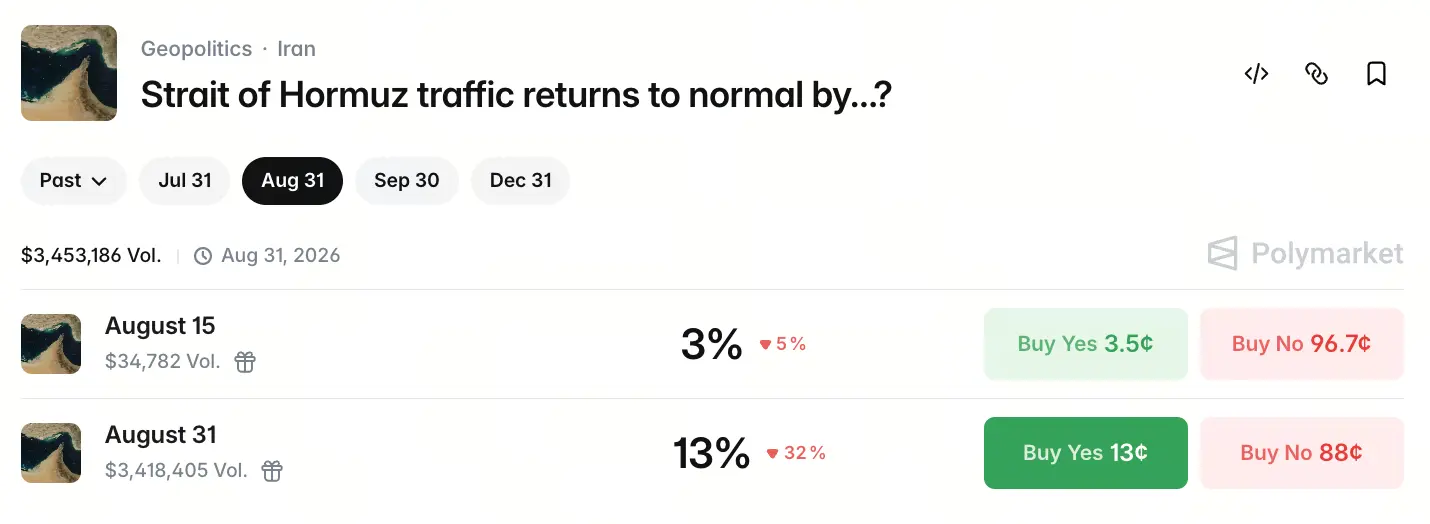
Judging from the probability structure, the extremely low probability in the short term reflects a high degree of skepticism in the market about achieving a substantive agreement within two weeks. The 13%probability by Aug. 31 suggests that even if the market is willing to leave a certain time window for diplomatic efforts, the chance of success is still less than two in ten. Notably, the52% probability by Dec. 31 means the market believes the likelihood of resolving the Strait’s shipping problem within the year is slightly above half—yet this probability itself also implies that nearly half of the funds are betting that it cannot be restored within the year.
This probability structure is itself an important risk signal. Tail risk—the Strait being closed for a long time—has risen from single-digit levels in June to nearly 50%. The change in pricing by prediction markets is essentially a quantitative expression of the narrative shift in which geopolitical risk has moved from “manageable” to “out of control.”
What kind of shock is the global energy market facing?
The Strait of Hormuz handles about a quarter of the world’s seaborne oil trade. The U.S.-Iran conflict that began in late February 2026, along with the subsequent strait blockade, has caused disruptions in about one fifth of global seaborne oil exports. Based on the weekly average price of Brent, oil prices rose from $71.36 per barrel in the week before the crisis to $124.61 per barrel in the week of April 10. That is a 74.6% increase over six weeks—one of the steepest oil price shocks since the 1990 Gulf War.
The International Monetary Fund (IMF) has cut its global growth forecast for 2026 and warned that the oil market buffer mechanism has failed, meaning supply shocks will have a bigger impact. IMF experts emphasized that even if the Strait reopens immediately, oil shortages can only ease gradually, and inventories will be drawn down to near operational minimum levels.
On July 16, the head of the International Energy Agency (IEA), Fatih Birol, warned that if oil transport through the Strait of Hormuz cannot resume within a few weeks, global energy security will flash red. On July 27, international oil prices saw sharp fluctuations; on the New York Mercantile Exchange (NYMEX), the light sweet crude oil futures contract for September delivery fell by $6.70, a 7.5% drop. The high volatility of oil prices itself reflects the market pricing very high uncertainty about the strait’s outlook.
What potential variables could drive the Strait back to operation?
Despite the heavy obstacles in the short term, several potential variables could change the trajectory.
Continued progress on external mediation is the most worth watching variable right now. Qatar, Egypt, and regional mediators have put forward a 10-day ceasefire proposal to the U.S. and Iran, aiming to stop hostilities and reopen the Strait of Hormuz. Talks between Iran and Oman on the management of the strait have also made positive progress. While these diplomatic efforts have not yet produced a breakthrough, they create potential channels for negotiation.
Time pressure from U.S. domestic politics is also not to be ignored. With the U.S. midterm elections approaching in November 2026, if the issue of the Strait of Hormuz continues to escalate, it would worsen imported inflation in the U.S. and directly weaken the election outlook. This time constraint may push the U.S. toward making certain diplomatic concessions.
Iran’s capacity to bear the economic cost is another variable. A long-term blockade impacts global energy supply, but Iran itself also pays a massive economic price for exports effectively going to zero. When the costs of the game build up beyond a certain point, the motivation to return to the negotiating table will naturally rise.
For now, the likelihood of a prolonged, low-intensity conflict appears relatively high, and both sides are trying to raise the costs for the other until one side cannot bear it and compromises. The low probability of restoring normal operations by late August essentially reflects the market’s assessment of this game logic: neither side has reached the moment when it must compromise.
FAQ
Q: How are the probability data in the Gate prediction market derived?
Prediction markets aggregate dispersed information and convert the probability of events into tradable price signals. The probabilities shown on the Gate prediction market are the combined bets by tens of thousands of participants—paid with real money—on the overall geopolitical situation, the military standoff, and the progress of diplomacy, representing the market’s “collective wisdom.”
Q: What does a 13% probability of restoration by Aug. 31 mean?
It means the market believes the likelihood of resolving the Strait’s shipping problem by late August is less than two in ten. This low probability reflects the market’s pessimistic expectations that both the U.S. and Iran can reach an agreement in the near term—because the positions of both sides on strait management are highly opposed, and the foundation for talks has been severely damaged.
Q: Even if the Strait resumes shipping, can oil supply return to normal immediately?
No. The IMF analysis indicates that even if the Strait of Hormuz is fully reopened, restoring oil transport to normal would still take two to three months. There is still significant uncertainty regarding the recovery of shipping operations, insurance, and operator confidence.
Q: What is the most critical factor affecting the timeline for restoring the Strait?
The most critical factor is whether the U.S. and Iran’s game over management of the Strait can shift from a “zero-sum” state to a “negotiable” state. Currently, Iran has raised control over the strait to the level of a national legal framework, while the U.S. continues to strip Iran of its military control capability through military strikes. Breaking this stalemate requires an external mediation breakthrough or a compromise by one side due to costs becoming too high.
Q: Apart from Gate, how do other prediction markets view the Strait’s outlook?
Data from other prediction platforms show a consistent trend with Gate. Kalshi data show that the probability of normalizing strait traffic flows by July 2027 has fallen to 47%. Polymarket traders price the probability of normalization by Aug. 31 at about 13.5%. Although the probabilities differ slightly across platforms, they all point to the same conclusion: the market is highly pessimistic about the prospect of a near-term restoration of operations in the Strait.


