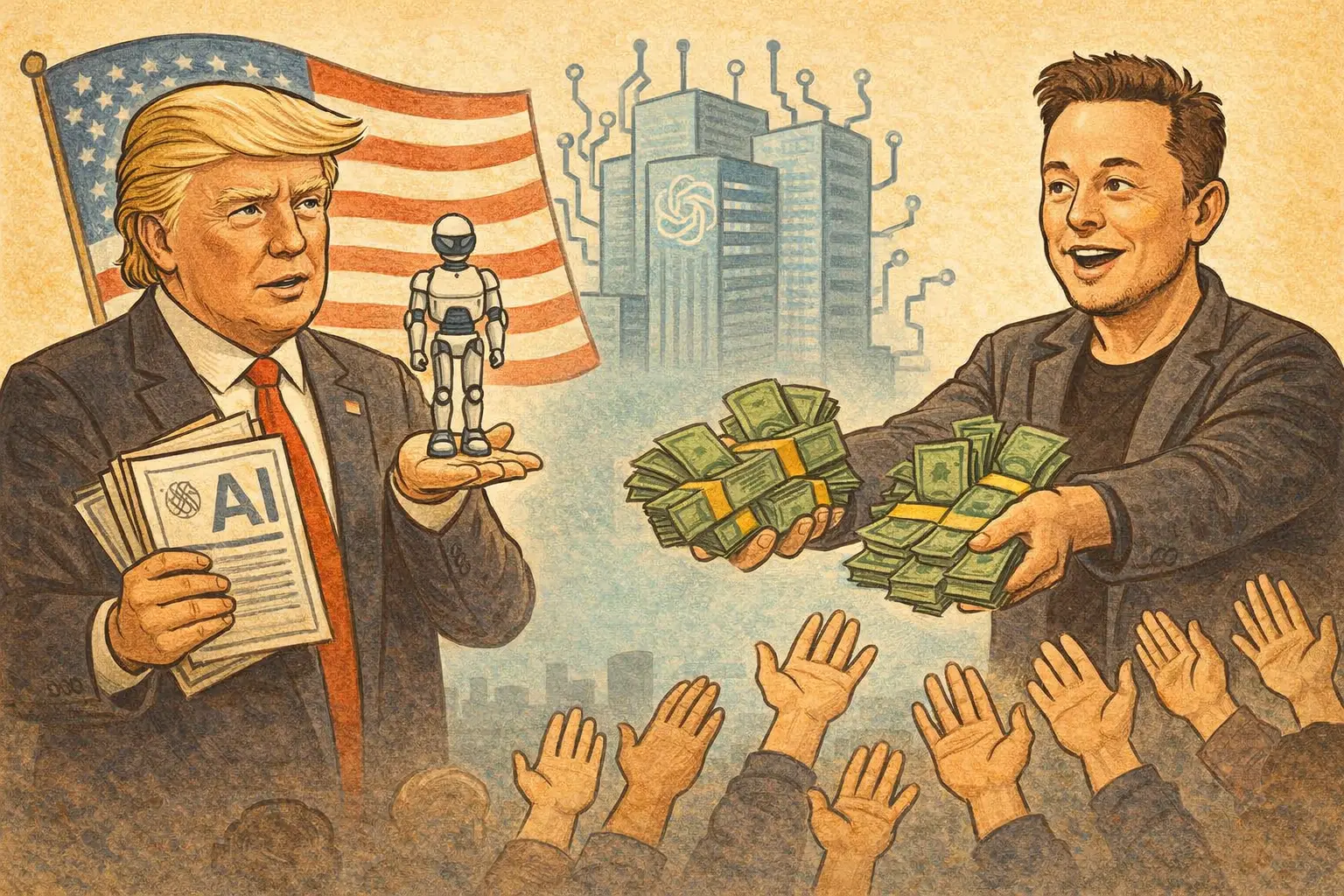
U.S. Vice President JD Vance disclosed on last week’s “CEO Diary” program that Trump supports the U.S. government taking equity stakes in major AI companies, favoring a structure in the form of a sovereign wealth fund. Vance said this is “very unusual” for Republicans. Musk responded on X on Saturday, arguing that “it’s best to just send money directly from the Treasury to the public,” and predicted that the development of AI and robots will prevent inflation, even to the extent of “fighting inflation like crazy.”
Vance: Trump supports a sovereign wealth fund holding stakes in major AI companies
On “CEO Diary,” which aired Thursday, Vance said: “The president backs the U.S. owning these big artificial intelligence companies.” He added that Trump “likes the idea of something like a sovereign wealth fund,” and admitted that this position is “very unusual” for Republicans. Vance also said he doubts whether relying on taxes alone can bring AI wealth to workers, and believes unions may be a better model: “You have to let workers participate in decision-making.”
Public responses from Musk and Cuban: direct cash vs an incomplete plan
On Saturday, Musk posted on X: “It’s best to send money directly from the Treasury to the public.” He said that “as long as the growth of goods and services exceeds the growth of the money supply, there will be no inflation,” and predicted that “we’re going to fight deflation like crazy.”
Mark Cuban said the idea “isn’t a plan by itself,” adding that the relevant companies still need to raise thousands of billions of dollars, and questioning whether taxpayers’ funds used to take equity can truly benefit taxpayers. He also asked who can represent taxpayers in such a deal: “Of course not politicians.”
Sanders’ bill proposed Thursday: 50% of stock from major AI companies into a federal fund, valuation at $7 trillion
On Thursday, Senator Sanders introduced the “U.S. AI Sovereign Wealth Fund Act,” calling for leading AI companies to pay a one-time stock tax, with 50% of each company’s stock placed into a federal fund. Sanders estimated the fund would reach $7 trillion, paying about $1,000 per year to Americans.
Disagreement inside the White House: Bessent and Lutnick take different positions; Trump hasn’t met with industry executives
Citing people familiar with the matter, Semafor reported that Treasury Secretary Scott Bessent wants to use AI equity to inject money into a “Trump account,” while Commerce Secretary Howard Lutnick favors injecting the equity into a sovereign wealth fund.
Talks are still in an early stage and no decision has been made. Earlier this month, Trump promised to convene “12 to 15 top executives” to discuss AI’s social impact, but the meeting has not taken place. Other industry leaders, aside from OpenAI, have largely reacted coolly—leaders at Microsoft and Meta have not responded. Wyoming Republican Senator Cynthia Lummis called the proposal “baffling.”
FAQs
At what stage is Trump’s AI sovereign wealth fund idea currently?
Citing people familiar with the matter, negotiations are still in an early stage and no decision has been made. Trump has already promised to hold a meeting with industry executives, but as of the time of the report, the meeting has not yet occurred. There are differences within the White House on the specifics, with the Treasury secretary and the commerce secretary preferring different approaches.
What is the core mechanism of Sanders’ “U.S. AI Sovereign Wealth Fund Act”?
According to reports, the bill introduced by Sanders on Thursday would require leading AI companies to pay a one-time stock tax, in the form of 50% of the stock being placed into a federal fund. The fund is expected to reach $7 trillion and pay about $1,000 per year to Americans. This is a legislative proposal and has not passed the legislative process.
Why has the broader industry, aside from OpenAI, generally reacted coolly to Trump’s AI equity plan?
According to reports, Caleb Marks, chairman of the U.S. National AI Association, said: “At this point, injections of money don’t appear to generate returns for them.” Mark Cuban questioned that these companies still need to raise thousands of billions of dollars, and whether it’s unclear who can represent taxpayers to exercise shareholder rights. Leaders at Microsoft and Meta are ignoring the proposal.


