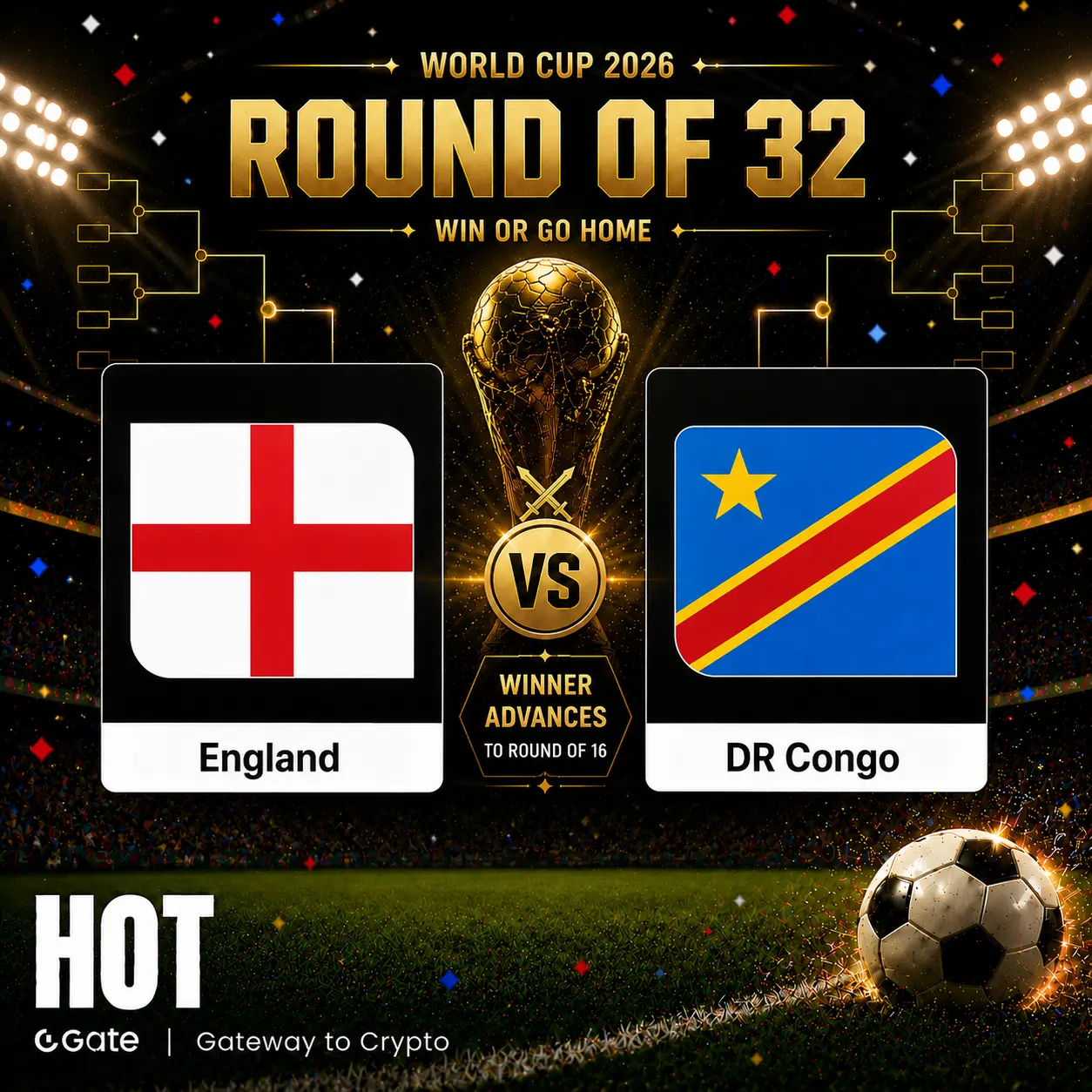
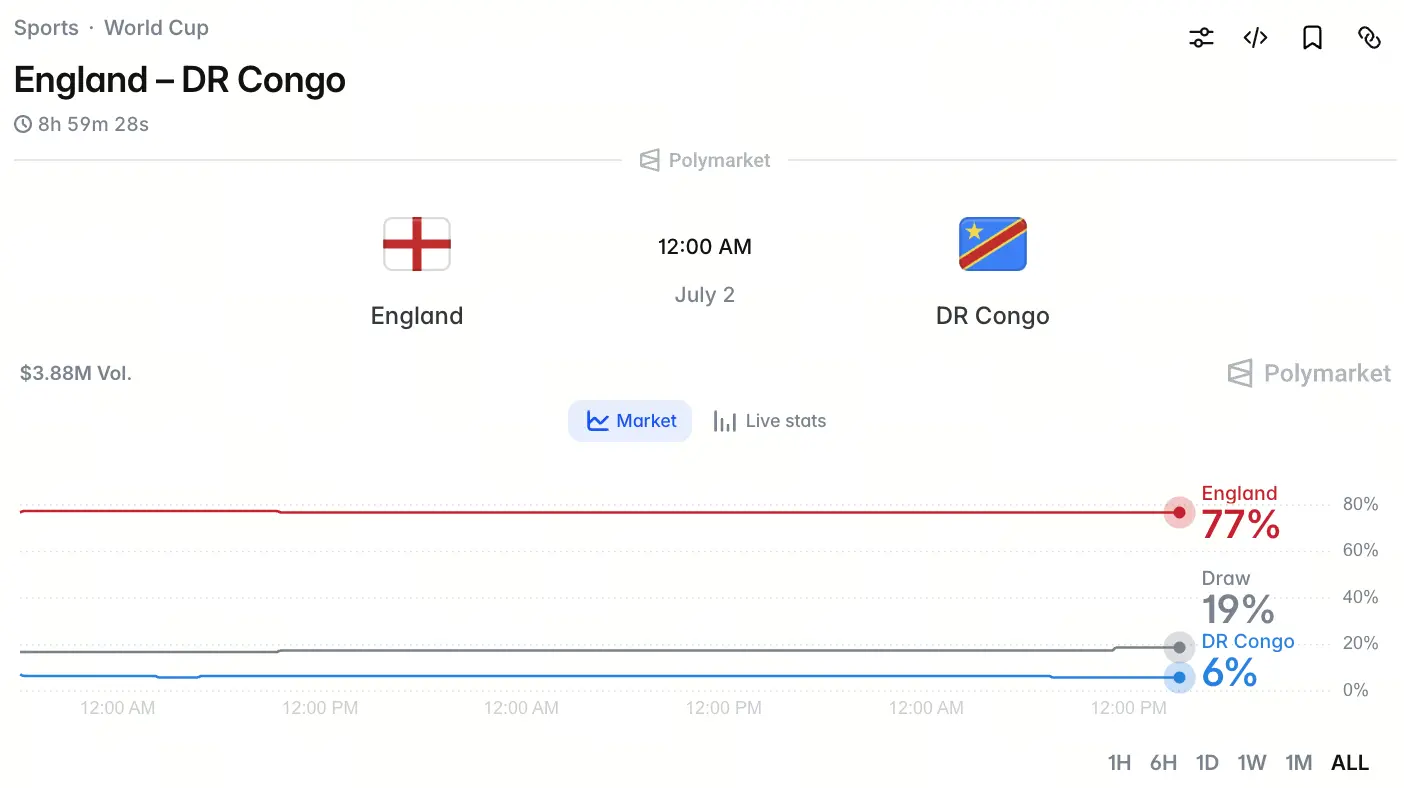
The 2026 World Cup 32-team knockout stage features a mismatch on paper – world No. 4 England against tournament surprise package Democratic Republic of Congo. According to Gate prediction market data, as of July 1, 2026, market funds give England a 77% probability of winning in regular time, a 19% chance of a draw, and only a 6% probability of a DR Congo upset victory.
77% vs 6%, a probability gap of more than 10 times, reflects the market's clear judgment on this match. But prediction market pricing is never just a simple reflection of 'who is stronger'; it is a complex game integrating multiple factors such as squad strength, tactical matchups, big-game experience, and on-the-spot variables.
Why does England command 77% market trust?
The market gives England a 77% win probability, first based on objective squad disparity. England's total squad value exceeds €1.3 billion, with core players like Kane, Bellingham, and Saka all capable of deciding match outcomes at the highest level. Although DR Congo has players from top five leagues such as Wan-Bissaka, Bakambu, and Mbemba, their overall squad depth is not on the same level as England's.
A deeper reason lies in the overwhelming tactical discipline. DR Congo's playing style relies on individual ability and physical duels, with tactical execution fluctuating greatly. Meanwhile, England, after years of tournament experience, has highly matured positioning, cover defense, and rotation in their three-center-back system. When a team that relies on 'street football' meets one of the most tactically adept opponents, the marginal utility of individual ability is greatly compressed.
Furthermore, England enjoys a psychological edge when facing African teams – historical records show England is unbeaten against African teams in World Cup matches. Although this data cannot be directly extrapolated to this match, it serves as one of the reference anchors for market pricing.
Does the 6% probability underestimate DR Congo's upset potential?
DR Congo is not without cards. This team held Portugal to a 1-1 draw in the group stage, showing defensive resilience against a possession-based strong team. The team primarily employs a five-man low block defense, compressing the penalty area and relying on counterattacks and set pieces for opportunities. Several defenders play in the Premier League and are familiar with the technical characteristics of England's players.
However, the 6% pricing precisely reflects the market's stringent assessment of the 'upset conditions'. For DR Congo to win, multiple high-difficulty conditions must be met simultaneously: no fatal defensive errors throughout the match, capitalizing on limited counterattack chances to score, and maintaining 90 minutes of focus under England's sustained pressure. Any break in the chain could cause the match to tip out of balance. Under the knockout tournament's do-or-die format, the combined probability of multiple conditions is naturally compressed to single digits.
19% draw probability: The most undervalued outcome?
The 19% draw probability is the only pricing between the two extremes among the three options, but this number may deserve more attention.
England exposed a structural issue in the group stage – inefficiency in breaking down a compact defense. In the second group match, they drew 0-0 against Ghana, with slow attacking progression against a five-man low block. DR Congo's tactical setup is highly similar to Ghana's, and their defensive players have stronger individual abilities.
If DR Congo successfully maintains a 0-0 scoreline past 60 minutes, the psychological pressure will shift. England, as the title favorite, facing a team they 'should beat' but failing to score, may see rising impatience and declining decision quality among players. At that point, the possibility of DR Congo breaking the deadlock through a set piece or fast counterattack, although low, is enough to steer the match in an unpredictable direction.
The draw probability is about 13 percentage points higher than DR Congo's win probability; this gap itself hints to the market: the likelihood of DR Congo dragging the match into extra time is far higher than the likelihood of a direct victory.
The capital logic behind the probability gap: Why not 90% vs 10%?
Since England has overwhelming advantages in squad, tactics, experience, and other dimensions, why hasn't the market given a win probability above 90%?
The answer lies in the inherent uncertainty of football matches. Red cards, penalties, goalkeeping heroics, a single defensive error – these uncontrollable factors exist in any match, and their impact is amplified in the knockout stage of major tournaments. Prediction market pricing not only reflects the 'average scenario' but also leaves probability space for 'extreme cases'.
Another dimension is the ceiling of England's own ability to break down a parked bus. In past major tournaments, England has repeatedly struggled against opponents who employ a defensive wall. DR Congo is not a team that will take the initiative to attack; their game plan from the start is to 'defend' rather than 'attack'. When one side is fully defending and the other is fully attacking, the match's expected goals value itself is lowered, and the probabilities of a draw and an upset correspondingly rise.
The data value of prediction markets: Beyond traditional odds as a signal
Traditional sports betting odds reflect the pricing after bookmakers balance funds, while prediction market probabilities come from direct voting by participants – each unit of capital represents a market participant's genuine judgment on the outcome.
As of July 1, 2026, the trading volume on Gate prediction market for this match has reached the level of millions of dollars. This scale of capital participation means the probability distribution has undergone multiple rounds of gaming and correction, offering strong reference value.
A 77% win probability does not mean England has a 77% chance of a 'big win', but rather the market's comprehensive pricing of the outcome 'England wins in regular time'. For users following this match, understanding the logic behind the probabilities is more informative than the numbers themselves – it reveals how the market thinks the match will unfold and which factors are most likely to become turning points.
FAQ
Q1: What does the 77% probability on Gate prediction market mean?
77% indicates the collective judgment formed by market participants through capital voting – that within the regular 90 minutes (including injury time), the probability of England winning is 77%. This data is based on market trading conditions as of July 1, 2026.
Q2: Does the 6% win probability mean DR Congo has no chance at all?
No. 6% means the market believes the probability of a DR Congo upset is low, but football matches have uncontrollable factors like red cards, penalties, and goalkeeper errors. DR Congo held Portugal to a draw in the group stage, showing they have the ability to cause surprises under certain conditions.
Q3: Why is the draw probability (19%) higher than DR Congo's win probability (6%)?
Because the market believes DR Congo is more likely to drag the match into extra time through stubborn defense rather than win directly within 90 minutes. England's inefficiency in breaking down a low block defense leaves greater probability space for a draw.
Q4: What is the difference between prediction market probabilities and traditional odds?
Prediction market probabilities come from direct capital voting by market participants, with each trade reflecting a real judgment. Traditional odds include bookmakers' margin adjustments and fund-balancing factors. Both can be used as references, but prediction markets offer higher transparency.
Q5: Will these probabilities change over time?
Yes. Prediction market probabilities change dynamically with capital inflows and news events (such as starting lineup announcements, player injury updates, etc.). The data as of July 1, 2026 is the analysis baseline for this article; actual pre-match probabilities may fluctuate.