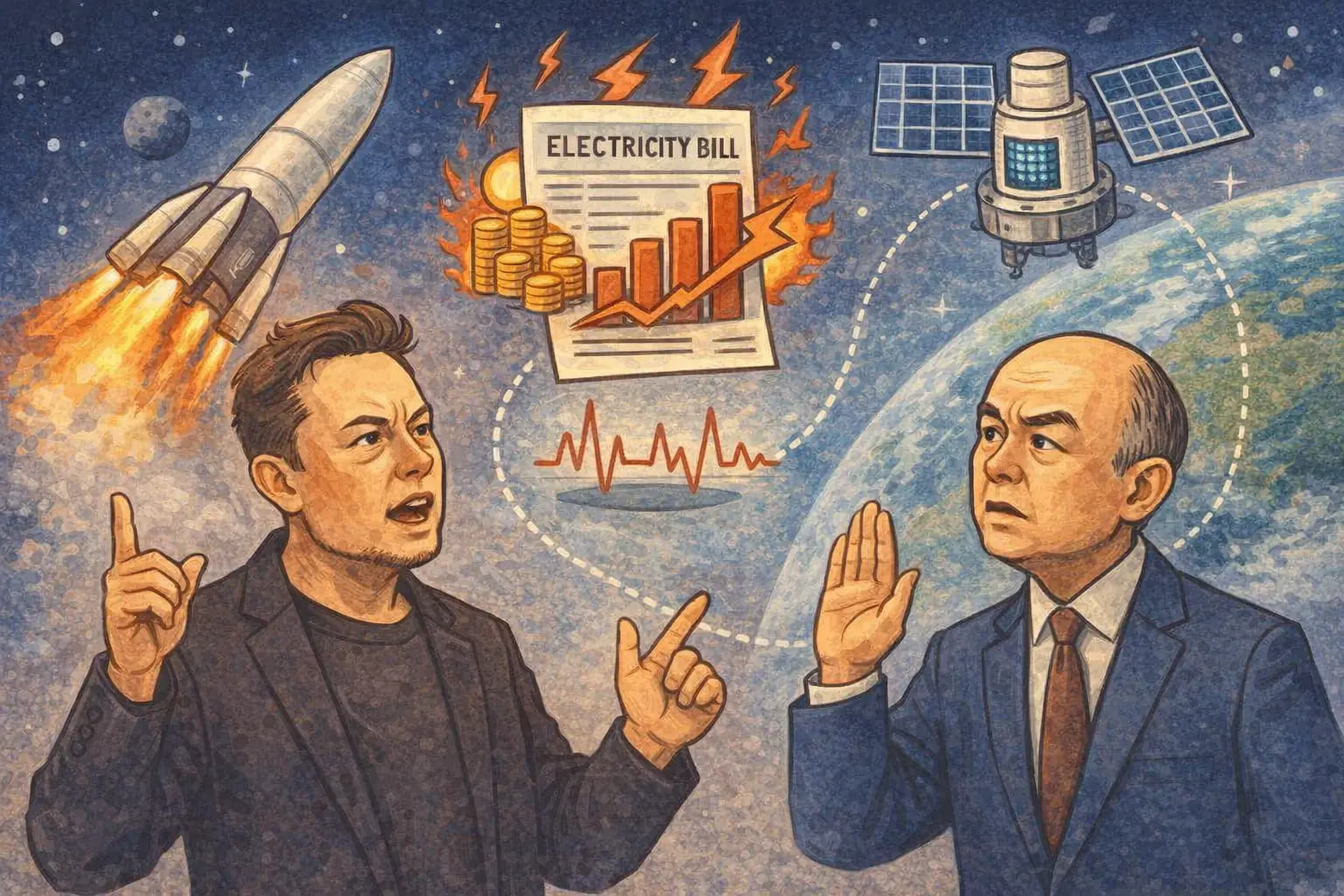
On June 23, SoftBank founder Masayoshi Son publicly denied Elon Musk’s idea of building data centers in space during a shareholders’ meeting of the telecom business under SoftBank Japan. Son said that electricity costs account for only a small portion of the overall operating costs of data centers; the real bulk is hardware spending such as AI chips. Comparing the saved electricity costs to the logistics and transportation costs of launching into space, the maintenance costs in orbit, and the unavoidable communication latency caused by signals traveling back and forth between Earth, Son said there is insufficient drive.
Masayoshi Son’s cost-analysis arguments: comparing electricity bills, space launch costs, and communication latency
Son’s counterargument logic starts from the cost structure. The most commonly cited advantage of space data centers is “saving electricity”—no need for a terrestrial power grid, and in theory they can be continuously powered by solar energy. Son’s rebuttal is that electricity costs are only a small part of a data center’s total operating costs, while hardware spending such as AI chips is the biggest cost.
Therefore, using the electricity savings to compare against the following three space-specific costs provides insufficient motivation: the transportation costs of rocket launches, the costs of maintaining operations in orbit, and communication latency (the physical limits that prevent signals from traveling to and from space and Earth without delay).
Timing argument: Son’s framework that “the next few years matter more than ten-plus years from now”
Son’s argument does not deny the technical feasibility of space data centers; it emphasizes timing. He pointed out that even if space data centers are technically feasible, they are a schedule of more than ten years. Meanwhile, the AI computing power race is being decided right now, right here.
The logic he repeatedly stresses is “the early bird wins”—in this race, deploying compute power now matters more than any long-term technical roadmap.
SoftBank’s computing investment commitments: OpenAI’s Stargate, €75 billion in France
SoftBank’s scale of computing investments on Earth explains Son’s practical logic for dismissing the space route:
· It has committed about $65 billion to OpenAI’s Stargate plan;
· In May 2026, it announced an investment of up to €75 billion in France (the first phase will build 3.1GW capacity with €45 billion, expected to be completed before 2031; construction sites include Dunkirk, Bosqueil, and Bouchain);
· A $50 billion super AI data center campus in Ohio, targeting 10GW capacity.
Earth-side resistance from mayors of 40 cities: Melbourne’s case and power-grid pressure data
At the same time Son called for “Earth first,” data center expansion on Earth was also facing backlash. Mayors from 40 cities reached a consensus to work together to curb the rapid expansion of data centers and mitigate impacts on power grids, water-supply systems, and local communities—London and Phoenix were among them. Melbourne Mayor Reece provided specific data: Melbourne currently operates about 50 large data centers; it is expected that by 2030 they will account for about 10% of local electricity demand, reaching 20% by 2040.
His analogy was: “Data centers are the biggest thing to put strain on power grids since air conditioning became widespread in the 1950s—air conditioning took decades to spread, but this is happening in just a few years.”
FAQ
Has Masayoshi Son completely denied the technical feasibility of space data centers?
According to reports, Son denies the necessity of space data centers “now,” not their technical feasibility itself. He said the space route is something that could happen “more than ten years from now,” and emphasized that the outcome of the AI race will be decided in the next few years—not in the distant future. He described Musk as an “excellent driving force for change,” with a tone that affirms his vision while rejecting his timing judgment.
Why is SoftBank investing so heavily in compute power on Earth?
According to reports, SoftBank has already committed thousands of billions of dollars in Earth-side compute investments in projects such as OpenAI’s Stargate, in France, and in Ohio. Son’s logic is that “the early bird wins” in the AI computing-power race, and because the build cycle on Earth is far shorter than in space, it can gain an advantage in the competition right now.
Will mayors of 40 cities restricting data center expansion affect Son’s Earth strategy?
Reports say Son and Musk are facing this issue together, but there has been almost no public discussion. No matter where computing power is built, it still requires energy, cooling, and infrastructure. Power-grid pressure data from cities such as Melbourne is one of the real constraints that Earth-side compute expansion faces.


