Bitmine Immersion Technologies, in its latest submitted 10-Q filing, reported that within the three months ended May 31, it generated $45.7 million in revenue through Ethereum staking and validation, accounting for 98% of total revenue. Bitmine said it has staked 85% of the ETH it holds, about 4.9 million ETH.
Bitmine Quarterly Financials: Ethereum staking accounts for 98% of revenue
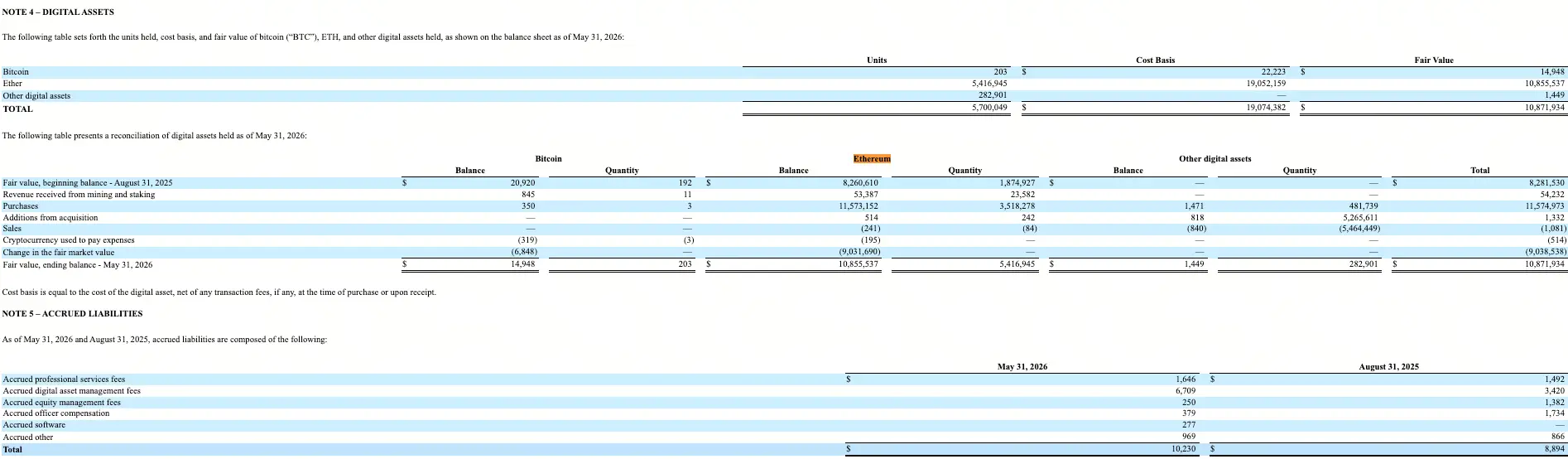 (Source: SEC)
According to Bitmine’s 10-Q filing, the following quarterly financial data as of May 31, 2026:
Ethereum staking and validation revenue: $45.7 million (98% of total revenue)
Bitcoin (BTC) mining revenue: $624,000
Advisory services revenue: $168,000
ETH holdings size: about 4.9 million ETH (85% staked)
Total revenue in the same period a year earlier: $2 million (mainly from machine rentals)
Tom Lee said the amount of staked ETH by Bitmine is more than any other institution, and it is expected that once fully staked, annualized rewards will reach $284 million (Lee’s personal estimate).
MAVAN platform background: Acquisition of Australia’s Pier Two Holdings
According to reports, MAVAN (full name: “Made in America Validator Network,” U.S.-made validator network), launched in March 2026, was built after Bitmine acquired the Australian non-custodial validator operator Pier Two Holdings as an institutional-grade Ethereum staking platform.
MAVAN was originally developed to support Bitmine’s own Ethereum treasury, and later expanded its service scope to institutional investors, custody providers, and ecosystem partners, operating validator infrastructure for external clients.
Bitmine’s Ethereum staking transition strategy this time marks a complete shift in its business model—from a Bitcoin mining machine rental business to an Ethereum staking infrastructure services provider.
FAQ
How is Bitmine’s Ethereum staking revenue generated?
According to reports, Bitmine operates validator nodes via the MAVAN platform (an institutional-grade Ethereum staking platform launched in March 2026) to provide staking services for its own holdings of about 4.9 million ETH (85% of its holdings) and for external institutional investors; Ethereum staking is carried out through validator nodes to earn ETH rewards at the protocol layer—up to the quarter ended May 31, 2026, it earned $45.7 million in total.
How does Tom Lee assess the relationship between the Robinhood Chain and Ethereum?
According to Tom Lee’s statement, after Robinhood Chain launched on July 1, 2026, trading volume had exceeded $1 billion, with “trading volume surpassing any other decentralized exchange (DEX)”; he noted that Robinhood Chain uses ETH as its native gas token, and transaction fees are denominated in ETH, meaning Robinhood’s 27 million users are all paying crypto fees denominated in ETH, showing that “ordinary users are starting to treat ETH as money.” All of the above are Lee’s personal views.
What is the core reason Bitmine’s revenue grew from $2 million to $45.7 million within a year?
According to reports, the main reason is Bitmine’s business model transition: from Bitcoin mining machine rentals (the primary revenue source in 2025) to Ethereum staking infrastructure services (the primary revenue source in 2026); the specific turning point was the March 2026 acquisition of Pier Two Holdings and the launch of the MAVAN platform, which began providing Ethereum validator services to external institutions.


