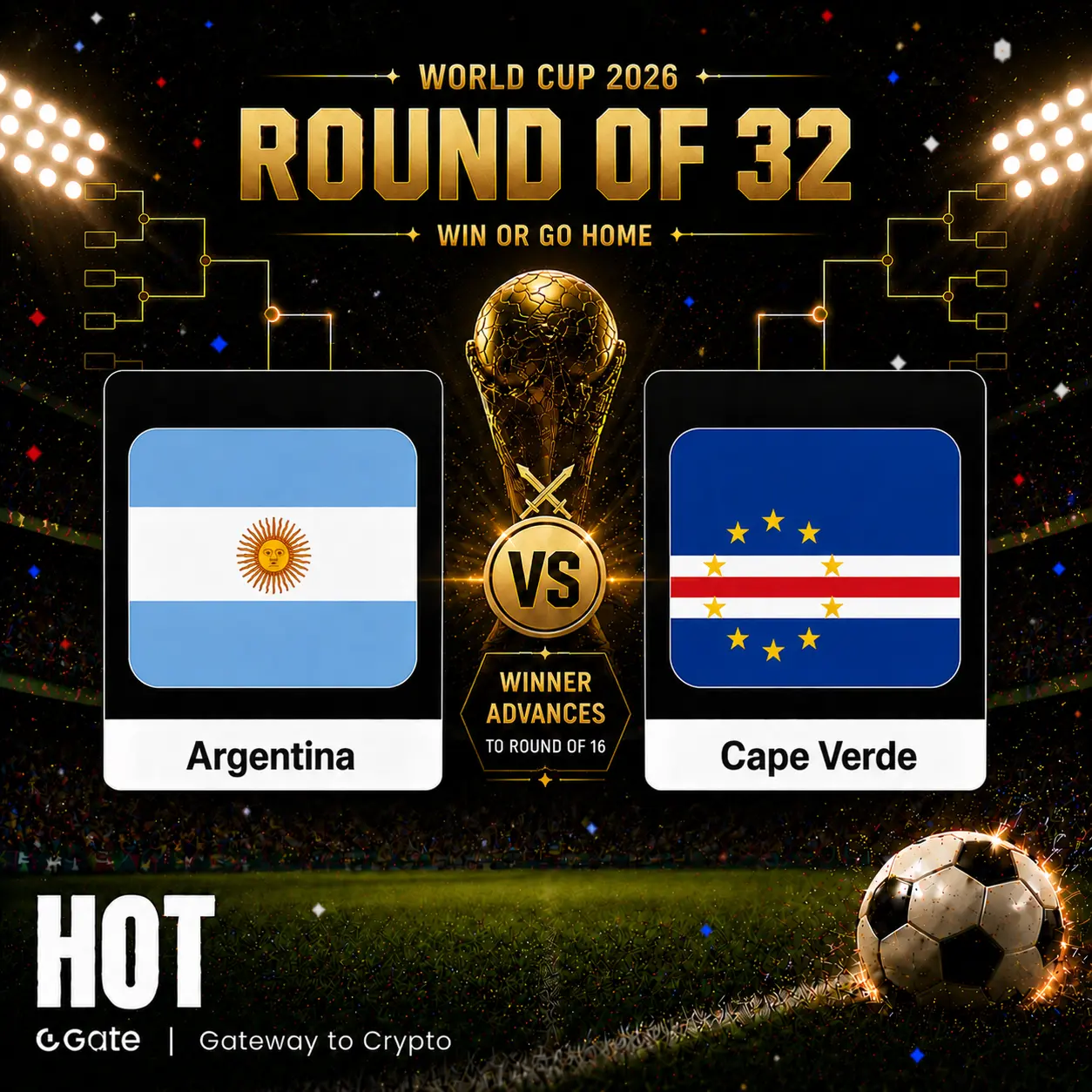
The Round of 16 match of the 2026 World Cup in the United States, Canada, and Mexico features a highly contrasting clash: defending champions Argentina against Cape Verde, an African island nation making its first World Cup appearance and reaching the knockout stage. According to Gate prediction market data, as of July 3, 2026, market funds give Argentina an 86% chance of winning, a 11% chance of a draw, and Cape Verde only a 4% chance of victory. What market judgment logic does this skewed probability distribution reflect? Is Cape Verde truly without a chance?
How Big Is the Strength Gap Between Argentina and Cape Verde?
In terms of FIFA rankings, Argentina is ranked first in the world, while Cape Verde sits at 67th. Argentina won all three group stage matches, scoring 8 goals and conceding just 1; Cape Verde drew all three matches, scoring 2 and conceding 2. In terms of squad value, Argentina exceeds €700 million, while Cape Verde is around €50 million — a figure less than a third of Messi's peak annual salary.
But the disparity in data does not equate to the end of the match. Cape Verde held Spain and Uruguay, two powerhouses, to draws in the group stage, advancing to the knockout stage undefeated. This island nation, with a population of just over 500,000, proved its defensive discipline and resilience through three draws. As Cape Verde coach Bubista said: "We qualified for the World Cup finals on merit, and from the qualifiers to the three group matches, we have shown that we have the ability to compete at this level."
Why Does the Prediction Market Give Such Disparate Probabilities of 86% and 4%?
The core logic of prediction markets is to aggregate dispersed information through fund betting, converting group judgment into probability data. The 86% win rate means market participants generally believe Argentina is highly likely to settle the match within regular time.
This judgment is based on multiple verifiable facts. Argentina averaged 58% possession in the group stage, with an attack led by Messi — who scored 6 goals in 3 group matches in fine form. Although Cape Verde's defense is tough, their attack only managed 2 goals in 3 matches, showing limited firepower. Opta's supercomputer, after 25,000 pre-match simulations, gave Argentina an 83.5% chance of winning within 90 minutes, compared to only 5.3% for Cape Verde. The 86% from Gate's prediction market is highly consistent with these independent models.
Notably, a 4% win rate is not meaningless in the context of a single-elimination knockout match. In football, the occurrence of low-probability events is nothing new — that is the charm of competitive sports.
Can Cape Verde's "Park the Bus" Defense Truly Contain Argentina's Attack?
Cape Verde used a 5-4-1 formation in the group stage, with compact spacing, voluntarily ceding possession, and forming a defensive network with strict discipline and accurate anticipation. The 40-year-old goalkeeper Vozinha made 7 key saves against 27 shots in the match against Spain, keeping a clean sheet. Cape Verde's expected goals against (xGA) in the group stage was as high as 4.8, but they actually conceded only 2 goals — this difference itself is proof of defensive efficiency.
However, Argentina is fundamentally different from the Spain and Uruguay that Cape Verde previously faced. Argentina's attack relies more on Messi's individual breakthroughs and finishing ability. Messi has already scored 19 World Cup goals, leading the all-time scoring list. Cape Verde's entire national team history has played only 244 matches, while Messi alone has made 202 appearances for Argentina. This generational gap in experience and ability is difficult to fully compensate for with any tactical discipline.
Could High Temperatures and Schedule Factors Become Variables?
The match will be held at Hard Rock Stadium in Miami, where local temperatures exceed 37°C, and the stadium has no air conditioning. The hot and humid environment places a huge toll on players' stamina, which could be a potential variable affecting the match outcome.
One noteworthy statistic: Cape Verde ran a total of 432,796 meters in the group stage, ranking 14th among 48 teams, while Argentina ran 318,655 meters, ranking 45th. Cape Verde's overall running ability is more abundant, which could translate into a certain advantage under high temperatures. Argentina rotated 9 starters in their final group match against Jordan, giving key players like Messi and De Paul rest — this helps alleviate fitness concerns to some extent. However, high temperatures often affect the defending side more than the ball-possession side. If Cape Verde maintains high-intensity pressing throughout the match, a stamina bottleneck in the second half could become a key turning point.
What Information Efficiency Does the Pricing Logic of Prediction Markets Reflect?
The effectiveness of prediction markets is built on the combination of "crowd wisdom" and "economic incentives." Participants use real money to express their judgments on event outcomes, and information is quickly integrated into price signals weighted by capital intent.
The 86% win rate is not an isolated data point. Opta's supercomputer gives Argentina a 89.8% probability of advancing; Whoscored predicts a 3:0 scoreline; multiple media outlets lean toward 2:0. The high consistency among multiple independent information sources means the market has fully digested Argentina's strength advantage and Cape Verde's tactical characteristics.
However, this does not mean prediction markets have no room for deviation. Handicap bias data shows that Cape Verde's actual probability of winning is 35%, higher than the 24% voting share, indicating Cape Verde may be undervalued. Prediction markets provide probability references, not definitive prophecies. Although a 4% low-probability event is statistically rare, in a single-elimination football match, it is never impossible.
Does Cape Verde's "Fairy Tale Narrative" Have a Logical Basis for Continuation?
Cape Verde has risen from 182nd in the FIFA rankings in 2000 to 68th before the 2026 World Cup. Making the knockout stage in their debut is already a miracle in the team's history and African football. Cape Verde President Neves even boldly predicted the team would beat Argentina 1:0.
But from a logical deduction standpoint, the structural obstacles for Cape Verde to "go all the way" are extremely significant. While the single-elimination format amplifies uncertainty, Argentina has won all seven of its World Cup matches against African teams. Cape Verde drew all three group matches, lacking practical experience in coming from behind. Once Argentina scores first, Cape Verde would be forced to push forward, and their defensive system, on which they rely, would quickly collapse.
Cape Verde coach Bubista said before the match: "We still have dreams and will continue to chase them." Dreams and probabilities are not in conflict — a 4% probability means that in 100 simulations, Cape Verde wins 4 times. That is the unquantifiable side of football as a "round ball game."
How Prediction Markets Are Reshaping the Value Discovery Mechanism of Sports Events
Argentina vs. Cape Verde is a match with a huge disparity in strength but strong narrative tension. Gate prediction market data shows an 86% win probability for Argentina and only 4% for Cape Verde. This probability distribution is highly consistent with Opta's supercomputer and mainstream media predictions, forming a consensus of information. Argentina holds overwhelming advantages in squad depth, tournament experience, and attacking efficiency; Cape Verde's defensive resilience and running ability pose some challenges but are unlikely to fundamentally change the expected match outcome. Cape Verde has already made history by reaching the knockout stage in their debut. To "go all the way" and overcome the defending champions would require a miracle far beyond a 4% probability — and miracles are called miracles precisely because they rarely happen, but never never happen.
The significance of the Argentina vs. Cape Verde match lies not only in the competition itself, but also in its role as a typical case for observing the information aggregation efficiency of prediction markets. Since 2026, prediction markets have experienced explosive growth. The global cumulative notional trading volume of prediction markets has reached $127.5 billion; in June 2026, the combined trading volume of Kalshi and Polymarket reached $44.8 billion, a 75% month-on-month increase. Bernstein predicts that the annual trading volume of prediction markets in 2026 will reach approximately $240 billion.
Sports events are becoming one of the most important application scenarios for prediction markets. Polymarket's World Cup-related contracts have accumulated over $3.3 billion in trading volume. Prediction markets, through price signals, integrate scattered fan judgments, data analysis, and capital preferences into quantifiable probabilities, providing participants with a decision-making reference framework that goes beyond traditional odds systems.
The 86% vs 4% probability distribution given by Gate's prediction market for Argentina vs. Cape Verde is a concrete manifestation of this information aggregation mechanism in practice. It is not an "opinion" but the collective judgment of market participants voting with their money.
FAQ
Q: How is the 86% win probability calculated by Gate's prediction market?
The win probability in a prediction market is determined by the buying and selling transactions of participants. Users bet on match outcomes, and the contract price reflects the market's collective judgment of the probability of an event in real time. The 86% means the vast majority of funds in the current market are betting on Argentina to win.
Q: Does Cape Verde's 4% win probability mean they have no chance at all?
4% is the probability assessment given by the market based on all currently available information; it does not mean the match result is predetermined. In a single-elimination format, low-probability events always have a chance of occurring. However, 4% also objectively reflects the significant gap between Cape Verde and Argentina in terms of strength, experience, and attacking efficiency.
Q: How does prediction market data differ from traditional models like Opta?
Models like Opta are based on historical data and algorithm simulations; prediction markets aggregate participants' subjective judgments and capital preferences. When the two corroborate each other, the signal's credibility is enhanced — the high consistency of 86% (Gate) and 83.5% (Opta) indicates that market judgment and data models have reached a consensus.
Q: How much impact will high temperatures have on the match result?
When the match takes place in Miami, temperatures exceed 37°C. High temperatures test the stamina of both sides. Cape Verde ranked 14th in group stage running distance, while Argentina ranked 45th, giving Cape Verde a slight advantage in physical reserves. However, Argentina rotated 9 starters in their final group match, ensuring key players' fitness, so the temperature variable may be diluted.
Q: If Cape Verde loses, does that mean the "fairy tale" ends?
From a competitive result perspective, exiting at the Round of 32 means the end of the World Cup journey. But from a narrative perspective, reaching the knockout stage in their debut and holding Spain and Uruguay to draws, Cape Verde has already achieved far more than expected. Regardless of the result against Argentina, this team's story is already written into World Cup history.